Refine search
Actions for selected content:
212937 results in Engineering
A compact UWB MIMO antenna augmented with isolation improvement structures in situ with ground stubs and slots
-
- Journal:
- International Journal of Microwave and Wireless Technologies / Volume 16 / Issue 3 / April 2024
- Published online by Cambridge University Press:
- 05 April 2024, pp. 454-465
-
- Article
- Export citation

Introduction to VLSI Design Flow
-
- Published online:
- 04 April 2024
- Print publication:
- 15 June 2023
-
- Textbook
- Export citation

Flow Control
- A Fluid Instability Approach
-
- Published online:
- 04 April 2024
- Print publication:
- 11 April 2024

Warship 3
- Frigate HNLMS Jacob van Heemskerck
-
- Published by:
- Amsterdam University Press
- Published online:
- 04 April 2024
-
- Book
- Export citation

Warship 5
- Protected Cruiser Gelderland
-
- Published by:
- Amsterdam University Press
- Published online:
- 04 April 2024
-
- Book
- Export citation
11 - Polymers for Phosphorescent LEDs
-
- Book:
- Conjugated Polymers for Organic Electronics
- Published online:
- 28 March 2024
- Print publication:
- 04 April 2024, pp 173-183
-
- Chapter
- Export citation
Index
-
- Book:
- Conjugated Polymers for Organic Electronics
- Published online:
- 28 March 2024
- Print publication:
- 04 April 2024, pp 263-264
-
- Chapter
- Export citation
8 - Other Arylene-Based Polymers
-
- Book:
- Conjugated Polymers for Organic Electronics
- Published online:
- 28 March 2024
- Print publication:
- 04 April 2024, pp 117-148
-
- Chapter
- Export citation
Frigate HNLMS Jacob Van Heemskerck
-
- Book:
- Warship 3
- Published by:
- Amsterdam University Press
- Published online:
- 04 April 2024, pp 2-48
-
- Chapter
- Export citation
Abbreviations
-
- Book:
- Conjugated Polymers for Organic Electronics
- Published online:
- 28 March 2024
- Print publication:
- 04 April 2024, pp xi-xii
-
- Chapter
- Export citation
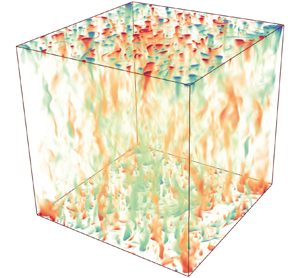
Scaling regimes in rapidly rotating thermal convection at extreme Rayleigh numbers
-
- Journal:
- Journal of Fluid Mechanics / Volume 984 / 10 April 2024
- Published online by Cambridge University Press:
- 04 April 2024, A45
-
- Article
-
- You have access
- Open access
- HTML
- Export citation
-
The geostrophic turbulence in rapidly rotating thermal convection exhibits characteristics shared by many highly turbulent geophysical and astrophysical flows. In this regime, the convective length and velocity scales and heat flux are all diffusion-free, i.e. independent of the viscosity and thermal diffusivity. Our direct numerical simulations (DNS) of rotating Rayleigh–Bénard convection in domains with no-slip top and bottom and periodic lateral boundary conditions for a fluid with the Prandtl number $Pr=1$ and extreme buoyancy and rotation parameters (the Rayleigh number up to $Ra=3\times 10^{13}$ and the Ekman number down to $Ek=5\times 10^{-9}$) indeed demonstrate all these diffusion-free scaling relations, in particular, that the dimensionless convective heat transport scales with the supercriticality parameter $\widetilde {Ra}\equiv Ra\, Ek^{4/3}$ as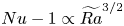 $Nu-1\propto \widetilde {Ra}^{3/2}$, where $Nu$ is the Nusselt number. We further derive and verify in the DNS that with the decreasing $\widetilde {Ra}$, the geostrophic turbulence regime undergoes a transition into another geostrophic regime, the convective heat transport in this regime is characterized by a very steep $\widetilde {Ra}$-dependence,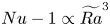 $Nu-1\propto \widetilde {Ra}^{3}$.


6 - Polyfluorenes and Related Polymers
-
- Book:
- Conjugated Polymers for Organic Electronics
- Published online:
- 28 March 2024
- Print publication:
- 04 April 2024, pp 74-103
-
- Chapter
- Export citation
References
-
- Book:
- Conjugated Polymers for Organic Electronics
- Published online:
- 28 March 2024
- Print publication:
- 04 April 2024, pp 208-262
-
- Chapter
- Export citation
5 - Poly(phenylene)s
-
- Book:
- Conjugated Polymers for Organic Electronics
- Published online:
- 28 March 2024
- Print publication:
- 04 April 2024, pp 61-73
-
- Chapter
- Export citation
Preface
-
- Book:
- Conjugated Polymers for Organic Electronics
- Published online:
- 28 March 2024
- Print publication:
- 04 April 2024, pp ix-x
-
- Chapter
- Export citation
10 - Polymers with Molecular-like Chromophores
-
- Book:
- Conjugated Polymers for Organic Electronics
- Published online:
- 28 March 2024
- Print publication:
- 04 April 2024, pp 160-172
-
- Chapter
- Export citation
Copyright page
-
- Book:
- Conjugated Polymers for Organic Electronics
- Published online:
- 28 March 2024
- Print publication:
- 04 April 2024, pp iv-iv
-
- Chapter
- Export citation
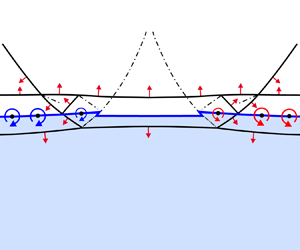
Refraction of a triple-shock configuration at planar fast–slow gas interfaces
-
- Journal:
- Journal of Fluid Mechanics / Volume 984 / 10 April 2024
- Published online by Cambridge University Press:
- 04 April 2024, A49
-
- Article
- Export citation
-
This paper characterizes the refraction of a triple-shock configuration at planar fast–slow gas interfaces. The primary objective is to reveal the wave configurations and elucidate the mechanisms governing circulation deposition and velocity perturbation on the interface caused by triple-shock refraction. The incident triple-shock configuration is generated by diffracting a planar shock around a rigid cylinder, and four interfaces with various $Z_{{r}}$ (i.e. acoustic impedance ratio across the interface) are considered. An analytical model describing the triple-shock refraction is developed, which accurately predicts both the wave configurations as well as circulation deposition and velocity perturbation. Depending on $Z_{{r}}$, three distinct patterns of transmitted waves can be anticipated: a triple-shock configuration; a four-shock configuration; a four-wave configuration. The underlying mechanism for the formation of these wave configurations is elucidated through shock polar analysis. A novel physical insight into the contribution of triple-shock refraction to the interface perturbation growth is provided. The results indicate that the reflected shock in an incident triple-shock configuration makes significant negative contribution to both circulation deposition and velocity perturbation. This investigation elucidates the underlying mechanism responsible for the relatively insignificant contribution of baroclinic circulation to the Richtmyer–Meshkov-like instability induced by a non-uniform shock, and provides an explanation for the decrease in growth rate of interface perturbation amplitude with increasing Atwood number.


14 - Conclusion and Outlook
-
- Book:
- Conjugated Polymers for Organic Electronics
- Published online:
- 28 March 2024
- Print publication:
- 04 April 2024, pp 204-207
-
- Chapter
- Export citation
Contents
-
- Book:
- Conjugated Polymers for Organic Electronics
- Published online:
- 28 March 2024
- Print publication:
- 04 April 2024, pp v-viii
-
- Chapter
- Export citation
