Refine search
Actions for selected content:
212937 results in Engineering

Instability in strongly stratified plane Couette flow with application to supercritical fluids
-
- Journal:
- Journal of Fluid Mechanics / Volume 984 / 10 April 2024
- Published online by Cambridge University Press:
- 02 April 2024, A31
-
- Article
-
- You have access
- Open access
- HTML
- Export citation
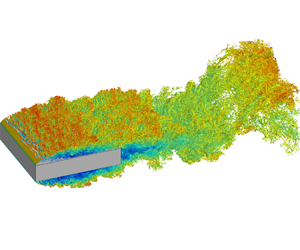
Reynolds number effects in separating and reattaching flows with passive scalar transport
-
- Journal:
- Journal of Fluid Mechanics / Volume 984 / 10 April 2024
- Published online by Cambridge University Press:
- 02 April 2024, A20
-
- Article
-
- You have access
- Open access
- HTML
- Export citation
Bioinspired planar switched beam network using Butler matrix on a flexible substrate targeting multifaceted millimeter-wave applications
-
- Journal:
- International Journal of Microwave and Wireless Technologies / Volume 16 / Issue 4 / May 2024
- Published online by Cambridge University Press:
- 02 April 2024, pp. 625-635
-
- Article
- Export citation
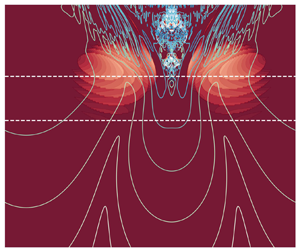
Long-wave instabilities of sloping stratified exchange flows
-
- Journal:
- Journal of Fluid Mechanics / Volume 983 / 25 March 2024
- Published online by Cambridge University Press:
- 02 April 2024, A12
-
- Article
-
- You have access
- Open access
- HTML
- Export citation
-
We investigate the linear instability of two-layer stratified shear flows in a sloping two-dimensional channel, subject to non-zero longitudinal gravitational forces. We reveal three previously unknown instabilities, distinct from the well-known Kelvin–Helmholtz instability and Holmboe wave instability, in that they have longer wavelengths (of the order of 10 to $10^3$ shear-layer depths) and often slower growth rates. Importantly, they can grow in background flows with gradient Richardson number $\gg 1$, which offers a new mechanism to sustain turbulence and mixing in strongly stratified flows. These instabilities are shown to be generic and relatively insensitive to Reynolds number, Prandtl number, base flow profile and boundary conditions. The nonlinear evolution of these instabilities is investigated through a forced direct numerical simulation, in which the background momentum and density are sustained. The growth of long unstable waves in background flows initially stable to short wave causes a decrease in the local gradient Richardson number. This leads to local nonlinear processes that result in small-scale overturns resembling Kelvin–Helmholtz billows. Our results establish a new energy exchange pathway, where the mean kinetic energy of a strongly stratified flow is extracted by primary unstable long waves and secondary short waves, and subsequently dissipated into internal energy.


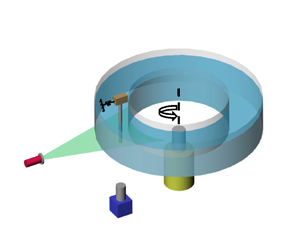
Elimination of lock-in phenomenon in vortex-induced vibration by passive modal control
-
- Journal:
- Journal of Fluid Mechanics / Volume 984 / 10 April 2024
- Published online by Cambridge University Press:
- 02 April 2024, A30
-
- Article
- Export citation
-
Theoretical analysis and numerical results have shown that frequency lock-in in vortex-induced vibration (VIV) is caused by the instability of the structural mode rather than a resonant response to external excitations. However, there is a lack of experimental evidence supporting relevant theoretical research findings. This study investigates VIV suppression with a passive modal controller (PMC) for a circular cylinder at Reynolds numbers $Re = 60$ and $Re = 40$, using experiments to distinguish the effects of stable and unstable wake modes. Comparative analysis before and after the implementation of the PMC reveals significant reduction in the vibration amplitude and the disappearance of the lock-in phenomenon at $Re = 60$. The vibration frequency closely follows the vortex shedding frequency after control, while dynamic mode decomposition of the flow field indicates that the wake mode is dominant. For $Re = 40$, the vibration is eliminated and the flow becomes steady. Additionally, the root loci of the coupled system are investigated before and after the PMC implementation via linear stability analysis. The results indicate that the PMC can alter the dynamic characteristics of the original system, causing the structural mode and PMC mode to couple when approaching the PMC frequency. Then, the interaction typically improves the stability of the structural mode. Finally, a parametric study is conducted in the experiment, as well as a linear stability analysis. The study provides experimental evidence that stability control of the structural mode is the key to suppressing VIV and eliminating the lock-in phenomenon.


Abating CO2 and non-CO2 emissions with hydrogen propulsion
- Part of
-
- Journal:
- The Aeronautical Journal / Volume 128 / Issue 1325 / July 2024
- Published online by Cambridge University Press:
- 02 April 2024, pp. 1576-1593
-
- Article
-
- You have access
- Open access
- HTML
- Export citation
Improvement of UAV thrust using the BSO algorithm-based ANFIS model
-
- Journal:
- The Aeronautical Journal / Volume 128 / Issue 1328 / October 2024
- Published online by Cambridge University Press:
- 02 April 2024, pp. 2364-2373
-
- Article
- Export citation

Hydrodynamic metamaterial redirector for steering fluid flow in pipelines with arbitrary curvatures
-
- Journal:
- Journal of Fluid Mechanics / Volume 984 / 10 April 2024
- Published online by Cambridge University Press:
- 01 April 2024, A18
-
- Article
- Export citation
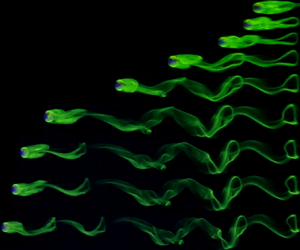
Effects of surface roughness on the drag coefficient of spheres freely rolling on an inclined plane
-
- Journal:
- Journal of Fluid Mechanics / Volume 984 / 10 April 2024
- Published online by Cambridge University Press:
- 01 April 2024, A13
-
- Article
-
- You have access
- Open access
- HTML
- Export citation
-
An experimental investigation identifying the effects of surface roughness on the drag coefficient ( $C_{D}$) of freely rolling spheres is reported. Although lubrication theory predicts an infinite drag force for an ideally smooth sphere in contact with a smooth wall, finite drag coefficients are obtained in experiments. It is proposed that surface roughness provides a finite effective gap ( $G$) between the sphere and panel, resulting in a finite drag force while also allowing physical contact between the sphere and plane. The measured surface roughnesses of both the sphere and panel are combined to give a total relative roughness ( $\xi$). The measured $C_{D}$ increases with decreasing $\xi$, in agreement with analytical predictions. Furthermore, the measured $C_{D}$ is also in good agreement with the combined analytical and numerical predictions for a smooth sphere and wall, with a gap approximately equal to the root-mean-square roughness ( $R_q$). The accuracy of these predictions decreases for low mean Reynolds numbers ( $\overline {Re}$), due to the existence of multiple scales of surface roughness that are not effectively captured by $R_{q}$. Experimental flow visualisations have been used to identify critical flow transitions that have been previously predicted numerically. Path tracking of spheres rolling on two panels with different surface roughnesses indicates that surface roughness does not significantly affect the sphere path or oscillations. Analysis of sphere Strouhal number ( $St$) highlights that wake shedding and sphere oscillations are coupled at low $\overline {Re}$ but with increasing $\overline {Re}$, the influence of wake shedding on the sphere path diminishes.


Propagation instabilities of the oblique detonation wave in partially prevaporized n-heptane sprays
-
- Journal:
- Journal of Fluid Mechanics / Volume 984 / 10 April 2024
- Published online by Cambridge University Press:
- 01 April 2024, A16
-
- Article
- Export citation
-
Two-dimensional oblique detonation wave (ODW) propagations in partially prevaporized n-heptane sprays are numerically simulated with a skeletal chemical mechanism. The influences of the droplet diameter and total equivalence on oblique detonation are considered. The initiation length is found to increase first and then decrease with increasing initial droplet diameter, and the effect of droplet size is maximized when the initial droplet diameter is approximately $10\ \mathrm {\mu } {\rm m}$. As the initial droplet diameter varies, unsteady and steady ODWs are observed. In the cases of unsteady ODWs, temperature gradients and non-uniform distributions of the reactant mixture due to droplet evaporation lead to formation of unsteady detonation propagation, therefore leading to fluctuations in the initiation length. The fluctuations in initiation length decrease as the pre-evaporation gas equivalence ratio increases for the unsteady cases. The results further suggest that the relationship between the evaporation layer thickness along the streamline and the corresponding theoretical initiation length can be used to identify an unsteady or steady ODW in cases with large droplets that evaporate behind an oblique shock wave or ODW under the effects of different initial droplet diameters.

Development of an ultrathin liquid sheet target for laser ion acceleration at high repetition rates in the kilohertz range
-
- Journal:
- High Power Laser Science and Engineering / Volume 12 / 2024
- Published online by Cambridge University Press:
- 01 April 2024, e37
-
- Article
-
- You have access
- Open access
- HTML
- Export citation
A canonical Hamiltonian formulation of the Navier–Stokes problem
-
- Journal:
- Journal of Fluid Mechanics / Volume 984 / 10 April 2024
- Published online by Cambridge University Press:
- 01 April 2024, A27
-
- Article
-
- You have access
- Open access
- HTML
- Export citation
-
This paper presents a novel Hamiltonian formulation of the isotropic Navier–Stokes problem based on a minimum-action principle derived from the principle of least squares. This formulation uses the velocities $u_{i}(x_{j},t)$ and pressure $p(x_{j},t)$ as the field quantities to be varied, along with canonically conjugate momenta deduced from the analysis. From these, a conserved Hamiltonian functional $H^{*}$ satisfying Hamilton's canonical equations is constructed, and the associated Hamilton–Jacobi equation is formulated for both compressible and incompressible flows. This Hamilton–Jacobi equation reduces the problem of finding four separate field quantities ( $u_{i}$, $p$) to that of finding a single scalar functional in those fields – Hamilton's principal functional ${S}^{*}[u_{i},p,t]$. Moreover, the transformation theory of Hamilton and Jacobi now provides a prescribed recipe for solving the Navier–Stokes problem: find ${S}^{*}$. If an analytical expression for ${S}^{*}$ can be obtained, it will lead via canonical transformation to a new set of fields which are simply equal to their initial values, giving analytical expressions for the original velocity and pressure fields. Failing that, if one can only show that a complete solution to this Hamilton–Jacobi equation does or does not exist, that will also resolve the question of existence of solutions. The method employed here is not specific to the Navier–Stokes problem or even to classical mechanics, and can be applied to any traditionally non-Hamiltonian problem.


Numerical study of a viscous breaking water wave and the limit of vanishing viscosity
-
- Journal:
- Journal of Fluid Mechanics / Volume 984 / 10 April 2024
- Published online by Cambridge University Press:
- 01 April 2024, R5
-
- Article
-
- You have access
- Open access
- HTML
- Export citation
Universal relative scaling of longitudinal structure functions in shear-dominated turbulence
-
- Journal:
- Journal of Fluid Mechanics / Volume 984 / 10 April 2024
- Published online by Cambridge University Press:
- 01 April 2024, A28
-
- Article
-
- You have access
- Open access
- HTML
- Export citation
-
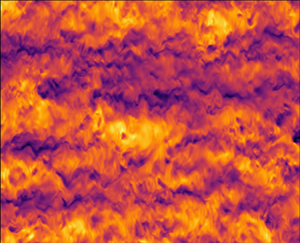
Shear significantly influences turbulence in the energy-containing range of shear-dominated flows, and the longitudinal structure functions do not have a universal form as they do in homogeneous isotropic turbulence. Despite this, the relative scaling of structure functions exhibits universal sub-Gaussian behaviour in shear-dominated flows, in particular for turbulent boundary layers, channels and Taylor–Couette flows. Our investigation of a turbulent vertical buoyancy layer at $Pr = 0.71$ using direct numerical simulation shows this universality even in moderate-Reynolds-number buoyancy-driven but shear-dominated boundary layers. It is demonstrated that the universality is related to the energy density of the eddies, which attains a hierarchical equilibrium in the energy-containing range of shear-dominated turbulence. We conjecture that the universal sub-Gaussian behaviour of the energy density of the energy-containing range, which was considered to be non-trivial in prior studies, is related to the universal anomalous scaling exponents of the inertial subrange turbulence. Based on this conjecture, we propose a hypothesis that relates large-scale eddies and the intermittent dissipation field in shear-dominated turbulence, highlighting a relationship between large and small scales. A phenomenological model is also developed to predict the scaling, which is verified using data from a turbulent boundary layer, half-channel and vertical buoyancy layer at friction Reynolds numbers spanning four orders of magnitude. Excellent agreement is observed.


Laminar boundary layer separation and reattachment on a rotating sphere
-
- Journal:
- Journal of Fluid Mechanics / Volume 984 / 10 April 2024
- Published online by Cambridge University Press:
- 01 April 2024, A15
-
- Article
-
- You have access
- Open access
- HTML
- Export citation
On the shear-induced lift in two-way coupled turbulent channel flow laden with heavy particles
-
- Journal:
- Journal of Fluid Mechanics / Volume 984 / 10 April 2024
- Published online by Cambridge University Press:
- 01 April 2024, A24
-
- Article
- Export citation
Subconvective wall-pressure fluctuations in low-Mach-number turbulent channel flow
-
- Journal:
- Journal of Fluid Mechanics / Volume 984 / 10 April 2024
- Published online by Cambridge University Press:
- 01 April 2024, R2
-
- Article
-
- You have access
- Open access
- HTML
- Export citation
New grating compressor designs for XCELS and SEL-100 PW projects
-
- Journal:
- High Power Laser Science and Engineering / Volume 12 / 2024
- Published online by Cambridge University Press:
- 01 April 2024, e36
-
- Article
-
- You have access
- Open access
- HTML
- Export citation
Dense turbulent suspensions at a liquid interface
-
- Journal:
- Journal of Fluid Mechanics / Volume 984 / 10 April 2024
- Published online by Cambridge University Press:
- 01 April 2024, R7
-
- Article
-
- You have access
- Open access
- HTML
- Export citation
Random pinhole attenuator for high-power laser beams
- Part of
-
- Journal:
- High Power Laser Science and Engineering / Volume 12 / 2024
- Published online by Cambridge University Press:
- 01 April 2024, e34
-
- Article
-
- You have access
- Open access
- HTML
- Export citation
