Refine search
Actions for selected content:
212937 results in Engineering

Active spheroids in viscosity gradients
-
- Journal:
- Journal of Fluid Mechanics / Volume 984 / 10 April 2024
- Published online by Cambridge University Press:
- 01 April 2024, A26
-
- Article
-
- You have access
- Open access
- HTML
- Export citation

Spatial growth rates of young wind waves under steady wind forcing
-
- Journal:
- Journal of Fluid Mechanics / Volume 984 / 10 April 2024
- Published online by Cambridge University Press:
- 01 April 2024, A22
-
- Article
-
- You have access
- Open access
- HTML
- Export citation
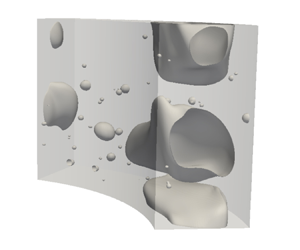
Numerical study on the mechanism of drag modulation by dispersed drops in two-phase Taylor–Couette turbulence
-
- Journal:
- Journal of Fluid Mechanics / Volume 984 / 10 April 2024
- Published online by Cambridge University Press:
- 01 April 2024, R3
-
- Article
-
- You have access
- Open access
- HTML
- Export citation

Diffusive-convection staircases in the polar oceans: the interplay between double diffusion and turbulence
-
- Journal:
- Journal of Fluid Mechanics / Volume 984 / 10 April 2024
- Published online by Cambridge University Press:
- 01 April 2024, A25
-
- Article
-
- You have access
- Open access
- HTML
- Export citation
-
Numerical simulations have been conducted to examine the structure of diffusive-convection staircases in the presence of vortical-mode-induced turbulent forcing. By modulating the input power $P$ and the background density ratio $R_\rho$, we have identified three distinct types of staircase structures in these simulations: namely staircases maintained in the system driven by double-diffusion, by turbulence or by a combination of both double-diffusion and turbulence. While we showed that staircases maintained in the double-diffusion-dominated system are accurately characterised by the existing model originally proposed by Linden & Shirtcliffe (J. Fluid Mech., vol. 87, no. 3, 1978, pp. 417–432), we introduced new physical models to describe the staircase structures maintained in the turbulence-dominated system and the system driven by both turbulence and double-diffusion. Our integrated model reveals that turbulence fundamentally governs the entire life cycle of the diffusive-convection staircases, encompassing their formation, maintenance and eventual disruption in the Arctic Ocean's thermohaline staircases. While our previous work of Ma & Peltier (J. Fluid Mech., vol. 931, 2022b) demonstrated that turbulence could initiate the formation of Arctic staircases, these staircases are sustained by both turbulence and double-diffusion acting together after formation has occurred. Strong turbulence may disrupt staircase structures; however, the presence of weak turbulence could lead to unstable stratification within mixed layers of the staircases, as well as enhancing vertical heat and salt fluxes. Turbulence can even sustain a stable staircase structure factor when $R_\rho$ is relatively large, following a similar mechanism to the density staircases observed in laboratory experiments. Consequently, previous parameterisations (e.g. Kelley, J. Geophys. Res.: Oceans, vol. 95, no. C3, 1990, pp. 3365–3371) on the vertical heat flux across the diffusive-convection staircases may provide a significant underestimation of the heat transport by ignoring the influences of turbulence.


A PINN approach for identifying governing parameters of noisy thermoacoustic systems
-
- Journal:
- Journal of Fluid Mechanics / Volume 984 / 10 April 2024
- Published online by Cambridge University Press:
- 01 April 2024, A21
-
- Article
- Export citation
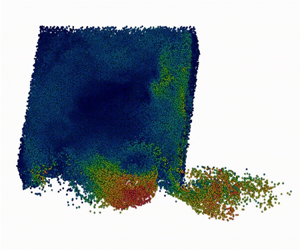
Lagrangian and Eulerian perspectives of turbulent transport mechanisms in a lateral cavity
-
- Journal:
- Journal of Fluid Mechanics / Volume 984 / 10 April 2024
- Published online by Cambridge University Press:
- 01 April 2024, A1
-
- Article
-
- You have access
- Open access
- HTML
- Export citation

Three-dimensional transition of the flow past an elastically mounted circular cylinder
-
- Journal:
- Journal of Fluid Mechanics / Volume 984 / 10 April 2024
- Published online by Cambridge University Press:
- 01 April 2024, A12
-
- Article
-
- You have access
- Open access
- HTML
- Export citation
-
Floquet stability analysis and direct simulations of a circular cylinder undergoing vortex-induced vibration (VIV) are presented. Simulation predictions are examined for the reduced velocity range over which there is a strong and periodic resonant response: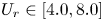 $U_r \in [4.0, 8.0]$, focusing on a mass ratio of $m^* = 2.546$ matching a number of previous investigations. Over most of this range, the dominant wake modes present are analogous to modes A, B and QP (quasi-periodic) observed in a stationary circular cylinder wake. However, at $U_r = 4.5$, the dominant modes are B, QP and a subharmonic mode (SH), whereas at $U_r = 4.0$, the two-dimensional base state switches to a $P+S$ wake. The critical Reynolds number for two- to three-dimensional transition is observed to decrease with an increase of $U_r$, in line with a decreasing response amplitude. Over this range, the minimum ${\textit {Re}}$ for which the wake remains two-dimensional is 202, which occurs at $U_r = 7.5$, but this increases to ${\textit {Re}}_{cr} = 300$ at $U_r = 4.5$, noting the critical Reynolds number for a stationary circular cylinder is ${\textit {Re}}_{cr}=189$. The corresponding critical spanwise wavelengths for $U_r = 4.5$ and 8 are $1.4D$ (mode B) and $4.0D$ (mode A), respectively. Simulations indicate that even at $Re=300$, flow three-dimensionality increases the amplitude of the lower branch considerably. The investigation establishes the role of oscillation amplitude and reduced velocity in three-dimensional transition for elastically mounted systems.


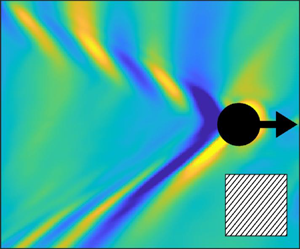
Asymmetrical wakes over anisotropic bathymetries
-
- Journal:
- Journal of Fluid Mechanics / Volume 984 / 10 April 2024
- Published online by Cambridge University Press:
- 01 April 2024, R6
-
- Article
-
- You have access
- Open access
- HTML
- Export citation
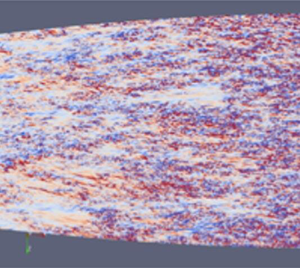
A streamline coordinate analysis of a turbulent boundary layer subject to pressure gradients and curvature on the windward side of a bump
-
- Journal:
- Journal of Fluid Mechanics / Volume 984 / 10 April 2024
- Published online by Cambridge University Press:
- 01 April 2024, A23
-
- Article
-
- You have access
- Open access
- HTML
- Export citation
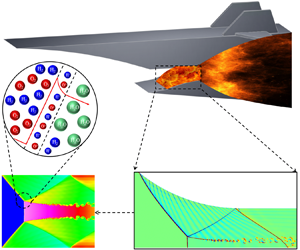
Curved detonation and its reflections
-
- Journal:
- Journal of Fluid Mechanics / Volume 984 / 10 April 2024
- Published online by Cambridge University Press:
- 01 April 2024, A11
-
- Article
- Export citation
A Monte Carlo approach for capacity and delay analyses of multiple interacting airports in Istanbul metroplex
-
- Journal:
- The Aeronautical Journal / Volume 128 / Issue 1327 / September 2024
- Published online by Cambridge University Press:
- 01 April 2024, pp. 1935-1960
-
- Article
- Export citation
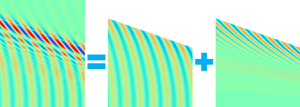
An Earth-fixed observer to ship waves
-
- Journal:
- Journal of Fluid Mechanics / Volume 984 / 10 April 2024
- Published online by Cambridge University Press:
- 01 April 2024, A14
-
- Article
-
- You have access
- Open access
- HTML
- Export citation
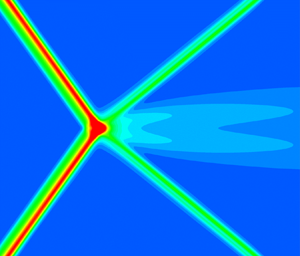
Regular reflection of shock waves in steady flows: viscous and non-equilibrium effects
-
- Journal:
- Journal of Fluid Mechanics / Volume 984 / 10 April 2024
- Published online by Cambridge University Press:
- 01 April 2024, A10
-
- Article
-
- You have access
- Open access
- HTML
- Export citation
-
Numerical analysis of a steady monatomic gas flow about the point of the regular reflection of a strong oblique shock wave from the symmetry plane is conducted with the Navier–Stokes–Fourier (NSF) equations, the regularized Grad 13-moment (R13) equations and the direct simulation Monte Carlo (DSMC) method. In contrast to the inviscid solution to this problem completely defined by the Rankine–Hugoniot (RH) relations, all three models predict a complicated flow structure with strong thermal non-equilibrium and a long wake with flow parameters not predicted by the RH relations. The temperature $T_y$ related to thermal motion of molecules in the direction normal to the symmetry plane has a maximum inside the reflection zone while in a planar shock wave the maximum is observed for the $T_x$ temperature. The R13 equations predict these features much better than the NSF equations and are in good agreement with the benchmark DSMC results. An analysis of the flow with the conservation equations was conducted in order to evaluate the effects of various processes on a fluid element moving along the symmetry plane. In contrast to the shock wave where effects of viscosity and heat conduction are one-dimensional with zeroth net contribution to the fluid-element energy across the shock, the flow across the zone of the shock reflection is dominated by two-dimensional effects with positive net contribution of viscosity and negative contribution of heat conduction to the fluid-element energy. These effects are believed to be the main source of the wake with parameters deviating from the RH values.


High-energy laser facility PHELIX at GSI: latest advances and extended capabilities
-
- Journal:
- High Power Laser Science and Engineering / Volume 12 / 2024
- Published online by Cambridge University Press:
- 01 April 2024, e39
-
- Article
-
- You have access
- Open access
- HTML
- Export citation
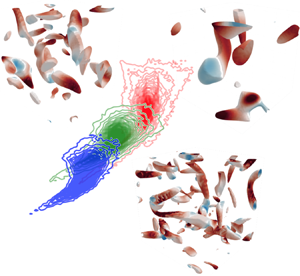
Data-driven nonlinear turbulent flow scaling with Buckingham Pi variables
-
- Journal:
- Journal of Fluid Mechanics / Volume 984 / 10 April 2024
- Published online by Cambridge University Press:
- 01 April 2024, R4
-
- Article
-
- You have access
- Open access
- HTML
- Export citation

Evaporation of acoustically levitated bicomponent droplets: mass and heat transfer characteristics
-
- Journal:
- Journal of Fluid Mechanics / Volume 984 / 10 April 2024
- Published online by Cambridge University Press:
- 01 April 2024, A17
-
- Article
-
- You have access
- Open access
- HTML
- Export citation

Gendering Green Criminology
-
- Published by:
- Bristol University Press
- Published online:
- 28 March 2024
- Print publication:
- 06 October 2023

Conjugated Polymers for Organic Electronics
- Design and Synthesis
-
- Published online:
- 28 March 2024
- Print publication:
- 04 April 2024
Copyright page
-
- Book:
- Fundamentals of Dispersed Multiphase Flows
- Published online:
- 22 March 2024
- Print publication:
- 28 March 2024, pp iv-iv
-
- Chapter
- Export citation
2 - Scales, Mechanisms, and Parameters
-
- Book:
- Fundamentals of Dispersed Multiphase Flows
- Published online:
- 22 March 2024
- Print publication:
- 28 March 2024, pp 18-45
-
- Chapter
- Export citation
