Refine search
Actions for selected content:
212937 results in Engineering

Tailbeat perturbations improve swimming efficiency in self-propelled flapping foils
-
- Journal:
- Journal of Fluid Mechanics / Volume 984 / 10 April 2024
- Published online by Cambridge University Press:
- 04 April 2024, A46
-
- Article
-
- You have access
- Open access
- HTML
- Export citation
3 - Poly(arylene vinylene)s
-
- Book:
- Conjugated Polymers for Organic Electronics
- Published online:
- 28 March 2024
- Print publication:
- 04 April 2024, pp 29-53
-
- Chapter
- Export citation
2 - Polyacetylenes
-
- Book:
- Conjugated Polymers for Organic Electronics
- Published online:
- 28 March 2024
- Print publication:
- 04 April 2024, pp 20-28
-
- Chapter
- Export citation
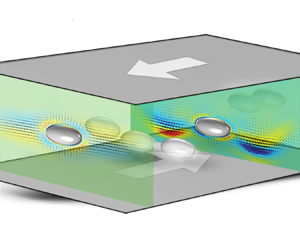
Bifurcation of equilibrium positions for ellipsoidal particles in inertial shear flows between two walls
-
- Journal:
- Journal of Fluid Mechanics / Volume 984 / 10 April 2024
- Published online by Cambridge University Press:
- 04 April 2024, A47
-
- Article
-
- You have access
- Open access
- HTML
- Export citation
Room acoustics of Mycelium Textiles: the Myx Sail at the Danish Design Museum
-
- Journal:
- Research Directions: Biotechnology Design / Volume 2 / 2024
- Published online by Cambridge University Press:
- 04 April 2024, e7
-
- Article
-
- You have access
- Open access
- HTML
- Export citation
7 - Polythiophenes
-
- Book:
- Conjugated Polymers for Organic Electronics
- Published online:
- 28 March 2024
- Print publication:
- 04 April 2024, pp 104-116
-
- Chapter
- Export citation
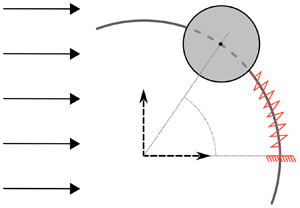
Flow-induced vibrations with and without structural restoring force: convergence under the effect of path curvature
-
- Journal:
- Journal of Fluid Mechanics / Volume 984 / 10 April 2024
- Published online by Cambridge University Press:
- 04 April 2024, A51
-
- Article
-
- You have access
- Open access
- HTML
- Export citation
-
When a cylinder is free to move along a transverse rectilinear path within a current, the vibrations developing with and without structural restoring force (SRF) noticeably deviate: if the elastic support is removed, their onset is delayed from a Reynolds number ( $Re$, based on the body diameter and inflow velocity) value of approximately 20 to 30, and their peak amplitudes and frequency bandwidths are substantially reduced. The present study examines the influence of a curved path on this deviation by considering that the cylinder, mounted on an elastic support or not, is free to translate along a circular path whose radius is varied. The investigation is carried out numerically at $Re=25$ and $100$, i.e. subcritical and postcritical values relative to the threshold of $47$ that marks the onset of flow unsteadiness for a fixed body. The principal result of this work is that the behaviours of the flow–structure systems with and without SRF tend to converge under the effect of path curvature. Beyond a certain curvature magnitude, both systems explore the same vibration ranges and the presence or absence of SRF becomes indiscernible. This convergence is accompanied by an enhancement of the responses appearing without SRF. It is analysed in light of the evolution of the effective added mass which determines the subset of responses reached with SRF that remain accessible without SRF. The apparent continuity of the physical mechanisms between the subcritical- and postcritical- $Re$ values suggests that the convergence phenomenon uncovered here could persist at higher $Re$.
$Re$.


Frontmatter
-
- Book:
- Warship 5
- Published by:
- Amsterdam University Press
- Published online:
- 04 April 2024, pp 1-1
-
- Chapter
- Export citation
Introduction
-
- Book:
- Warship 5
- Published by:
- Amsterdam University Press
- Published online:
- 04 April 2024, pp 2-48
-
- Chapter
- Export citation
13 - Polymers for Other Luminescent Devices
-
- Book:
- Conjugated Polymers for Organic Electronics
- Published online:
- 28 March 2024
- Print publication:
- 04 April 2024, pp 196-203
-
- Chapter
- Export citation
12 - Polymers for White-Emitting PLEDs
-
- Book:
- Conjugated Polymers for Organic Electronics
- Published online:
- 28 March 2024
- Print publication:
- 04 April 2024, pp 184-195
-
- Chapter
- Export citation
1 - Introduction
-
- Book:
- Conjugated Polymers for Organic Electronics
- Published online:
- 28 March 2024
- Print publication:
- 04 April 2024, pp 1-19
-
- Chapter
- Export citation
4 - Poly(arylene ethynylene)s
-
- Book:
- Conjugated Polymers for Organic Electronics
- Published online:
- 28 March 2024
- Print publication:
- 04 April 2024, pp 54-60
-
- Chapter
- Export citation
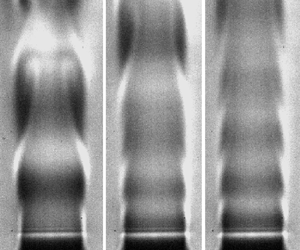
Chaos via type-II intermittency in a forced globally unstable jet
-
- Journal:
- Journal of Fluid Mechanics / Volume 984 / 10 April 2024
- Published online by Cambridge University Press:
- 04 April 2024, R8
-
- Article
-
- You have access
- Open access
- HTML
- Export citation
-
We explore the transition to chaos in a prototypical hydrodynamic oscillator, namely a globally unstable low-density jet subjected to external time-periodic forcing. As the forcing strengthens at an off-resonant frequency, we find that the jet exhibits a sequence of nonlinear states: period-1 limit cycle $\rightarrow $ quasiperiodicity $\rightarrow$ intermittency $\rightarrow$ low-dimensional chaos. We show that the intermittency obeys type-II Pomeau–Manneville dynamics by analysing the first return map and the scaling properties of the quasiperiodic lifetimes between successive chaotic epochs. By providing experimental evidence of the type-II intermittency route to chaos in a globally unstable jet, this study reinforces the idea that strange attractors emerge via universal mechanisms in open self-excited flows, facilitating the development of instability control strategies based on chaos theory.


Frontmatter
-
- Book:
- Warship 3
- Published by:
- Amsterdam University Press
- Published online:
- 04 April 2024, pp 1-1
-
- Chapter
- Export citation
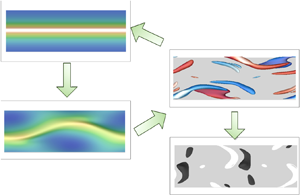
On the generation of near-wall dilatational motions in hypersonic turbulent boundary layers
-
- Journal:
- Journal of Fluid Mechanics / Volume 984 / 10 April 2024
- Published online by Cambridge University Press:
- 04 April 2024, A44
-
- Article
- Export citation
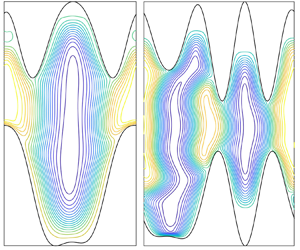
Optimal wall shapes and flows for steady planar convection
-
- Journal:
- Journal of Fluid Mechanics / Volume 984 / 10 April 2024
- Published online by Cambridge University Press:
- 04 April 2024, A43
-
- Article
-
- You have access
- Open access
- HTML
- Export citation
-
We compute steady planar incompressible flows and wall shapes that maximize the rate of heat transfer ( $Nu$) between hot and cold walls, for a given rate of viscous dissipation by the flow ( $Pe^2$), with no-slip boundary conditions at the walls. In the case of no flow, we show theoretically that the optimal walls are flat and horizontal, at the minimum separation distance. We use a decoupled approximation to show that flat walls remain optimal up to a critical non-zero flow magnitude. Beyond this value, our computed optimal flows and wall shapes converge to a set of forms that are invariant except for a $Pe^{-1/3}$ scaling of horizontal lengths. The corresponding rate of heat transfer $Nu \sim Pe^{2/3}$. We show that these scalings result from flows at the interface between the diffusion-dominated and convection-dominated regimes. We also show that the separation distance of the walls remains at its minimum value at large $Pe$.
$Pe$.


Calendar of Forthcoming Meetings: (Occurring after 1 July 2024)
-
- Journal:
- Powder Diffraction / Volume 39 / Issue 2 / June 2024
- Published online by Cambridge University Press:
- 04 April 2024, pp. 115-116
-
- Article
-
- You have access
- HTML
- Export citation
9 - Hyperbranched Polymers, Star Polymers and Dendrimers
-
- Book:
- Conjugated Polymers for Organic Electronics
- Published online:
- 28 March 2024
- Print publication:
- 04 April 2024, pp 149-159
-
- Chapter
- Export citation

Warship 6
- Destroyer HMCS Haida
-
- Published by:
- Amsterdam University Press
- Published online:
- 03 April 2024
-
- Book
- Export citation
