Refine search
Actions for selected content:
212967 results in Engineering
Select Bibliography
-
- Book:
- The Truth About Energy
- Published online:
- 01 February 2024
- Print publication:
- 08 February 2024, pp 671-674
-
- Chapter
- Export citation
4 - Old to New: The Sun and All Its Glory
- from Part II - In with the New
-
- Book:
- The Truth About Energy
- Published online:
- 01 February 2024
- Print publication:
- 08 February 2024, pp 299-379
-
- Chapter
- Export citation
Chapter 10 - Wireless Networking
-
- Book:
- Wireless Communications
- Published online:
- 22 March 2024
- Print publication:
- 08 February 2024, pp 491-532
-
- Chapter
- Export citation
Contents
-
- Book:
- The Truth About Energy
- Published online:
- 01 February 2024
- Print publication:
- 08 February 2024, pp vii-x
-
- Chapter
- Export citation

Sum-frequency triad interactions among surface waves propagating through an ice sheet
-
- Journal:
- Journal of Fluid Mechanics / Volume 980 / 10 February 2024
- Published online by Cambridge University Press:
- 06 February 2024, A45
-
- Article
- Export citation

Periodic flow features in a planar sudden expansion with pulsatile inflow velocity
-
- Journal:
- Journal of Fluid Mechanics / Volume 980 / 10 February 2024
- Published online by Cambridge University Press:
- 06 February 2024, A43
-
- Article
-
- You have access
- Open access
- HTML
- Export citation
-
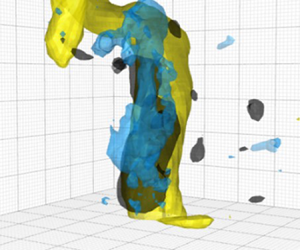
Flow through sudden expansion finds its application in several engineering and biological processes. Though the stability of flow through steady sudden expansion has garnered much attention, little to none is given to the pulsatile flow through sudden expansion. Hence, in the present work we study the influence of inflow pulsatility on flow characteristics in a sudden expansion. The inflow velocity is a sinusoidal waveform that is modulated to encompass a wide range of amplitudes, ${{a}}$, and reduced velocities, ${{U_{r}}}$. We report four different modes, namely, synchronized growth of the recirculation region (at high ${{U_{r}}}$), necking and diffusion of the recirculation region (at moderately high ${{U_{r}}}$), splitting and convection of the recirculation region (at moderate ${{U_{r}}}$) and inverse growth of the recirculation region (at low ${{U_{r}}}$). In each mode, the symmetry-breaking critical Reynolds number is obtained through numerical experiments and compared with those of Floquet stability analysis. We found that diffusion and the convection mode of the recirculation region increases the stability of the flow while the inverse growth mode of the recirculation region decreases the same. The effect of the expansion ratio, ${{ER}}$, is also explored, and we found that as ${{ER}}$ increases, the absolute stability of flow decreases, but relative stability between the modes remains similar. Finally, we explain the dynamics of the modes by using terms involving the vorticity transport equation.


Comparing local energy cascade rates in isotropic turbulence using structure-function and filtering formulations
- Part of
-
- Journal:
- Journal of Fluid Mechanics / Volume 980 / 10 February 2024
- Published online by Cambridge University Press:
- 06 February 2024, A42
-
- Article
-
- You have access
- Open access
- HTML
- Export citation
-
Two common definitions of the spatially local rate of kinetic energy cascade at some scale $\ell$ in turbulent flows are (i) the cubic velocity difference term appearing in the ‘scale-integrated local Kolmogorov–Hill’ equation (structure-function approach), and (ii) the subfilter-scale energy flux term in the transport equation for subgrid-scale kinetic energy (filtering approach). We perform a comparative study of both quantities based on direct numerical simulation data of isotropic turbulence at Taylor-scale Reynolds number 1250. While in the past observations of negative subfilter-scale energy flux (backscatter) have led to debates regarding interpretation and relevance of such observations, we argue that the interpretation of the local structure-function-based cascade rate definition is unambiguous since it arises from a divergence term in scale space. Conditional averaging is used to explore the relationship between the local cascade rate and the local filtered viscous dissipation rate as well as filtered velocity gradient tensor properties such as its invariants. We find statistically robust evidence of inverse cascade when both the large-scale rotation rate is strong and the large-scale strain rate is weak. Even stronger net inverse cascading is observed in the ‘vortex compression’ $R>0$, $Q>0$ quadrant, where $R$ and $Q$ are velocity gradient invariants. Qualitatively similar but quantitatively much weaker trends are observed for the conditionally averaged subfilter-scale energy flux. Flow visualizations show consistent trends, namely that spatially, the inverse cascade events appear to be located within large-scale vortices, specifically in subregions when $R$ is large.


Dynamics of collapse of free-surface bubbles: effects of gravity and viscosity
-
- Journal:
- Journal of Fluid Mechanics / Volume 980 / 10 February 2024
- Published online by Cambridge University Press:
- 06 February 2024, A36
-
- Article
- Export citation
-
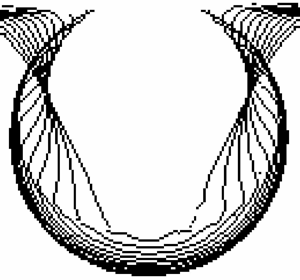
The rupture of the thin film at the top of a bubble at a liquid–gas interface leads to an axisymmetric collapse of the bubble cavity. We present scaling laws for such a cavity collapse, established from experiments conducted with bubbles spanning a wide range of Bond ( ${10^{-3}< Bo\leq 1}$) and Ohnesorge numbers ( ${10^{-3}< Oh<10^{-1}}$), defined with the bubble radius $R$. The cavity collapse is a capillary-driven process, with a dependency on viscosity and gravity, affecting respectively, precursory capillary waves on the cavity boundary and the static bubble shape. The collapse is characterised by the normal interface velocity ( $U_n$) and by the tangential wave propagation velocity of the kink ( $U_t$), defined by the intersection of the concave cavity boundary formed after the rupture of the thin film with the convex boundary of the bubble cavity. During the collapse, $U_t$ remains constant and is shown to be $U_t=4.5U_c{\mathcal {W}}_R$, where $U_c$ is the capillary velocity and ${\mathcal {W}}_R(Oh,Bo)={(1-\sqrt {Oh {\mathscr {L}}} )^{-1/2}}$ is the wave resistance factor due to the precursory capillary waves, with $\mathscr {L}(Bo)$ being the path correction of the kink motion. The movement of the kink in the normal direction is part of the inward shrinkage of the whole cavity due to the sudden reduction of gas pressure inside the bubble cavity after the thin film rupture. This normal velocity is shown to scale as $U_c$ in the equatorial plane, while at the bottom of the cavity $\bar {U}_{nb}=U_c(Z_c/R)({\mathcal {W}_R}/ {\mathscr {L}})$, where $Z_c(Bo)$ is the static cavity depth. The filling rate of the cavity, which remains a constant throughout the collapse, is shown to be entirely determined by the shrinking velocity and scales as ${Q_T\simeq 2{\rm \pi} R Z_c U_c}$. From $Q_T$ we recover the jet velocity scaling, thereby relating the cavity collapse with the jet velocity scaling.


On the interfacial instabilities of a ventilation cavity induced by gaseous injection into liquid crossflow
-
- Journal:
- Journal of Fluid Mechanics / Volume 980 / 10 February 2024
- Published online by Cambridge University Press:
- 06 February 2024, A44
-
- Article
- Export citation
Granular-fluid avalanches: the role of vertical structure and velocity shear
-
- Journal:
- Journal of Fluid Mechanics / Volume 980 / 10 February 2024
- Published online by Cambridge University Press:
- 06 February 2024, A11
-
- Article
-
- You have access
- Open access
- HTML
- Export citation

Covering convection with a thermal blanket: numerical simulation and stochastic modelling
-
- Journal:
- Journal of Fluid Mechanics / Volume 980 / 10 February 2024
- Published online by Cambridge University Press:
- 06 February 2024, A47
-
- Article
-
- You have access
- Open access
- HTML
- Export citation
Supergranule aggregation: a Prandtl number-independent feature of constant heat flux-driven convection flows
-
- Journal:
- Journal of Fluid Mechanics / Volume 980 / 10 February 2024
- Published online by Cambridge University Press:
- 06 February 2024, A46
-
- Article
- Export citation
-
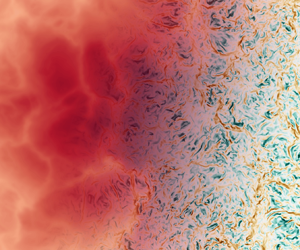
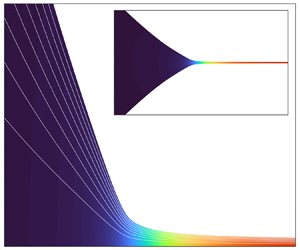
Supergranule aggregation, i.e. the gradual aggregation of convection cells to horizontally extended networks of flow structures, is a unique feature of constant heat flux-driven turbulent convection. In the present study, we address the question if this mechanism of self-organisation of the flow is present for any fluid. Therefore, we analyse three-dimensional Rayleigh–Bénard convection at a fixed Rayleigh number ${Ra} \approx 2.0 \times 10^{5}$ across $4$ orders of Prandtl numbers ${Pr} \in [10^{-2}, 10^{2}]$ by means of direct numerical simulations in horizontally extended periodic domains with aspect ratio $\varGamma = 60$. Our study confirms the omnipresence of the mechanism of supergranule aggregation for the entire range of investigated fluids. Moreover, we analyse the effect of ${Pr}$ on the global heat and momentum transport, and clarify the role of a potential stable stratification in the bulk of the fluid layer. The ubiquity of the investigated mechanism of flow self-organisation underlines its relevance for pattern formation in geophysical and astrophysical convection flows, the latter of which are often driven by prescribed heat fluxes.


Self-similarity of the dipole–multipole transition in rapidly rotating dynamos
-
- Journal:
- Journal of Fluid Mechanics / Volume 980 / 10 February 2024
- Published online by Cambridge University Press:
- 05 February 2024, A30
-
- Article
-
- You have access
- Open access
- HTML
- Export citation
Analysis of self-heating in electrosprays operating in the cone-jet mode
-
- Journal:
- Journal of Fluid Mechanics / Volume 980 / 10 February 2024
- Published online by Cambridge University Press:
- 05 February 2024, A40
-
- Article
-
- You have access
- Open access
- HTML
- Export citation

Water entry of an elastic conical shell
-
- Journal:
- Journal of Fluid Mechanics / Volume 980 / 10 February 2024
- Published online by Cambridge University Press:
- 05 February 2024, A34
-
- Article
-
- You have access
- Open access
- HTML
- Export citation
Effects of porous substrates on the structure of turbulent boundary layers
-
- Journal:
- Journal of Fluid Mechanics / Volume 980 / 10 February 2024
- Published online by Cambridge University Press:
- 05 February 2024, A39
-
- Article
-
- You have access
- Open access
- HTML
- Export citation
-
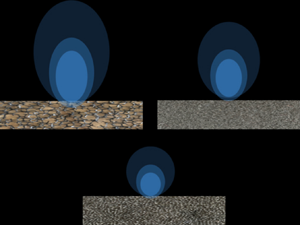
Three different porous substrates (with different pore sizes, $s$, and permeabilities, $K$) are used to examine their effect on the structure of boundary layer flow over them. The flow is characterised with single-point hot-wire measurements as well as planar particle image velocimetry. In order to elucidate differences in shallow and deep flows past porous substrates, foams with two different thicknesses ( $h$) are used (for all three substrates). A wide range of friction Reynolds numbers ( $2000< Re_\tau <13\,500$) and permeability-based Reynolds numbers ( $1< Re_K< 50$) are attained. For substrates with $Re_K \sim 1$, the flow behaviour remains similar to flow over impermeable smooth walls and as such Townsend's hypothesis remains valid. Very large-scale motions are observed over permeable foams even when the $Re_K > 1$. In contrast, a substantial reduction in velocity disturbances and associated length scales is achieved for permeable foams with intermediate values of pore density and relative foam thickness ( $h/s$), which affects outer-layer similarity. As permeability is increased by increasing pore size, the foam becomes sparse relative to viscous scales at high Reynolds numbers. For such foams, the flow conforms to outer-layer similarity and is more akin to flow over rough surfaces. Permeability attenuates the wavelengths associated with the outer-layer peak.


Unifying heat transport model for the transition between buoyancy-dominated and Lorentz-force-dominated regimes in quasistatic magnetoconvection
-
- Journal:
- Journal of Fluid Mechanics / Volume 980 / 10 February 2024
- Published online by Cambridge University Press:
- 05 February 2024, R3
-
- Article
-
- You have access
- Open access
- HTML
- Export citation
-
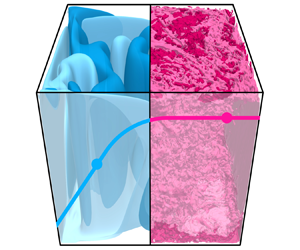
In magnetoconvection, the flow of an electromagnetically conductive fluid is driven by a combination of buoyancy forces, which create the fluid motion due to thermal expansion and contraction, and Lorentz forces, which distort the convective flow structure in the presence of a magnetic field. The differences in the global flow structures in the buoyancy-dominated and Lorentz-force-dominated regimes lead to different heat transport properties in these regimes, reflected in distinct dimensionless scaling relations of the global heat flux (Nusselt number $Nu$) versus the strength of buoyancy (Rayleigh number $Ra$) and electromagnetic forces (Hartmann number $Ha$). Here, we propose a theoretical model for the transition between these two regimes for the case of a static vertical magnetic field applied across a convective fluid layer confined between two isothermal, a lower warmer and an upper colder, horizontal surfaces. The model suggests that the scaling exponents $\gamma$ in the buoyancy-dominated regime, $Nu\sim Ra ^\gamma$, and $\xi$ in the Lorentz-force-dominated regime, $Nu\sim (Ha^{-2}Ra)^\xi$, are related as $\xi =\gamma /(1-2\gamma )$, and the onset of the transition scales with $Ha^{-1/\gamma }Ra$. These theoretical results are supported by our direct numerical simulations for $10\leq Ha\leq 2000$, Prandtl number $Pr=0.025$ and $Ra$ up to $10^9$ and data from the literature.


The skating of drops impacting over gas or vapour layers
-
- Journal:
- Journal of Fluid Mechanics / Volume 980 / 10 February 2024
- Published online by Cambridge University Press:
- 05 February 2024, A35
-
- Article
-
- You have access
- Open access
- HTML
- Export citation
Use of heated corrugations for propulsion
-
- Journal:
- Journal of Fluid Mechanics / Volume 980 / 10 February 2024
- Published online by Cambridge University Press:
- 05 February 2024, A41
-
- Article
-
- You have access
- Open access
- HTML
- Export citation

Preferential accumulation of finite-size particles in near-wall streaks
-
- Journal:
- Journal of Fluid Mechanics / Volume 980 / 10 February 2024
- Published online by Cambridge University Press:
- 05 February 2024, A38
-
- Article
- Export citation
