Refine search
Actions for selected content:
212964 results in Engineering
Appendix A - Matrix Primer
- from Part IV - Appendices
-
- Book:
- State Estimation for Robotics
- Published online:
- 11 January 2024
- Print publication:
- 01 February 2024, pp 435-457
-
- Chapter
- Export citation
6 - Variational Inference
- from Part I - Estimation Machinery
-
- Book:
- State Estimation for Robotics
- Published online:
- 11 January 2024
- Print publication:
- 01 February 2024, pp 182-214
-
- Chapter
- Export citation

Effects of horizontal magnetic fields on turbulent Rayleigh–Bénard convection in a cuboid vessel with aspect ratio Γ = 5
-
- Journal:
- Journal of Fluid Mechanics / Volume 980 / 10 February 2024
- Published online by Cambridge University Press:
- 31 January 2024, A24
-
- Article
- Export citation
-
Direct numerical simulations have been conducted to investigate turbulent Rayleigh– Bénard convection (RBC) of liquid metal in a cuboid vessel with aspect ratio $\varGamma =5$ under an imposed horizontal magnetic field. Flows with Prandtl number $Pr=0.033$, Rayleigh numbers ranging up to $Ra\leq 10^{7}$, and Chandrasekhar numbers up to $Q\leq 9 \times 10^6$ are considered. For weak magnetic fields, our findings reveal that a previously undiscovered decreasing region precedes the enhancement of heat transfer and kinetic energy. For moderate magnetic fields, we have reproduced the reversals of the large-scale flow, which are considered a reorganization process of the roll-like structures that were reported experimentally by Yanagisawa et al. (Phys. Rev. E, vol. 83, 2011, 036307). Nevertheless, the proposed approach of skewed-varicose instability has been substantiated as insufficient to elucidate fundamentally the phenomenon of flow reversal, an occurrence bearing a striking resemblance to the large-scale intermittency observed in magnetic channel flows. As we increase the magnetic field strength further, we observe that the energy dissipation of the system comes primarily from the viscous dissipation within the boundary layer. Consequently, the dependence of Reynolds number $Re$ on $Q$ approaches a scaling as $Re\,Pr/Ra^{2/3} \sim Q^{-1/3}$. At the same time, we find the law for the cutoff frequency that separates large quasi-two-dimensional scales from small three-dimensional ones in RBC flow, which scales with the interaction parameter as ${\sim }N^{1/3}$.


The characteristics of the circular hydraulic jump and vortex structure
-
- Journal:
- Journal of Fluid Mechanics / Volume 980 / 10 February 2024
- Published online by Cambridge University Press:
- 31 January 2024, A15
-
- Article
- Export citation
-
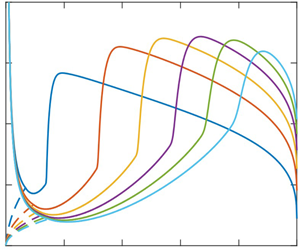
In an effort to capture the continuous hydraulic jump and flow structure for a jet impinging on a disk, we recently proposed a composite mean-field thin-film approach consisting of subdividing the flow domain into three distinct connected regions of increasing gravity strength (Wang et al., J. Fluid Mech., vol. 966, 2023, A15). In the present study, we further validate our approach, and examine the characteristics and structure of the circular jump and recirculation. The influence of the disk radius is found to be significant, especially in the subcritical region. Below a disk radius, the jump transits from type Ia to type 0 after the recirculation zone has faded. The supercritical flow and jump location are insensitive to the disk size, but the jump length and height as well as the vortex size are strongly affected, all decreasing with decreasing disk radius, exhibiting a maximum with the flow rate for a small disk. The jump is relatively steep with a strong recirculation zone for a high obstacle at the disk edge. Comparison against the Navier–Stokes solution of Askarizadeh et al. (Phys. Rev. Fluids, vol. 4, 2019, 114002; Intl J. Heat Mass Transfer, vol. 146, 2020, 118823) for the weak and intermediate surface tension suggests that the surface tension effect is unimportant for a high obstacle for a jump of type 0 or type Ia. The film thickness at the disk edge for a freely draining film is found to comprise, in addition to a static component (capillary length), a dynamic component: ${h_\infty }\sim {(Fr/{r_\infty })^{2/3}}$ that we establish by minimizing the Gibbs free energy at the disk edge, and, equivalently, is also the consequence of the flow becoming supercritical near the edge. By assuming negligible film slope and curvature at the leading edge of the jump and maximum height at the trailing edge, we show that the jump length is related to the jump radius as ${L_J}\sim Re{(F{r^2}/{r_J}^5)^{1/3}}$. The vortex length follows the same behaviour. The energy loss and conjugate depth ratio exhibit a maximum with the flow rate, which we show to originate from the descending and ascending branches of the supercritical film thickness. The presence of the jump is not necessarily commensurate with that of a recirculation; the existence of the vortex closely depends on the upstream curvature and steepness of the jump. The surface separating the regions of existence/non-existence of the recirculation is given by the universal relation $R{e^{10/3}}F{r^2} = 9r_\infty ^9/50$. The jump can be washed off the edge of the disk, particularly at low viscosity and small disk size. The flow in the supercritical region remains insensitive to the change in gravity level and disk size but is greatly affected by viscosity.
Flows with free boundaries and hydrodynamic singularities
-
- Journal:
- Journal of Fluid Mechanics / Volume 980 / 10 February 2024
- Published online by Cambridge University Press:
- 31 January 2024, A23
-
- Article
- Export citation
Yielding to percolation: a universal scale
-
- Journal:
- Journal of Fluid Mechanics / Volume 980 / 10 February 2024
- Published online by Cambridge University Press:
- 31 January 2024, A14
-
- Article
-
- You have access
- Open access
- HTML
- Export citation
Path instability of deformable bubbles rising in Newtonian liquids: a linear study
-
- Journal:
- Journal of Fluid Mechanics / Volume 980 / 10 February 2024
- Published online by Cambridge University Press:
- 31 January 2024, A19
-
- Article
-
- You have access
- Open access
- HTML
- Export citation
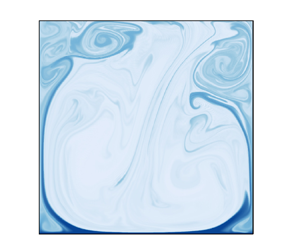
Coulomb-driven electroconvection turbulence in two-dimensional cavity
-
- Journal:
- Journal of Fluid Mechanics / Volume 980 / 10 February 2024
- Published online by Cambridge University Press:
- 31 January 2024, A22
-
- Article
- Export citation
-
A comprehensive direct numerical simulation of electroconvection (EC) turbulence caused by strong unipolar charge injection in a two-dimensional cavity is performed. The EC turbulence has strong fluctuations and intermittency in the closed cavity. Several dominant large-scale structures are found, including two vertical main rolls and a single primary roll. The flow mode significantly influences the charge transport efficiency. A nearly $Ne \sim T^{1/2}$ scaling stage is observed, and the optimal $Ne$ increment is related to the mode with two vertical rolls, while the single roll mode decreases the charge transport efficiency. As the flow strength increases, EC turbulence transitions from an electric force-dominated mode to an inertia-dominated mode. The former utilizes the Coulomb force more effectively and allocates more energy to convection. The vertical mean profiles of charge, electric field and energy budget provide intuitive information on the spatial energy distribution. With the aid of the energy-box technique, a detailed energy transport evolution is illustrated with changing electric Rayleigh numbers. This exploration of EC turbulence can help explain more complicated electrokinetic turbulence mechanisms and the successful utilization of Fourier mode decomposition and energy-box techniques is expected to benefit future EC studies.


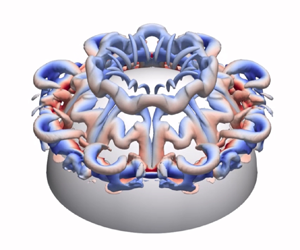
Collisions of vortex rings with hemispheres
-
- Journal:
- Journal of Fluid Mechanics / Volume 980 / 10 February 2024
- Published online by Cambridge University Press:
- 31 January 2024, A17
-
- Article
-
- You have access
- Open access
- HTML
- Export citation
-
A numerical investigation was conducted on $Re_{\varGamma _{0}}=3000$ vortex rings colliding with wall-mounted hemispheres to study how their relative sizes affect the resulting vortex dynamics and structures. The hemisphere to vortex ring diameter ratio ranges from $D/d=0.5$ to $D/d=2$. Secondary/tertiary vortex rings are observed to result from hemispheric surface boundary layer separations rather than wall boundary layer separations as the diameter ratio increases. While those for $D/d\leq 1$ hemispheres can be attributed to sequential hemispheric and wall boundary layer separations, the primary vortex ring produces a series of secondary/tertiary vortex rings only along the $D/d=2$ hemispheric surface. This indicates that the presence of the wall makes little difference when the hemisphere is sufficiently large. On top of comparing vortex ring circulations and translational velocities between hemisphere and flat-wall based collisions, present collision outcomes have also been compared with those predicted by specific discharge velocity models. Additionally, comparisons of vortex core trajectories and vortex ring formation locations with earlier cylindrical convex surface based collisions provide more clarity on differences between two- and three-dimensional convex surfaces. Finally, vortex flow models are presented to account for the significantly different flow behaviour as the hemisphere size varies. Specifically, the vortex flow model for the $D/d=2$ hemisphere hypothesizes that the recurring tertiary vortex ring formations cease only when the primary vortex ring slows down sufficiently for the last tertiary vortex ring to entangle with it and render it incoherent. Until that happens, the primary vortex ring will continue to induce more tertiary vortex rings to form, with potential implications for heat/mass transfer optimizations.


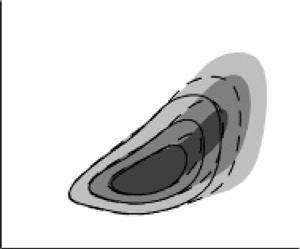
A data-driven quasi-linear approximation for turbulent channel flow
-
- Journal:
- Journal of Fluid Mechanics / Volume 980 / 10 February 2024
- Published online by Cambridge University Press:
- 31 January 2024, A12
-
- Article
-
- You have access
- Open access
- HTML
- Export citation
-
A data-driven implementation of a quasi-linear approximation is presented, extending a minimal quasi-linear approximation (MQLA) (Hwang & Ekchardt, J. Fluid Mech., vol. 894, 2020, p. A23) to incorporate non-zero streamwise Fourier modes. A data-based approach is proposed, matching the two-dimensional wavenumber spectra for a fixed spanwise wavenumber between a direct numerical simulation (DNS) (Lee & Moser, J. Fluid Mech., vol. 774, 2015, pp. 395–415) and that generated by the eddy viscosity enhanced linearised Navier–Stokes equations at $Re_\tau \approx 5200$, where $Re_\tau$ is the friction Reynolds number. Leveraging the self-similar nature of the energy-containing part in the DNS velocity spectra, a universal self-similar streamwise wavenumber weight is determined for the linearised fluctuation equations at $Re_\tau \simeq ~5200$. The data-driven quasi-linear approximation (DQLA) provides noteworthy enhancements in the wall-normal and spanwise turbulence intensity profiles. It exhibits a qualitatively similar structure in the spanwise wavenumber velocity spectra compared with the MQLA. Additionally, the DQLA offers extra statistical outputs in the streamwise wavenumber coordinates, enabling a comprehensive global analysis of this modelling approach. By comparing the DQLA results with DNS results, the limitations of the presented framework are discussed, mainly pertaining to the lack of the streak instability (or transient growth) mechanism and energy cascade from the linearised model. The DQLA is subsequently employed over a range of Reynolds numbers up to $Re_\tau = 10^5$. Overall, the turbulence statistics and spectra produced by the DQLA scale consistently with the available DNS and experimental data, with the Townsend–Perry constants displaying a mild Reynolds dependence (Hwang, Hutchins & Marusic, J. Fluid Mech., vol. 933, 2022, p. A8). The scaling behaviour of the turbulence intensity profiles deviates away from the classic $\ln (Re_\tau )$ scaling, following the inverse centreline velocity scaling for the higher Reynolds numbers.


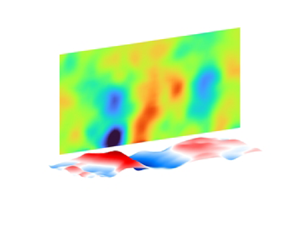
On the scaling and critical layer in a turbulent boundary layer over a compliant surface
-
- Journal:
- Journal of Fluid Mechanics / Volume 980 / 10 February 2024
- Published online by Cambridge University Press:
- 31 January 2024, R2
-
- Article
-
- You have access
- Open access
- HTML
- Export citation
FLM volume 979 Cover and Front matter
-
- Journal:
- Journal of Fluid Mechanics / Volume 979 / 25 January 2024
- Published online by Cambridge University Press:
- 31 January 2024, p. f1
-
- Article
-
- You have access
- Export citation
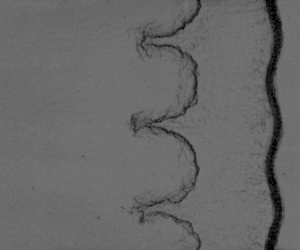
Interfacial instabilities driven by co-directional rarefaction and shock waves
-
- Journal:
- Journal of Fluid Mechanics / Volume 980 / 10 February 2024
- Published online by Cambridge University Press:
- 31 January 2024, A20
-
- Article
- Export citation
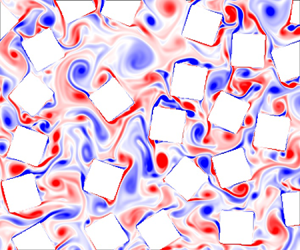
Extended Darcy–Forchheimer law including inertial flow deflection effects
-
- Journal:
- Journal of Fluid Mechanics / Volume 980 / 10 February 2024
- Published online by Cambridge University Press:
- 31 January 2024, A13
-
- Article
-
- You have access
- Open access
- HTML
- Export citation
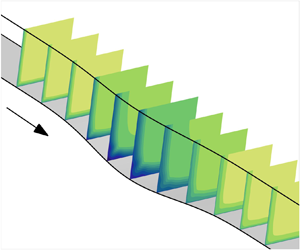
Turbulence anisotropy effects on corner-flow separation: physics and turbulence modelling
-
- Journal:
- Journal of Fluid Mechanics / Volume 980 / 10 February 2024
- Published online by Cambridge University Press:
- 31 January 2024, A21
-
- Article
-
- You have access
- Open access
- HTML
- Export citation
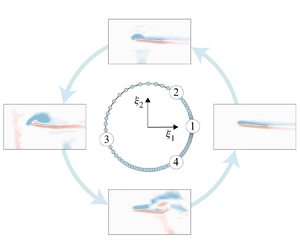
A cyclic perspective on transient gust encounters through the lens of persistent homology
-
- Journal:
- Journal of Fluid Mechanics / Volume 980 / 10 February 2024
- Published online by Cambridge University Press:
- 30 January 2024, A18
-
- Article
-
- You have access
- Open access
- HTML
- Export citation
Thinned array distribution with grating lobe canceller at any scan angle for automotive radar applications
-
- Journal:
- International Journal of Microwave and Wireless Technologies / Volume 16 / Issue 5 / June 2024
- Published online by Cambridge University Press:
- 30 January 2024, pp. 750-762
-
- Article
- Export citation
Position-independent self-adaptive wireless power transfer: topology, modeling, and design
-
- Journal:
- International Journal of Microwave and Wireless Technologies / Volume 16 / Issue 3 / April 2024
- Published online by Cambridge University Press:
- 29 January 2024, pp. 391-399
-
- Article
- Export citation
A wall model for large-eddy simulation of highly compressible flows based on a new scaling of the law of the wall
-
- Journal:
- Journal of Fluid Mechanics / Volume 980 / 10 February 2024
- Published online by Cambridge University Press:
- 29 January 2024, A9
-
- Article
- Export citation
-
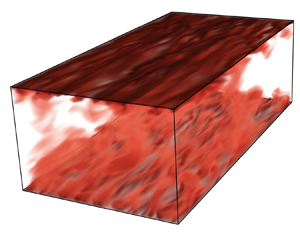
Wall modelling in large-eddy simulation (LES) is of high importance to allow scale resolving simulations of industrial applications. Numerous models were developed and validated for incompressible flows, including a simple quasi-analytical model based on Reichardt's formula that approximates the law of the wall. In this paper, a scaling is proposed to generalize this wall model to highly compressible flows. First, the results of wall-resolved LES (wrLES) of adiabatic compressible turbulent channel flows at $Re_\tau = 1000$ and at centreline Mach numbers of $M_c= 0.76$ and $1.5$ are presented. Then, three potential scalings of the incompressible wall model are proposed, and their a priori performance is evaluated : (i) the Howarth–Stewartson scaling, (ii) an improved Van Driest scaling and (iii) a new scaling obtained from a blending of those two. The results of wall-modelled LES (wmLES) of compressible channel flows using these three models are compared with the reference wrLES data, showing the superior accuracy of the hybrid scaling. The consistency of the new wall model at low Mach numbers is also verified by comparing the results of a wmLES at $M_c= 0.25$ with those of reference incompressible DNS data at $Re_\tau = 1000$ and $5200$. Finally, the proposed wall model is also applied to a turbulent channel flow at $M_c=1.5$ and $Re_\tau =5200$.


The stress in static granular media under gravity
-
- Journal:
- Journal of Fluid Mechanics / Volume 980 / 10 February 2024
- Published online by Cambridge University Press:
- 29 January 2024, A10
-
- Article
-
- You have access
- Open access
- HTML
- Export citation
