Refine search
Actions for selected content:
212964 results in Engineering
Dynamic interaction of gravity currents in a confined porous layer
-
- Journal:
- Journal of Fluid Mechanics / Volume 979 / 25 January 2024
- Published online by Cambridge University Press:
- 25 January 2024, A52
-
- Article
- Export citation
-
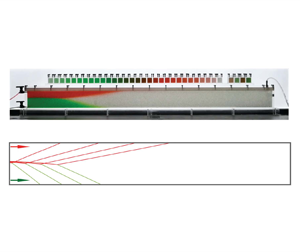
We study the dynamic interaction of two gravity currents in a confined porous layer, one heavier and one lighter, partly inspired by the practice of geological $\mathrm {CO}_2$ sequestration in oil fields. Two coupled nonlinear advective-diffusive equations are derived to describe the time evolution of the profile shape of both the upper (lighter) and lower (heavier) currents. At early times, the upper and lower currents remain separated and propagate independently. As time progresses, the currents approach each other and start to interact. We have identified eight different regimes of gravity current interaction at late times, impacted by four dimensionless parameters, representing the flow rate partition, ratio of buoyancy over the injection force, and the viscosity contrasts between the two injecting and displaced fluids. By defining appropriate similarity variables at either the early or late times, the governing partial differential equations (PDEs) reduce to different ordinary differential equations (ODEs), corresponding to the classic nonlinear diffusion solutions at early times and eight different self-similar solutions at late times when the currents attach to each other. It is of interest to note that in four of the eight regimes of late-time interaction (regimes 2, 6–8), self-similar solutions can be constructed by combining appropriately the three basic solutions (i.e. shock, rarefaction and travelling wave solutions) identified during single fluid injection in confined porous layers. In the four other regimes (regimes 1, 3–5), implicit solutions in the form of logarithm or error functions are obtained due to the influence of flow confinement and interaction of gravity currents. Potential implications of the model and solutions are also briefly discussed in the context of ${\rm CO}_2$-water co-flooding for simultaneous ${\rm CO}_2$ sequestration and oil recovery.


A parametric large-eddy simulation study of wind-farm blockage and gravity waves in conventionally neutral boundary layers
- Part of
-
- Journal:
- Journal of Fluid Mechanics / Volume 979 / 25 January 2024
- Published online by Cambridge University Press:
- 25 January 2024, A54
-
- Article
-
- You have access
- Open access
- HTML
- Export citation
-
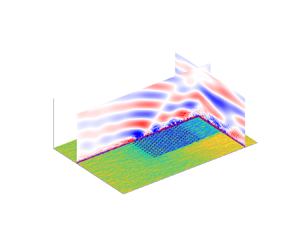
We present a suite of large-eddy simulations (LES) of a wind farm operating in conventionally neutral boundary layers. A fixed 1.6 GW wind farm is considered for 40 different atmospheric stratification conditions to investigate effects on wind-farm efficiency and blockage, as well as related gravity-wave excitation. A tuned Rayleigh damping layer and a wave-free fringe-region method are used to avoid spurious excitation of gravity waves, and a domain-size study is included to evaluate and minimize effects of artificial domain blockage. A fully neutral reference case is also considered, to distinguish between a case with hydrodynamic blockage only, and cases that include hydrostatic blockage induced by the air column above the boundary layer and the excitation of gravity waves therein. We discuss in detail the dependence of gravity-wave excitation, flow fields and wind-farm blockage on capping-inversion height, strength and free-atmosphere lapse rate. In all cases, an unfavourable pressure gradient is present in front of the farm, and a favourable pressure gradient in the farm, with hydrostatic contributions arising from gravity waves at least an order of magnitude larger than hydrodynamic effects. Using respectively non-local and wake efficiencies $\eta _{nl}$ and $\eta _{w}$, we observe a strong negative correlation between the unfavourable upstream pressure rise and $\eta _{nl}$, and a strong positive correlation between the favourable pressure drop in the farm and $\eta _{w}$. Using a simplified linear gravity-wave model, we formulate a simple scaling for the ratio $(1-\eta _{nl})/\eta _{w}$, which matches reasonably well with the LES results.


Analytical solution for laminar entrance flow in circular pipes
-
- Journal:
- Journal of Fluid Mechanics / Volume 979 / 25 January 2024
- Published online by Cambridge University Press:
- 25 January 2024, A51
-
- Article
- Export citation
-
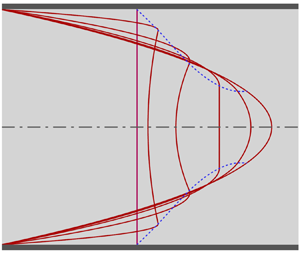
This study introduces an analytical solution for the laminar entrance flow in circular pipes, aiming to confirm the occurrence of velocity overshoot. Velocity overshoot is characterised by the maximum axial velocity appearing near the pipe wall instead of the central axis. Similar to the previous studies, the analytical solution is derived from the parabolised Navier–Stokes equation; however, the specific approach used in linearising the momentum equation has not been attempted before. The accuracy of this analytical solution has been verified through a comprehensive comparison with various published experimental data. The existence of velocity overshoot at a short distance from the inlet, which is evident in numerous numerical calculations based on the full Navier–Stokes equations and corroborated by recent magnetic resonance (MR) velocimetry experiments, is identified analytically for the first time. The parabolised Navier–Stokes equation has inherent self-similarity with respect to the Reynolds number, implying that $Re$ is incorporated into the dimensionless variables rather than serving as an independent flow parameter. According to both MR velocimetry measurements and the present analytical solution, the self-similarity is not valid immediately following the pipe inlet, and this becomes more evident as $Re$ decreases; hence, the analytical solution derived from the parabolised Navier–Stokes equation cannot accurately predict the evolution of the velocity profile within this region near the pipe inlet.


Plume flow characteristics of rectangular exhaust nozzles in a micro-jet engine
-
- Journal:
- The Aeronautical Journal / Volume 128 / Issue 1322 / April 2024
- Published online by Cambridge University Press:
- 24 January 2024, pp. 685-705
-
- Article
- Export citation
Smoothed particle hydrodynamics modelling of particle-size segregation in granular flows
-
- Journal:
- Journal of Fluid Mechanics / Volume 977 / 25 December 2023
- Published online by Cambridge University Press:
- 24 January 2024, A47
-
- Article
- Export citation
-
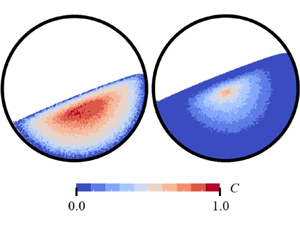
In this work, smoothed particle hydrodynamics (SPH) is employed to investigate the segregation evolution in granular flows. We first provide the Lagrangian description-based governing equations, including the linear momentum conservation and the segregation–diffusion equation. Then the hybrid continuum surface reaction scheme is introduced to formulate the concentration-related inhomogeneous Neumann boundary condition on the free and wall surfaces. We follow a two-stage strategy to advance boundary particle searching and normal direction identification. Moreover, $C^1$ consistency is considered based on the Taylor series to obtain accurate segregation flux gradient along the boundary. Our SPH model is validated with a shear box experiment. The model is then applied to investigate the segregation mechanism in bidisperse-sized granular flows in a rotating drum.

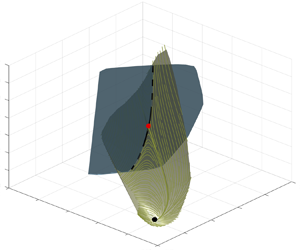
Capturing the edge of chaos as a spectral submanifold in pipe flows
- Part of
-
- Journal:
- Journal of Fluid Mechanics / Volume 979 / 25 January 2024
- Published online by Cambridge University Press:
- 24 January 2024, A48
-
- Article
-
- You have access
- Open access
- HTML
- Export citation

Rounded-corners-induced re-entrant non-occlusion in a horizontal tube
-
- Journal:
- Journal of Fluid Mechanics / Volume 979 / 25 January 2024
- Published online by Cambridge University Press:
- 24 January 2024, A49
-
- Article
- Export citation
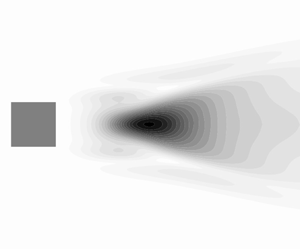
Momentum analysis of complex time-periodic flows
-
- Journal:
- Journal of Fluid Mechanics / Volume 979 / 25 January 2024
- Published online by Cambridge University Press:
- 24 January 2024, A50
-
- Article
-
- You have access
- Open access
- HTML
- Export citation
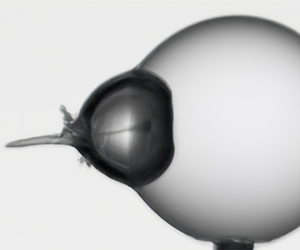
Cavitation bubble dynamics inside a droplet suspended in a different host fluid
-
- Journal:
- Journal of Fluid Mechanics / Volume 979 / 25 January 2024
- Published online by Cambridge University Press:
- 23 January 2024, A47
-
- Article
-
- You have access
- Open access
- HTML
- Export citation
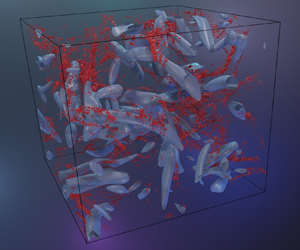
Viscosity-modulated clustering of heated bidispersed particles in a turbulent gas
-
- Journal:
- Journal of Fluid Mechanics / Volume 979 / 25 January 2024
- Published online by Cambridge University Press:
- 23 January 2024, A46
-
- Article
-
- You have access
- Open access
- HTML
- Export citation
miniSCIDOM: a scintillator-based tomograph for volumetric dose reconstruction of single laser-driven proton bunches
-
- Journal:
- High Power Laser Science and Engineering / Volume 12 / 2024
- Published online by Cambridge University Press:
- 23 January 2024, e17
-
- Article
-
- You have access
- Open access
- HTML
- Export citation
-
Laser plasma accelerators (LPAs) enable the generation of intense and short proton bunches on a micrometre scale, thus offering new experimental capabilities to research fields such as ultra-high dose rate radiobiology or material analysis. Being spectrally broadband, laser-accelerated proton bunches allow for tailored volumetric dose deposition in a sample via single bunches to excite or probe specific sample properties. The rising number of such experiments indicates a need for diagnostics providing spatially resolved characterization of dose distributions with volumes of approximately 1 cm ${}^3$ for single proton bunches to allow for fast online feedback. Here we present the scintillator-based miniSCIDOM detector for online single-bunch tomographic reconstruction of dose distributions in volumes of up to approximately 1 cm ${}^3$. The detector achieves a spatial resolution below 500 $\unicode{x3bc}$m and a sensitivity of 100 mGy. The detector performance is tested at a proton therapy cyclotron and an LPA proton source. The experiments’ primary focus is the characterization of the scintillator’s ionization quenching behaviour.


The importance of Righi–Leduc heat flux to the ablative Rayleigh–Taylor instability during a laser irradiating targets
-
- Journal:
- High Power Laser Science and Engineering / Volume 12 / 2024
- Published online by Cambridge University Press:
- 23 January 2024, e24
-
- Article
-
- You have access
- Open access
- HTML
- Export citation
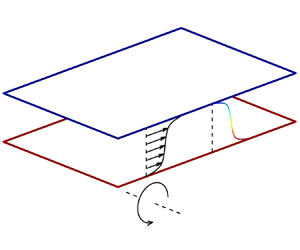
Twin forces: similarity between rotation and stratification effects on wall turbulence
-
- Journal:
- Journal of Fluid Mechanics / Volume 979 / 25 January 2024
- Published online by Cambridge University Press:
- 22 January 2024, A45
-
- Article
- Export citation
-
Can the similarity between rotation and stratification provide quantitative predictions for complex turbulence? In this work, we focus on plane Couette turbulence as the background flow, which allows us to eliminate the key differences between Rayleigh–Bénard and Taylor–Couette turbulence, and facilitates a quantitative mapping across many complex turbulent systems involving rotation, stratification and curvature effects. To characterize the separated or coupled effects of rotation and stratification, we introduce an overall Richardson number ${Ri}_\chi$ which is the sum of the Coriolis Richardson number $Ri_\theta$ and the buoyancy Richardson number $Ri_T$. When the Prandtl number $Pr=1$, the heat and inertial-frame momentum transport almost coincide and mainly depend on ${Ri}_\chi$ and the Reynolds number, regardless of the specific ratio between $Ri_\theta$ and $Ri_T$. When $Pr$ varies, the weighted average ${Nu}_\chi$ of the transport coefficients can still remain approximately invariant in most cases. Furthermore, the large-scale structures in purely rotating and purely stratified cases exhibit strikingly similar features. These findings not only indicate a more reasonable analogy for the ultimate Taylor–Couette turbulence but also pave the way for developing new predictive models for natural and industrial processes.


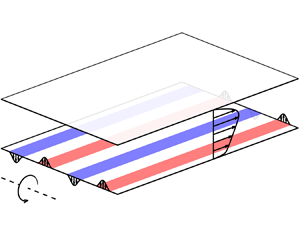
Enhancing large-scale motions and turbulent transport in rotating plane Poiseuille flow
-
- Journal:
- Journal of Fluid Mechanics / Volume 979 / 25 January 2024
- Published online by Cambridge University Press:
- 22 January 2024, A43
-
- Article
- Export citation
-
Based on the characteristics of large-scale plume currents in rotating plane Poiseuille flows (RPPF), an injection/suction control strategy is introduced to augment the intensity of plume currents and improve the turbulent transport of passive scalar. The control strategy maintains the conventional non-penetrative condition on the stable side, and applies a wall-normal velocity that varies in the spanwise direction on the unstable side. For comparison, the control with non-penetrative condition on the unstable side and injection/suction on the stable side is also examined. The RPPF at $Re_\tau$ ranging from $180$ to $300$ and $Ro_\tau$ ranging from $0$ to $30$ are studied. Injection/suction with fixed root-mean-squared wall-normal velocity (below $1\,\%$ of the bulk mean velocity) at the wall is considered. Direct numerical simulations reveal that the injection/suction on the stable side has minor effect for all cases studied, whereas the injection/suction with properly distributed slots on the unstable side can significantly enhance the large-scale plume currents and the turbulent transport efficiency at small or moderate rotation numbers. This is attributed to the fact that plumes are generated on the unstable side, and controlling the origin of plumes is more effective. A proper strategy for maximum enhancement of turbulent transport is limiting the distance between injection slots equal to or slightly larger than the intrinsic distance between plume currents. This strategy is valid for all physical and computational parameters currently considered, and is potentially applicable over a much wider parameter range.


Modal analysis and higher order mode suppression of a high impedance surface-based bowtie antenna
-
- Journal:
- International Journal of Microwave and Wireless Technologies / Volume 16 / Issue 6 / July 2024
- Published online by Cambridge University Press:
- 22 January 2024, pp. 1043-1055
-
- Article
- Export citation

Assessment of coupled bilayer–cytoskeleton modelling strategy for red blood cell dynamics in flow
-
- Journal:
- Journal of Fluid Mechanics / Volume 979 / 25 January 2024
- Published online by Cambridge University Press:
- 22 January 2024, A44
-
- Article
- Export citation

The Economics of Fund Management
-
- Published by:
- Agenda Publishing
- Published online:
- 20 January 2024
- Print publication:
- 13 October 2022

Supercharge Me
- Net Zero Faster
-
- Published by:
- Agenda Publishing
- Published online:
- 20 January 2024
- Print publication:
- 24 February 2022

Beyond Climate Fixes
- From Public Controversy to System Change
-
- Published by:
- Bristol University Press
- Published online:
- 20 January 2024
- Print publication:
- 09 May 2023
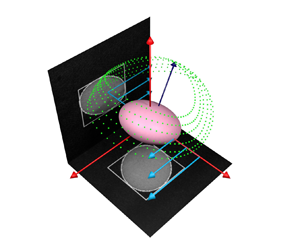
Influence of small inertia on Jeffery orbits
- Part of
-
- Journal:
- Journal of Fluid Mechanics / Volume 979 / 25 January 2024
- Published online by Cambridge University Press:
- 19 January 2024, A42
-
- Article
- Export citation
