Refine search
Actions for selected content:
212971 results in Engineering
MRF volume 15 issue 8 Cover and Front matter
-
- Journal:
- International Journal of Microwave and Wireless Technologies / Volume 15 / Issue 8 / October 2023
- Published online by Cambridge University Press:
- 09 November 2023, pp. f1-f2
-
- Article
-
- You have access
- Export citation
Evaluation of global sensitivity analysis methods for computational structural mechanics problems
-
- Journal:
- Data-Centric Engineering / Volume 4 / 2023
- Published online by Cambridge University Press:
- 09 November 2023, e28
-
- Article
-
- You have access
- Open access
- HTML
- Export citation
MRF volume 15 issue 8 Cover and Back matter
-
- Journal:
- International Journal of Microwave and Wireless Technologies / Volume 15 / Issue 8 / October 2023
- Published online by Cambridge University Press:
- 09 November 2023, p. b1
-
- Article
-
- You have access
- Export citation
EuCAP 2022 special issue
-
- Journal:
- International Journal of Microwave and Wireless Technologies / Volume 15 / Issue 8 / October 2023
- Published online by Cambridge University Press:
- 09 November 2023, pp. 1271-1272
-
- Article
-
- You have access
- HTML
- Export citation
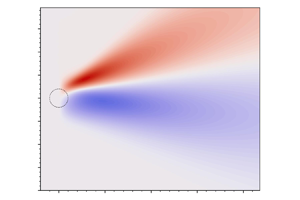
Scattering of swell by currents
- Part of
-
- Journal:
- Journal of Fluid Mechanics / Volume 975 / 25 November 2023
- Published online by Cambridge University Press:
- 09 November 2023, A1
-
- Article
-
- You have access
- Open access
- HTML
- Export citation
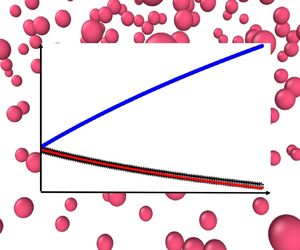
A constitutive relation generalizing the Navier–Stokes theory to high-rate regimes
-
- Journal:
- Journal of Fluid Mechanics / Volume 974 / 10 November 2023
- Published online by Cambridge University Press:
- 09 November 2023, A30
-
- Article
-
- You have access
- Open access
- HTML
- Export citation
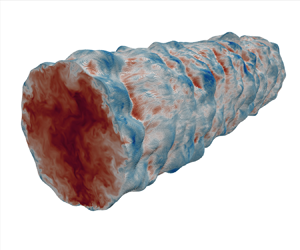
Direct numerical simulation of turbulent flow in pipes with realistic large roughness at the wall
- Part of
-
- Journal:
- Journal of Fluid Mechanics / Volume 974 / 10 November 2023
- Published online by Cambridge University Press:
- 09 November 2023, A40
-
- Article
-
- You have access
- Open access
- HTML
- Export citation
Analysis of modern fan manufacturing variations and their links to Jet-engine performance
- Part of
-
- Journal:
- The Aeronautical Journal / Volume 128 / Issue 1320 / February 2024
- Published online by Cambridge University Press:
- 09 November 2023, pp. 273-291
-
- Article
- Export citation

Decomposition of the drag force in steady and oscillatory flow through a hexagonal sphere pack
-
- Journal:
- Journal of Fluid Mechanics / Volume 974 / 10 November 2023
- Published online by Cambridge University Press:
- 09 November 2023, A32
-
- Article
-
- You have access
- Open access
- HTML
- Export citation
-
We investigate steady and oscillatory flow through a hexagonal close-packed arrangement of spheres in the framework of the volume-averaged momentum equation. We quantify the friction and pressure drag based on a direct numerical simulation dataset. Using the pressure decomposition of Graham (J. Fluid Mech., vol. 881, 2019), the pressure drag can be further split up into an accelerative, a viscous and a convective contribution. For the accelerative pressure, a closed-form expression can be given in terms of the potential flow solution. We investigate the contributions of the different drag components to the volume-averaged momentum budget and their Reynolds number scaling. For steady flow, we find that the friction and viscous pressure drag are proportional to $Re$ at low Reynolds numbers and scale with $Re^{1.4}$ for high Reynolds numbers. This is close to the steady laminar boundary layer scaling. For the convective pressure drag, we find a cubic scaling at low and a quadratic scaling at high Reynolds numbers. The Reynolds stresses have a minor contribution to the momentum budget. For oscillatory flow at low and medium Womersley numbers, the amplitudes of the drag components are similar to the steady cases at the same Reynolds number. At high Womersley numbers, the drag components behave quite differently and the friction and viscous pressure drag are relatively insignificant. The drag components are not in phase with the forcing and the superficial velocity; the phase lag increases with the Womersley number. This suggests that new models beyond the current quasisteady approaches need to be developed.


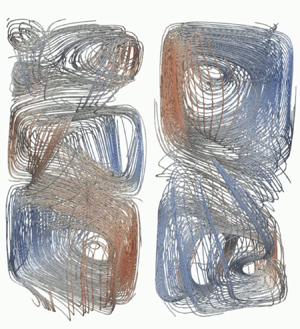
Three-dimensional flow structures in turbulent Rayleigh–Bénard convection at low Prandtl number Pr = 0.03
-
- Journal:
- Journal of Fluid Mechanics / Volume 974 / 10 November 2023
- Published online by Cambridge University Press:
- 09 November 2023, A48
-
- Article
-
- You have access
- Open access
- HTML
- Export citation
-
In this paper we report on an experimental study focusing on the manifestation and dynamics of the large-scale circulation (LSC) in turbulent liquid metal convection. The experiments are performed inside a cylinder of aspect ratio $\varGamma = 0.5$ filled with the ternary alloy GaInSn, which has a Prandtl number of $Pr = 0.03$. The large-scale flow structures are classified and characterized at Rayleigh numbers of ${Ra} = 9.33 \times 10^6, 5.31 \times 10^7$ and $6.02 \times 10^8$ by means of the contactless inductive flow tomography which enables the full reconstruction of the three-dimensional (3-D) flow structures in the entire convection cell. This is complemented with the multi-thermal-probe method for capturing the azimuthal temperature variation induced by the LSC at the sidewall. We use proper orthogonal decomposition (POD) to identify the dominating modes of the turbulent convection. The analysis reveals that a single-roll structure of the LSC alternates in short succession with double-roll structures or a three-roll structure. This is accompanied by dramatic fluctuations of the Reynolds number, whose instantaneous values can deviate by more than 50 % from the time-average value. No coherent oscillations are observed, whereas a correlation analysis indicates a residual contribution of the torsion and sloshing modes. Results of the POD analysis suggest a stabilization of the single-roll LSC with increasing $Ra$ at the expense of flow structures with multiple rolls. Moreover, the relative lifetime of all identified flow states, measured in units of free-fall times, increases with rising $Ra$.
$Ra$.


The Australian International Aerospace Congress AIAC 19/20
- Part of
-
- Journal:
- The Aeronautical Journal / Volume 127 / Issue 1318 / December 2023
- Published online by Cambridge University Press:
- 09 November 2023, p. 2067
-
- Article
-
- You have access
- HTML
- Export citation

One-dimensional mechanism of gaseous deflagration-to-detonation transition
-
- Journal:
- Journal of Fluid Mechanics / Volume 974 / 10 November 2023
- Published online by Cambridge University Press:
- 08 November 2023, A46
-
- Article
- Export citation
Large-scale streaks in a turbulent bluff body wake
-
- Journal:
- Journal of Fluid Mechanics / Volume 974 / 10 November 2023
- Published online by Cambridge University Press:
- 08 November 2023, A47
-
- Article
-
- You have access
- Open access
- HTML
- Export citation
-
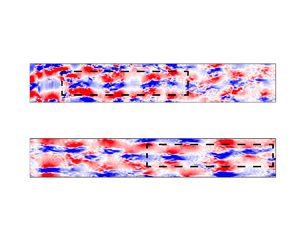
A turbulent circular disk wake database (Chongsiripinyo & Sarkar, J. Fluid Mech., vol. 885, 2020) at Reynolds number $Re = U_\infty D/\nu = 5 \times 10^{4}$ is interrogated to identify the presence of large-scale streaks – coherent elongated regions of streamwise velocity. The unprecedented streamwise length – until $x/D \approx 120$ – of the simulation enables investigation of the near and far wakes. The near wake is dominated by the vortex shedding (VS) mode residing at azimuthal wavenumber $m=1$ and Strouhal number $St = 0.135$. After filtering out the VS structure, conclusive evidence of large-scale streaks with frequency $St \rightarrow 0$, equivalently streamwise wavenumber $k_x \rightarrow 0$ in the wake, becomes apparent in visualizations and spectra. These streaky structures are found throughout the simulation domain beyond $x/D \approx 10$. Conditionally averaged streamwise vorticity fields reveal that the lift-up mechanism is active in the near as well as the far wake, and that ejections contribute more than sweeps to events of intense $-u'_xu'_r$. Spectral proper orthogonal decomposition is employed to extract the energy and the spatiotemporal features of the large-scale streaks. The streak energy is concentrated in the $m=2$ azimuthal mode over the entire domain. Finally, bispectral mode decomposition is conducted to reveal strong interaction between $m=1$ and $St = \pm 0.135$ modes to give the $m=2$, $St \rightarrow 0$ streak mode. Our results indicate that the self-interaction of the VS mode generates the $m=2$, $St \rightarrow 0$ streamwise vortices, which leads to streak formation through the lift-up process. To the authors’ knowledge, this is the first study that reports and characterizes large-scale low-frequency streaks and the associated lift-up mechanism in a turbulent wake.


Frequency reconfigurable two-element MIMO antenna for cognitive radio and 5G new radio sub-6 GHz applications
-
- Journal:
- International Journal of Microwave and Wireless Technologies / Volume 16 / Issue 2 / March 2024
- Published online by Cambridge University Press:
- 08 November 2023, pp. 295-305
-
- Article
- Export citation

Interaction and breakdown induced by multiple optimal disturbances in hypersonic boundary layer
-
- Journal:
- Journal of Fluid Mechanics / Volume 974 / 10 November 2023
- Published online by Cambridge University Press:
- 07 November 2023, A50
-
- Article
-
- You have access
- Open access
- HTML
- Export citation
-
The present paper finds that the coexistence of multiple primary instability waves may cause a non-trivial nonlinear interaction and breakdown process, which has not been reported before. In the considered Mach 6 flat-plate boundary layer, a global resolvent analysis reports three optimal disturbances (local maxima): a high-frequency planar wave, a low-frequency oblique wave and a stationary streak. For the dominant planar and oblique waves, a parabolised stability equation analysis identifies the initial non-modal transient growth and downstream modal growth. Initiated by these two optimal disturbances jointly, the complete linear and nonlinear instability processes until breakdown to turbulence are shown with direct numerical simulation. Owing to the transient growth, the oblique wave may be more significant than the planar wave in the breakdown. The oblique wave and scales of nonlinear interactions are pronounced in the outer layer, whose significance may not be comprehensively characterised by the wall pressure measurement. Fourier modes characterising the oblique-wave oblique breakdown, the planar-wave fundamental resonance, the planar-wave subharmonic resonance and the combination resonance related to a detuned mode are observed successively. The detuned mode seems to dominate the near-wall dynamics in the late nonlinear stage, characterised by $\varLambda$-like structures. Meanwhile, the existence of this detuned mode is independent of the initial amplitude ratio and the absolute amplitude of the oblique and planar waves. Weakly nonlinear stability analyses demonstrate that the detuned mode is mainly a consequence of the secondary instability under the combination of planar and oblique primary waves. Wave vector plots reveal the resonant state of multiple triads. Energy budget and amplitude-correction analyses provide a clear physical image of energy transfer.

Wall cooling effect on spectra and structures of thermodynamic variables in hypersonic turbulent boundary layers
-
- Journal:
- Journal of Fluid Mechanics / Volume 974 / 10 November 2023
- Published online by Cambridge University Press:
- 07 November 2023, A55
-
- Article
- Export citation
Enhancement of off-body communications with a low-SAR, high-gain multiband patch antenna designed with a quad-band artificial magnetic conductor
-
- Journal:
- International Journal of Microwave and Wireless Technologies / Volume 16 / Issue 2 / March 2024
- Published online by Cambridge University Press:
- 07 November 2023, pp. 318-338
-
- Article
- Export citation
Direct numerical simulation of a zero-pressure-gradient turbulent boundary layer with passive scalars up to Prandtl number Pr = 6
-
- Journal:
- Journal of Fluid Mechanics / Volume 974 / 10 November 2023
- Published online by Cambridge University Press:
- 07 November 2023, A49
-
- Article
-
- You have access
- Open access
- HTML
- Export citation
-
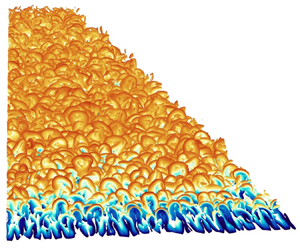
The objective of the present study is to provide a numerical database of thermal boundary layers and to contribute to the understanding of the dynamics of passive scalars at different Prandtl numbers. In this regard, a direct numerical simulation (DNS) of an incompressible zero-pressure-gradient turbulent boundary layer is performed with the Reynolds number based on momentum thickness ${\textit {Re}}_{\theta }$ ranging up to $1080$. Four passive scalars, characterized by the Prandtl numbers ${\textit {Pr}} = 1,2,4,6$ are simulated using the pseudo-spectral code SIMSON (Chevalier et al., SIMSON : a pseudo-spectral solver for incompressible boundary layer flows. Tech. Rep. TRITA-MEK 2007:07. KTH Mechanics, Stockholm, Sweden, 2007). To the best of our knowledge, the present DNS provides the thermal boundary layer with the highest Prandtl number available in the literature. It corresponds to that of water at ${\sim }24\,^{\circ }{\rm C}$, when the fluid temperature is considered as a passive scalar. Turbulence statistics for the flow and thermal fields are computed and compared with available numerical simulations at similar Reynolds numbers. The mean flow and scalar profiles, root-mean-squared velocity and scalar fluctuations, turbulent heat flux, turbulent Prandtl number and higher-order statistics agree well with the numerical data reported in the literature. Furthermore, the pre-multiplied two-dimensional spectra of the velocity and of the passive scalars are computed, providing a quantitative description of the energy distribution at the different length scales for various wall-normal locations. The energy distribution of the heat-flux fields at the wall is concentrated on longer temporal structures with increasing Prandtl number. This is due to the thinner thermal boundary layer as thermal diffusivity decreases and, thereby, the longer temporal structures exhibit a different footprint at the wall.


Self-propulsion of an elliptical phoretic disk emitting solute uniformly
-
- Journal:
- Journal of Fluid Mechanics / Volume 974 / 10 November 2023
- Published online by Cambridge University Press:
- 07 November 2023, A57
-
- Article
-
- You have access
- Open access
- HTML
- Export citation
-
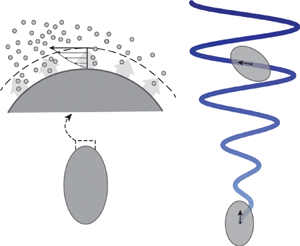
Self-propulsion of chemically active droplets and phoretic disks has been studied widely; however, most research overlooks the influence of disk shape on swimming dynamics. Inspired by experimentally observed prolate composite droplets and elliptical camphor disks, we employ simulations to investigate the phoretic dynamics of an elliptical disk that emits solutes uniformly in the creeping flow regime. By varying the disk's eccentricity $e$ and the Péclet number $Pe$, we distinguish five disk behaviours: stationary, steady, orbiting, periodic and chaotic. We perform a linear stability analysis (LSA) to predict the onset of instability and the most unstable eigenmode when a stationary disk transitions spontaneously to steady self-propulsion. In addition to the LSA, we use an alternative approach to determine the perturbation growth rate, illustrating the competing roles of advection and diffusion. The steady motion features a transition from a puller-type to a neutral-type swimmer as $Pe$ increases, which occurs as a bimodal concentration profile at the disk surface shifts to a polarized solute distribution, driven by convective solute transport. An elliptical disk achieves an orbiting motion through a chiral symmetry-breaking instability, wherein it repeatedly follows a circular path while simultaneously rotating. The periodic swinging motion, emerging from a steady motion via a supercritical Hopf bifurcation, is characterized by a wave-like trajectory. We uncover a transition from normal diffusion to superdiffusion as eccentricity $e$ increases, corresponding to a random-walking circular disk and a ballistically swimming elliptical counterpart, respectively.


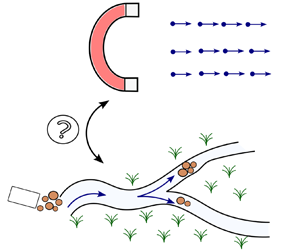
Viewing second-order phase transitions as a metaphor for river bifurcations
-
- Journal:
- Journal of Fluid Mechanics / Volume 974 / 10 November 2023
- Published online by Cambridge University Press:
- 07 November 2023, A53
-
- Article
-
- You have access
- Open access
- HTML
- Export citation
