Refine search
Actions for selected content:
212971 results in Engineering
8 - Ion Implantation
-
- Book:
- Integrated Circuit Fabrication
- Published online:
- 01 December 2023
- Print publication:
- 16 November 2023, pp 380-447
-
- Chapter
- Export citation
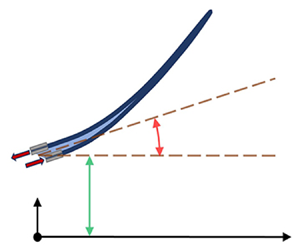
Effects of antagonistic muscle actuation on the bilaminar structure of ray-finned fish in propulsion
-
- Journal:
- Journal of Fluid Mechanics / Volume 975 / 25 November 2023
- Published online by Cambridge University Press:
- 16 November 2023, A23
-
- Article
- Export citation

Forced oscillations of a cylinder in the flow of viscoelastic fluids
-
- Journal:
- Journal of Fluid Mechanics / Volume 975 / 25 November 2023
- Published online by Cambridge University Press:
- 16 November 2023, A28
-
- Article
- Export citation
-
We investigate the effects of fluid elasticity on the flow forces and the wake structure when a rigid cylinder is placed in a viscoelastic flow and is forced to oscillate sinusoidally in the transverse direction. We consider a two-dimensional, uniform, incompressible flow of viscoelastic fluid at $Re=100$, and use the FENE-P model to represent the viscoelastic fluid. We study how the flow forces and the wake patterns change as the amplitude of oscillations, $A^*$, the frequency of oscillations (inversely proportional to a reduced velocity, $U^*$), the Weissenberg number, $Wi$, the square of maximum polymer extensibility, $L^2$, and the viscosity ratio, $\beta$, change individually. We calculate the lift coefficient in phase with cylinder velocity to determine the range of different system parameters where self-excited oscillations might occur if the cylinder is allowed to oscillate freely. We also study the effect of fluid elasticity on the added mass coefficient as these parameters change. The maximum elastic stress of the fluid occurs in between the vortices that are observed in the wake. We observe a new mode of shedding in the wake of the cylinder: in addition to the primary vortices that are also observed in the Newtonian flows, secondary vortices that are caused entirely by the viscoelasticity of the fluid are observed in between the primary vortices. We also show that, for a constant $Wi$, the strength of the polymeric stresses increases with increasing reduced velocity or with decreasing amplitude of oscillations.


3 - Economic Incentive
- from Part I - Cryptoeconomics Basics
-
- Book:
- Cryptoeconomics
- Published online:
- 06 January 2024
- Print publication:
- 16 November 2023, pp 39-50
-
- Chapter
- Export citation
4 - Semiconductor Manufacturing: Cleanrooms, Wafer Cleaning, Gettering and Chip Yield
-
- Book:
- Integrated Circuit Fabrication
- Published online:
- 01 December 2023
- Print publication:
- 16 November 2023, pp 111-158
-
- Chapter
- Export citation
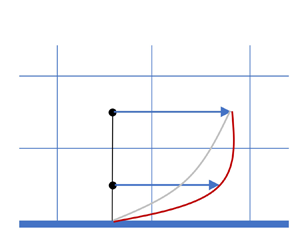
A POD-mode-augmented wall model and its applications to flows at non-equilibrium conditions
-
- Journal:
- Journal of Fluid Mechanics / Volume 975 / 25 November 2023
- Published online by Cambridge University Press:
- 16 November 2023, A24
-
- Article
- Export citation
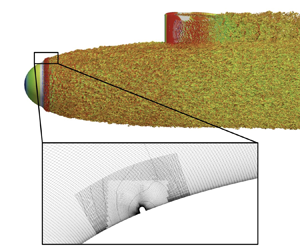
Tripping effects on model-scale studies of flow over the DARPA SUBOFF
-
- Journal:
- Journal of Fluid Mechanics / Volume 975 / 25 November 2023
- Published online by Cambridge University Press:
- 15 November 2023, A3
-
- Article
-
- You have access
- Open access
- HTML
- Export citation
Detailed characterization of kHz-rate laser-driven fusion at a thin liquid sheet with a neutron detection suite
- Part of
-
- Journal:
- High Power Laser Science and Engineering / Volume 12 / 2024
- Published online by Cambridge University Press:
- 15 November 2023, e2
-
- Article
-
- You have access
- Open access
- HTML
- Export citation
-
We present detailed characterization of laser-driven fusion and neutron production ( $\sim {10}^5$/second) using 8 mJ, 40 fs laser pulses on a thin (<1 μm) D ${}_2$O liquid sheet employing a measurement suite. At relativistic intensity ( $\sim 5\times {10}^{18}$ W/cm ${}^2$) and high repetition rate (1 kHz), the system produces deuterium–deuterium (D-D) fusion, allowing for consistent neutron generation. Evidence of D-D fusion neutron production is verified by a measurement suite with three independent detection systems: an EJ-309 organic scintillator with pulse-shape discrimination, a ${}^3\mathrm{He}$ proportional counter and a set of 36 bubble detectors. Time-of-flight analysis of the scintillator data shows the energy of the produced neutrons to be consistent with 2.45 MeV. Particle-in-cell simulations using the WarpX code support significant neutron production from D-D fusion events in the laser–target interaction region. This high-repetition-rate laser-driven neutron source could provide a low-cost, on-demand test bed for radiation hardening and imaging applications.


Revisiting the role of friction coefficients in granular collapses: confrontation of 3-D non-smooth simulations with experiments
-
- Journal:
- Journal of Fluid Mechanics / Volume 975 / 25 November 2023
- Published online by Cambridge University Press:
- 15 November 2023, A14
-
- Article
-
- You have access
- Open access
- HTML
- Export citation
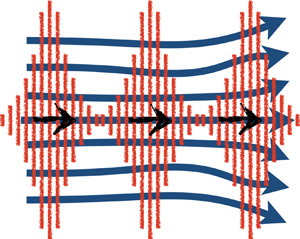
Theory of acoustic streaming for arbitrary Reynolds number flow
-
- Journal:
- Journal of Fluid Mechanics / Volume 975 / 25 November 2023
- Published online by Cambridge University Press:
- 15 November 2023, A4
-
- Article
-
- You have access
- Open access
- HTML
- Export citation
-
We study a fifty-year-old problem of fast acoustic streaming, that is, the generation of moderate or large hydrodynamic Reynolds number ( $\textit {Re}$) acoustic streaming (or steady flow) by the convection of momentum in an acoustic wave (or another periodic flow), while the latter is simultaneously altered by the former. The intrinsic disparity of length and time scales makes a brute-force solution of the full Navier–Stokes and continuity equations a formidable problem. Circumventing this difficulty, we split the problem into a time-averaged system of equations for the steady flow component and a dynamic system of equations for its quasi-periodic flow counterpart. The latter system of equations is obtained by subtracting the time-averaged Navier–Stokes equation from its original dynamic form, and is rendered a nonlinear wave equation using the continuity equation and an adiabatic connection between density and pressure. The resulting equations are compatible with the theory by Eckart for small $\textit {Re}$ flow, and capture large- $\textit {Re}$ effects. Scaling analysis and a case study show that acoustic streaming is weak and does not contribute to the acoustic wave close to the wave source, relevant to many microfluidic systems. At small $\textit {Re}$, the streaming magnitude is proportional to an inverse Strouhal number, a small quantity in experiments. Moderate and large $\textit {Re}$ render the streaming magnitude comparable to the pre-attenuating periodic flow (or particle velocity of the wave) at approximately a wave attenuation length away from the wave source or further; the wave is altered by the streaming that it generates, and the streaming dominates the flow far from the wave source.


Active frequency selective surfaces: a systematic review for sub-6 GHz band
-
- Journal:
- International Journal of Microwave and Wireless Technologies / Volume 16 / Issue 4 / May 2024
- Published online by Cambridge University Press:
- 15 November 2023, pp. 544-558
-
- Article
- Export citation
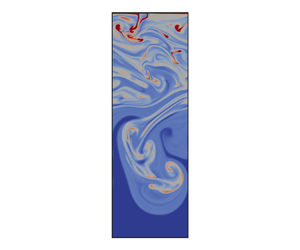
Interacting density fronts in saturated brines cooled from above
-
- Journal:
- Journal of Fluid Mechanics / Volume 975 / 25 November 2023
- Published online by Cambridge University Press:
- 15 November 2023, A5
-
- Article
-
- You have access
- Open access
- HTML
- Export citation
Design, performance and application of a line-imaging velocity interferometer system for any reflector coupled with a streaked optical pyrometer system at the Shenguang-II upgrade laser facility
-
- Journal:
- High Power Laser Science and Engineering / Volume 12 / 2024
- Published online by Cambridge University Press:
- 15 November 2023, e6
-
- Article
-
- You have access
- Open access
- HTML
- Export citation
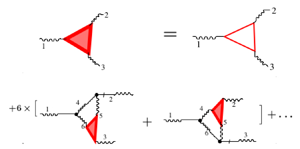
Energy flux and high-order statistics of hydrodynamic turbulence
-
- Journal:
- Journal of Fluid Mechanics / Volume 975 / 25 November 2023
- Published online by Cambridge University Press:
- 15 November 2023, A17
-
- Article
- Export citation
-
We use the Dyson–Wyld diagrammatic technique to analyse the infinite series for the correlation functions of the velocity in hydrodynamic turbulence. We demonstrate the fundamental role played by the triple correlator of the velocity in determining the entire statistics of the hydrodynamic turbulence. All higher-order correlation functions are expressed through the triple correlator. This is shown through the suggested triangular re-summation of the infinite diagrammatic series for multi-point correlation functions. The triangular re-summation is the next logical step after the Dyson–Wyld line re-summation for the Green's function and the double correlator. In particular, it allows us to explain why the inverse cascade of the two-dimensional hydrodynamic turbulence is close to Gaussian. Since the triple correlator dictates the flux of energy $\varepsilon$ through the scales, we support the Kolmogorov-1941 idea that $\varepsilon$ is one of the main characteristics of hydrodynamic turbulence.


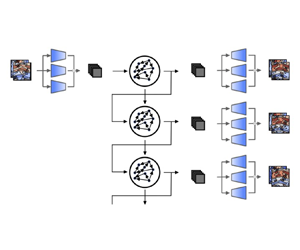
Predicting turbulent dynamics with the convolutional autoencoder echo state network
-
- Journal:
- Journal of Fluid Mechanics / Volume 975 / 25 November 2023
- Published online by Cambridge University Press:
- 15 November 2023, A2
-
- Article
-
- You have access
- Open access
- HTML
- Export citation
-
The dynamics of turbulent flows is chaotic and difficult to predict. This makes the design of accurate reduced-order models challenging. The overarching objective of this paper is to propose a nonlinear decomposition of the turbulent state to predict the flow based on a reduced-order representation of the dynamics. We divide the turbulent flow into a spatial problem and a temporal problem. First, we compute the latent space, which is the manifold onto which the turbulent dynamics live. The latent space is found by a series of nonlinear filtering operations, which are performed by a convolutional autoencoder (CAE). The CAE provides the decomposition in space. Second, we predict the time evolution of the turbulent state in the latent space, which is performed by an echo state network (ESN). The ESN provides the evolution in time. Third, by combining the CAE and the ESN, we obtain an autonomous dynamical system: the CAE-ESN. This is the reduced-order model of the turbulent flow. We test the CAE-ESN on the two-dimensional Kolmogorov flow and the three-dimensional minimal flow unit. We show that the CAE-ESN: (i) finds a latent-space representation of the turbulent flow that has ${\lesssim }1\,\%$ of the degrees of freedom than the physical space; (ii) time-accurately and statistically predicts the flow at different Reynolds numbers; and (iii) takes ${\lesssim }1\,\%$ computational time to predict the flow with respect to solving the governing equations. This work opens possibilities for nonlinear decomposition and reduced-order modelling of turbulent flows from data.


Dispersion effects in porous medium gravity currents experiencing local drainage
-
- Journal:
- Journal of Fluid Mechanics / Volume 975 / 25 November 2023
- Published online by Cambridge University Press:
- 14 November 2023, A18
-
- Article
-
- You have access
- Open access
- HTML
- Export citation
-
We develop a theoretical model to study (dense) two-dimensional gravity current flow in a laterally extensive porous medium experiencing leakage through a discrete fissure situated along this boundary at some finite distance from the injection point. Our model, which derives from the depth-averaged mass and buoyancy equations in conjunction with Darcy's law, considers dispersive mixing between the gravity current and the surrounding ambient by allowing two different gravity current phases. Thus do we define a bulk phase consisting of fluid whose density is close to that of the source fluid and a dispersed phase consisting of fluid whose density is close to that of the ambient. We characterize the degree of dispersion by estimating, as a function of time, the buoyancy of the dispersed phase and the separation distance between the bulk nose and the dispersed nose. On this basis, it can be shown that the amount of dispersion depends on the flow conditions upstream of the fissure, the fissure permeability and the vertical and horizontal extents of the fissure. We also show that dispersion is larger when the gravity current propagates along an inclined barrier rather than along a horizontal barrier. Model predictions are fitted against numerical simulations. The simulations in question are performed using COMSOL and consider different inclination angles and fissure and upstream flow conditions. Our study is motivated by processes related to underground $\mathrm {H}_2$ storage e.g. an irrecoverable loss of $\mathrm {H}_2$ when it is injected into the cushion gas saturating an otherwise depleted natural gas reservoir.


Dedication
-
- Book:
- Neurocomputational Poetics
- Published by:
- Anthem Press
- Published online:
- 01 March 2024
- Print publication:
- 14 November 2023, pp ix-x
-
- Chapter
- Export citation
4 - Reader and Reading Act Analysis
-
- Book:
- Neurocomputational Poetics
- Published by:
- Anthem Press
- Published online:
- 01 March 2024
- Print publication:
- 14 November 2023, pp 87-112
-
- Chapter
- Export citation
Frontmatter
-
- Book:
- Neurocomputational Poetics
- Published by:
- Anthem Press
- Published online:
- 01 March 2024
- Print publication:
- 14 November 2023, pp i-iv
-
- Chapter
- Export citation
5 - Computational Poetics I: Simple Applications
-
- Book:
- Neurocomputational Poetics
- Published by:
- Anthem Press
- Published online:
- 01 March 2024
- Print publication:
- 14 November 2023, pp 113-140
-
- Chapter
- Export citation
