Refine search
Actions for selected content:
212971 results in Engineering
Calendar of Short Courses and Workshops
-
- Journal:
- Powder Diffraction / Volume 38 / Issue 3 / September 2023
- Published online by Cambridge University Press:
- 13 November 2023, p. 232
-
- Article
-
- You have access
- HTML
- Export citation
On the settling of aligned spherical particles in various quiescent media
-
- Journal:
- Journal of Fluid Mechanics / Volume 975 / 25 November 2023
- Published online by Cambridge University Press:
- 13 November 2023, R1
-
- Article
-
- You have access
- Open access
- HTML
- Export citation
-
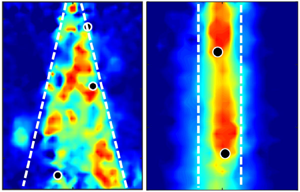
We investigated experimentally the settling behaviour of vertically aligned spherical particles within various quiescent media at different release frequencies. The particles had a diameter of $d = 4$ mm and density of $\rho _s = 2200$ kg m $^{-3}$, and were released near the free surface of water, ethanol, a G60 water–glycerine mixture (60 % glycerine by weight) and oil media at frequencies of $f_P = 4$, 6 and 8 Hz, thereby allowing study of Galileo numbers, $Ga \in [16, 976]$. Particle tracking velocimetry quantified the motion of nearly 800 particles in a 600 mm high tank, and particle image velocimetry examined flow patterns around the particles. Results revealed that the centre of mass of the particle trajectories exhibited preferential in-plane motions, with significant lateral dispersion and large $Ga$ in water and ethanol, and nearly vertical paths with low $Ga$ in the G60 mixture and oil media. Varying degrees of particle separation resulted in higher terminal velocities than for a single particle. Hence, particle drag decreased in all cases, with the oil medium showing the highest drag reduction under the closest particle separation, reaching up to nearly 70 % of that for the single particle. The vertical and lateral pair dispersions, $R^2_z$ and $R^2_L$, exhibited ballistic scaling, with dependences on the initial separation, $r_0$, and the type of medium. With large $Ga$,
$Ga$,  $R^2_z$ displayed a ballistic regime followed by a slower rate, whereas with small $Ga$,
$Ga$,  $R^2_z$ maintained a consistent ballistic regime throughout settling. Finally, normalized $R^2_z$ demonstrated distinct scaling (exponent 2/3 and 1) dependent on the normalized initial separation and $Ga$.
$Ga$.


Crystal structure of calcium L-5-methyltetrahydrofolate trihydrate type I, C20H23N7O6Ca(H2O)3
-
- Journal:
- Powder Diffraction / Volume 38 / Issue 3 / September 2023
- Published online by Cambridge University Press:
- 13 November 2023, pp. 207-214
-
- Article
-
- You have access
- Open access
- HTML
- Export citation
VistoSeg: Processing utilities for high-resolution images for spatially resolved transcriptomics data
-
- Journal:
- Biological Imaging / Volume 3 / 2023
- Published online by Cambridge University Press:
- 13 November 2023, e23
-
- Article
-
- You have access
- Open access
- HTML
- Export citation
A spatial statistical framework for the parametric study of fiber networks: Application to fibronectin deposition by normal and activated fibroblasts
-
- Journal:
- Biological Imaging / Volume 3 / 2023
- Published online by Cambridge University Press:
- 13 November 2023, e25
-
- Article
-
- You have access
- Open access
- HTML
- Export citation

Self-excited vortex-acoustic lock-in in a bluff body combustor
-
- Journal:
- Journal of Fluid Mechanics / Volume 975 / 25 November 2023
- Published online by Cambridge University Press:
- 13 November 2023, A16
-
- Article
- Export citation
-
We investigate self-excited vortex-acoustic lock-in in a bluff body combustor. The bluff body not only anchors the flame but also sheds vortices. Mutual interaction between vortex shedding and the combustor acoustic field leads to lock-in. A lower-order model for vortex shedding is coupled to the acoustic equations to obtain a set of discrete dynamical maps, which are then solved numerically. Lock-in is identified when a definite phase relationship between vortex shedding and acoustic field remains unaltered with time. The common frequency during (phase) lock-in is either close to the natural acoustic or vortex shedding frequencies, accordingly termed A- or V-lock-in, respectively. Instability and amplitude suppression occur with most parts of the A- and V-lock-in regions, respectively. Furthermore, we relate the lock-in and pre-lock-in regimes observed in our previous experiments (Singh & Mariappan, Combust. Sci. Technol., 2019, pp. 1–29) to A- and V-lock-in phenomena, respectively. Among the two lock-in phenomena, combustion instability is favoured by $1:1$ A-lock-in, whose boundaries in the parameter space can be obtained from a forced response of the vortex shedding process. Finally, we discuss the bifurcations leading to lock-in.

A generative model to simulate spatiotemporal dynamics of biomolecules in cells
-
- Journal:
- Biological Imaging / Volume 3 / 2023
- Published online by Cambridge University Press:
- 13 November 2023, e22
-
- Article
-
- You have access
- Open access
- HTML
- Export citation
Observations of transient wave-induced mean drift profiles caused by virtual wave stresses in a two-layer system
-
- Journal:
- Journal of Fluid Mechanics / Volume 975 / 25 November 2023
- Published online by Cambridge University Press:
- 13 November 2023, A12
-
- Article
-
- You have access
- Open access
- HTML
- Export citation
A GHz chirped amplitude-modulated laser for high-contrast plasma gratings
-
- Journal:
- High Power Laser Science and Engineering / Volume 12 / 2024
- Published online by Cambridge University Press:
- 13 November 2023, e8
-
- Article
-
- You have access
- Open access
- HTML
- Export citation
Numerical analyses of the flow past a short rotating cylinder
-
- Journal:
- Journal of Fluid Mechanics / Volume 975 / 25 November 2023
- Published online by Cambridge University Press:
- 13 November 2023, A15
-
- Article
-
- You have access
- Open access
- HTML
- Export citation
-
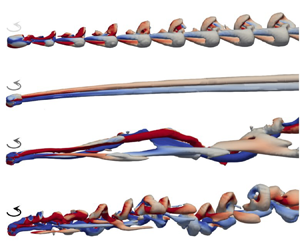
This work studies the three-dimensional flow dynamics around a rotating circular cylinder of finite length, whose axis is positioned perpendicular to the streamwise direction. Direct numerical simulations and global stability analyses are performed within a parameter range of Reynolds number $Re=DU_\infty /\nu <500$ (based on cylinder diameter $D$, uniform incoming flow velocity $U_\infty$), length-to-diameter ratio ${\small \text{AR}}=L/D\leq 2$ and dimensionless rotation rate $\alpha =D\varOmega /2U_\infty \leq 2$ (where $\varOmega$ is rotation rate). By solving Navier–Stokes equations, we investigated the wake patterns and explored the phase diagrams of the lift and drag coefficients. For a cylinder with ${\small \text{AR}}=1$, we found that when the rotation effect is weak ( $0\leq \alpha \lesssim 0.3$), the wake pattern is similar to the unsteady wake past the non-rotating finite-length cylinder, but with a new linear unstable mode competing to dominate the saturation state of the wake. The flow becomes stable for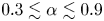 $0.3\lesssim \alpha \lesssim 0.9$ when $Re<360$. When the rotation effect is strong ( $\alpha \gtrsim 0.9$), new low-frequency wake patterns with stronger oscillations emerge. Generally, the rotation effect first slightly decreases and then sharply increases the $Re$ threshold of the flow instability when $\alpha$ is relatively small, but significantly decreases the threshold at high $\alpha$ ( $0.9<\alpha \leq 2$). Furthermore, the stability analyses based on the time-averaged flows and on the steady solutions demonstrate the existence of multiple unstable modes undergoing Hopf bifurcation, greatly influenced by the rotation effect. The shapes of these global eigenmodes are presented and compared, as well as their structural sensitivity, visualising the flow region important for the disturbance development with rotation. This research contributes to our understanding of the complex bluff-body wake dynamics past this critical configuration.


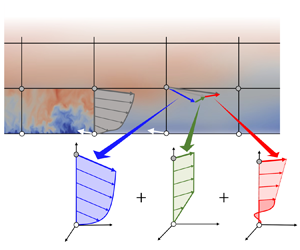
A multi-time-scale wall model for large-eddy simulations and applications to non-equilibrium channel flows
- Part of
-
- Journal:
- Journal of Fluid Mechanics / Volume 974 / 10 November 2023
- Published online by Cambridge University Press:
- 10 November 2023, A51
-
- Article
-
- You have access
- Open access
- HTML
- Export citation
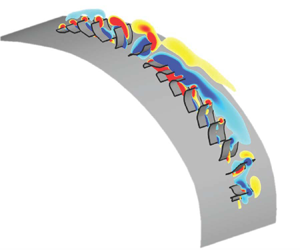
A new propulsion enhancement mechanism in metachronal rowing at intermediate Reynolds numbers
-
- Journal:
- Journal of Fluid Mechanics / Volume 974 / 10 November 2023
- Published online by Cambridge University Press:
- 10 November 2023, A45
-
- Article
-
- You have access
- Open access
- HTML
- Export citation
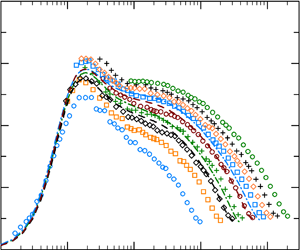
Reynolds number dependence of turbulent kinetic energy and energy balance of 3-component turbulence intensity in a pipe flow
-
- Journal:
- Journal of Fluid Mechanics / Volume 975 / 25 November 2023
- Published online by Cambridge University Press:
- 10 November 2023, A9
-
- Article
- Export citation
-
Measurement data sets are presented for the turbulence intensity profile of three velocity components ( $u$,
$u$,  $v$ and $w$) and turbulent kinetic energy (TKE, $k$) over a wide range of Reynolds numbers from $Re_\tau =990$ to 20 750 in a pipe flow. The turbulence intensity profiles of the $u$- and $w$-component show logarithmic behaviour, and that of the $v$-component shows a constant region at high Reynolds numbers, $Re_\tau >10\,000$. Furthermore, a logarithmic region is also observed in the TKE profile at $y/R=0.055\unicode{x2013}0.25$. The Reynolds number dependences of peak values of $u$-,
$u$-,  $w$-component and TKE fit to both a logarithmic law (Marusic et al., Phys. Rev. Fluids, vol. 2, 2017, 100502) and an asymptotic law (Chen and Sreenivasan, J. Fluid Mech., vol. 908, 2020, R3), within the uncertainty of measurement. The Reynolds number dependence of the bulk TKE $k^+_{bulk}$, which is the total amount of TKE in the cross-sectional area of the pipe also fits to both laws. When the asymptotic law is applied to the $k^+_{bulk}$, it asymptotically increases to the finite value $k^+_{bulk}=11$ as the Reynolds number increases. The contribution ratio $\langle u'^2\rangle /k$ reaches a plateau, and the value tends to be constant within $100< y^+<1000$ at $Re_\tau >10\ 000$. Therefore, the local balance of each velocity component also indicates asymptotic behaviour. The contribution ratios are balanced in this region at high Reynolds numbers as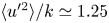 $\langle u'^2\rangle /k\simeq 1.25$,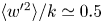 $\langle w'^2\rangle /k\simeq 0.5$ and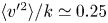 $\langle v'^2\rangle /k \simeq 0.25$.


Grounding-line flux conditions for marine ice-sheet systems under effective-pressure- dependent and hybrid friction laws
-
- Journal:
- Journal of Fluid Mechanics / Volume 975 / 25 November 2023
- Published online by Cambridge University Press:
- 10 November 2023, A6
-
- Article
- Export citation
Energy cascade in the Garrett–Munk spectrum of internal gravity waves
-
- Journal:
- Journal of Fluid Mechanics / Volume 975 / 25 November 2023
- Published online by Cambridge University Press:
- 10 November 2023, A11
-
- Article
-
- You have access
- Open access
- HTML
- Export citation
Cross-stream oscillations in the granular flow through a vertical channel
-
- Journal:
- Journal of Fluid Mechanics / Volume 975 / 25 November 2023
- Published online by Cambridge University Press:
- 10 November 2023, A10
-
- Article
-
- You have access
- Open access
- HTML
- Export citation
-
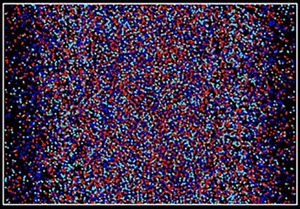
The gravity flow of a granular material between two vertical walls separated by a width $2W$ is simulated using the discrete element method (DEM). Periodic boundary conditions are applied in the flow (vertical) and the other horizontal directions. The mass flow rate is controlled by specifying the average solids fraction $\bar {\phi }$, the ratio of the volume of the particles to the volume of the channel. A steady fully developed state can be achieved for a narrow range of $\bar {\phi }$, $\bar {\phi }_{max} \geq \bar {\phi } \geq \bar {\phi }_{cr}$, and the material is in free fall for $\bar {\phi } < \bar {\phi }_{min}$. For an intermediate range of $\bar {\phi }$ ( $\bar {\phi }_{cr} > \bar {\phi } \geq \bar {\phi }_{min}$), there are oscillations in the horizontal coordinate of the centre of mass, velocity components and stress. As $\bar {\phi }$ decreases in the range $\bar {\phi }_{cr} > \bar {\phi } \geq \bar {\phi }_{min}$, the amplitude of the oscillations increases proportional to $\sqrt {\bar {\phi }_{cr} - \bar {\phi }}$ and the frequency appears to tend to a non-zero value as $\bar {\phi } \rightarrow \bar {\phi }_{cr}$, indicating a supercritical Hopf bifurcation. The relation between the dominant frequency and the higher harmonics of the position, velocity and stress fluctuations are explained using the momentum balance. It is found that dissipation in the inter-particle and particle–wall contacts is critical for the presence of an oscillatory state.


Wake bi-modality: the effect of upstream boundary layer dynamics
-
- Journal:
- Journal of Fluid Mechanics / Volume 975 / 25 November 2023
- Published online by Cambridge University Press:
- 10 November 2023, A7
-
- Article
- Export citation
Pattern evolution and modal decomposition of Faraday waves in a brimful cylinder
-
- Journal:
- Journal of Fluid Mechanics / Volume 974 / 10 November 2023
- Published online by Cambridge University Press:
- 10 November 2023, A56
-
- Article
- Export citation
-
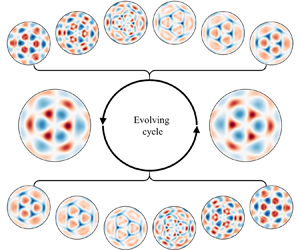
This paper investigates the steady-state pattern evolution of symmetric Faraday waves excited in a brimful cylindrical container when driving parameters much exceed critical thresholds. In such liquid systems, parametric surface responses are typically considered as the resonant superposition of unstable standing waves. A modified free-surface synthetic Schlieren method is employed to obtain full three-dimensional spatial reconstructions of instantaneous surface patterns. Multi-azimuth structures and localized travelling waves during the small-elevation phases of the oscillation cycle give rise to modal decomposition in the form of $\nu$-basis modes. Two-step surface-fitting results provide insight into the spatiotemporal characteristics of dominant wave components and corresponding harmonics in the experimental observations. Arithmetic combination of modal indices and uniform frequency distributions reveal the nonlinear mechanisms behind pattern formation and the primary pathways of energy transfer. Taking the hypothetical surface manifestation of multiple azimuths as the modal solutions, a linear stability analysis of the inviscid system is utilised to calculate fundamental resonance tongues (FRTs) with non-overlapping bottoms, which correspond to subharmonic or harmonic $\nu$-basis modes induced by surface instability at the air–liquid interface. Close relationships between experimental observations and corresponding FRTs provide qualitative verification of dominant modes identified using surface-fitting results. This supports the validity and rationality of the applied $\nu$-basis modes.


Attitude tracking control of hypersonic vehicle based on an improved prescribed performance dynamic surface control
-
- Journal:
- The Aeronautical Journal / Volume 128 / Issue 1323 / May 2024
- Published online by Cambridge University Press:
- 10 November 2023, pp. 875-895
-
- Article
- Export citation
Nonlinear deterministic reconstruction and prediction of remotely measured ocean surface waves
-
- Journal:
- Journal of Fluid Mechanics / Volume 975 / 25 November 2023
- Published online by Cambridge University Press:
- 10 November 2023, A8
-
- Article
-
- You have access
- Open access
- HTML
- Export citation
