Refine search
Actions for selected content:
212971 results in Engineering
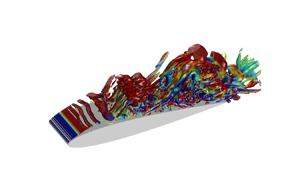
Vorticity forces of coherent structures on the NACA0012 aerofoil
-
- Journal:
- Journal of Fluid Mechanics / Volume 974 / 10 November 2023
- Published online by Cambridge University Press:
- 07 November 2023, A52
-
- Article
-
- You have access
- Open access
- HTML
- Export citation
-
This study examined the impact of coherent structures on the aerodynamic forces exerted on a NACA0012 aerofoil with angles of attack $7.5^{\circ }$ and $10^{\circ }$, and a chord-based Reynolds number $50\,000$. The study utilized the spectral proper orthogonal decomposition (SPOD) algorithm to identify the coherent structures, and vorticity force analysis to quantify their impact on lift and drag forces. Results showed that at $10^{\circ }$, the zeroth frequency of the first SPOD mode had a significant impact on drag and lift forces due to a large vortex structure that caused a strong flow along the suction side of the aerofoil. The first and second frequencies of the first SPOD mode represented asymmetric vortex pairs and a series of vortex pairs that determined the leading-edge separation, respectively. At $7.5^{\circ }$, the zeroth frequency of the first mode corresponded to an oscillating near-wall stream that followed the reattachment flow pattern, while the first frequency corresponded to a counter-rotating vortex pair that originated where the flow reattaches. Finally, the second frequency of the first mode corresponded to smaller counter-rotating vortex pairs at the shear layer originated near the reattachment point. These findings suggest that coherent structures have a significant impact on aerodynamic forces exerted on aerofoils, and can be identified and quantified using the SPOD algorithm and vorticity force analysis.


Dual-tunable phononic waveguides for manipulation of guided Lamb waves
-
- Journal:
- Programmable Materials / Volume 1 / 2023
- Published online by Cambridge University Press:
- 07 November 2023, e11
-
- Article
-
- You have access
- Open access
- HTML
- Export citation

Discovering optimal flapping wing kinematics using active deep learning
-
- Journal:
- Journal of Fluid Mechanics / Volume 974 / 10 November 2023
- Published online by Cambridge University Press:
- 07 November 2023, A54
-
- Article
- Export citation
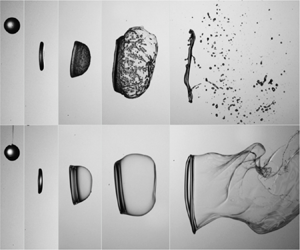
Breakup of particle-laden droplets in airflow
-
- Journal:
- Journal of Fluid Mechanics / Volume 974 / 10 November 2023
- Published online by Cambridge University Press:
- 06 November 2023, A42
-
- Article
- Export citation
-
The atomisation of a suspension containing liquid and dispersed particles is prevalent in many applications. Previous studies of droplet breakup mainly focused on homogeneous fluids, and the heterogeneous effect of particles on the breakup progress is unclear. In this study, the breakup of particle-laden droplets in airflow is investigated experimentally. Combining synchronised high-speed images from the side view and the 45 $^\circ$ view, we compare the morphology of particle-laden droplets with that of homogeneous fluids in different breakup modes. The results show that the higher effective viscosity of particle-laden droplets affects the initial deformation, and the heterogeneous effect of particles appears in the later breakup stage. To evaluate the heterogeneous effect of particles quantitatively, we eliminate the effect of the higher effective viscosity of particle-laden droplets by comparing cases corresponding to the same inviscid Weber number. The quantitative comparison reveals that the heterogeneous effect of particles accelerates the fragmentation of the liquid film and promotes localised rapid piercing. A correlation length that depends on the particle diameter and the volume fraction is proposed to characterise the length scale of the concentration fluctuation under the combined effect of the initial flattening and later stretching during the droplet breakup process. Based on this correlation length, the fragment size distributions are analysed, and the scaling results agree well with the experimental data.

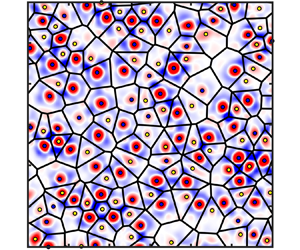
Vortex dynamics in rotating Rayleigh–Bénard convection
-
- Journal:
- Journal of Fluid Mechanics / Volume 974 / 10 November 2023
- Published online by Cambridge University Press:
- 06 November 2023, A43
-
- Article
- Export citation
-
We investigate the spatial distribution and dynamics of the vortices in rotating Rayleigh–Bénard convection in a reduced Rayleigh number range $1.3\le Ra/Ra_{c}\le 83.1$. Under slow rotations ( $Ra\approx 80\,Ra_{c}$), the vortices are distributed randomly, which is manifested by the size distribution of the Voronoi cells of the vortex centres being a standard $\varGamma$ distribution. The vortices exhibit Brownian-type horizontal motion in the parameter range $Ra\gtrsim 10\,Ra_{c}$. The probability density functions of the vortex displacements are, however, non-Gaussian at short time scales. At modest rotating rates ( $4\,Ra_{c}\le Ra\lesssim 10\,Ra_{c}$), the centrifugal force leads to radial vortex motions, i.e. warm cyclones (cold anticyclones) moving towards (outwards from) the rotation axis. The horizontal scale of the vortices decreases with decreasing $Ra/Ra_c$, and the size distribution of their Voronoi cells deviates from the $\varGamma$ distribution. In the rapidly rotating regime ( $1.6\,Ra_{c}\le Ra\le 4\,Ra_{c}$), the vortices are densely distributed. The hydrodynamic interaction of neighbouring vortices results in the formation of vortex clusters. Within clusters, cyclones exhibit inverse-centrifugal motion as they submit to the outward motion of the strong anticyclones, and the radial velocity of the anticyclones is enhanced. The radial mobility of isolated vortices, scaled by their vorticity strength, is shown to be a simple power function of the Froude number. For all flow regimes studied, we show that the number of vortices with a lifespan greater than $t$ decreases exponentially as $\exp ({-t/{\tau }})$ for large time, where $\tau$ represents the characteristic lifetime of long-lived vortices.


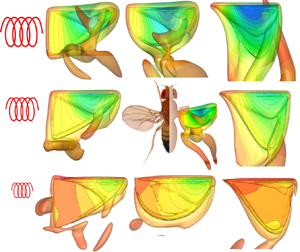
Power synchronisations determine the hovering flight efficiency of passively pitching flapping wings
-
- Journal:
- Journal of Fluid Mechanics / Volume 974 / 10 November 2023
- Published online by Cambridge University Press:
- 06 November 2023, A41
-
- Article
- Export citation
-
The power exchange between fluid and structure plays a significant role in the force production and flight efficiency of flapping wings in insects and artificial flyers. This work numerically investigates the performance of flapping wings by using a high-fidelity fluid–structure interaction solver. Simulations are conducted by varying the hinge flexibility (measured by the Cauchy number, $Ch$, i.e. the ratio between aerodynamic and torsional elastic forces) and the wing shape (quantified by the radius of the first moment of area, $\bar {r}_1$). Results show that the lift production is optimal at $0.05 < Ch \leq 0.2$ and larger $\bar {r}_1$ where the minimum angle of attack is around $45^\circ$ at midstroke. The power economy is maximised for wings with lower $\bar {r}_1$ near $Ch=0.2$. Power analysis indicates that the optimal performance measured by the power economy is obtained for those cases where two important power synchronisations occur: anti-synchronisation of the pitching elastic power and the pitching aerodynamic and inertial powers and nearly in-phase synchronisation of the flapping aerodynamic power and the total input power of the system. While analysis of the kinematics for the different wing shapes and hinge stiffnesses reveals that the optimal performance occurs when the timing of pitch and stroke reversals are matched, thus supporting the effective transfer of input power from flapping to passive pitching and into the fluid. These results suggest that careful optimisation between wing shapes and hinge properties can allow insects and robots to exploit the passive dynamics to improve flight performance.


Reducing laser beam fluence and intensity fluctuations in symmetric and asymmetric compressors
-
- Journal:
- High Power Laser Science and Engineering / Volume 11 / 2023
- Published online by Cambridge University Press:
- 06 November 2023, e93
-
- Article
-
- You have access
- Open access
- HTML
- Export citation
FLUTE: A Python GUI for interactive phasor analysis of FLIM data
-
- Journal:
- Biological Imaging / Volume 3 / 2023
- Published online by Cambridge University Press:
- 06 November 2023, e21
-
- Article
-
- You have access
- Open access
- HTML
- Export citation

Slamming forces during water entry of a simple harmonic oscillator
-
- Journal:
- Journal of Fluid Mechanics / Volume 974 / 10 November 2023
- Published online by Cambridge University Press:
- 06 November 2023, A23
-
- Article
-
- You have access
- Open access
- HTML
- Export citation
PAAQ: Paired Alternating AcQuisitions for virtual high frame rate multichannel cardiac fluorescence microscopy
-
- Journal:
- Biological Imaging / Volume 3 / 2023
- Published online by Cambridge University Press:
- 06 November 2023, e20
-
- Article
-
- You have access
- Open access
- HTML
- Export citation
Design of bandwidth-enhanced polarization controlled frequency selective surface based microwave absorber
-
- Journal:
- International Journal of Microwave and Wireless Technologies / Volume 16 / Issue 5 / June 2024
- Published online by Cambridge University Press:
- 06 November 2023, pp. 862-870
-
- Article
- Export citation
Direct numerical simulation of supersonic boundary layers over a microramp: effect of the Reynolds number
-
- Journal:
- Journal of Fluid Mechanics / Volume 974 / 10 November 2023
- Published online by Cambridge University Press:
- 06 November 2023, A44
-
- Article
-
- You have access
- Open access
- HTML
- Export citation
-
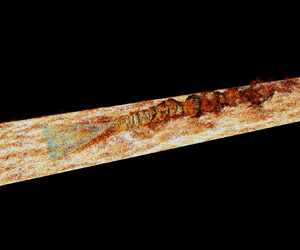
Microvortex generators are passive control devices smaller than the boundary layer thickness that energise the boundary layer to prevent flow separation with limited induced drag. In this work, we use direct numerical simulations (DNS) to investigate the effect of the Reynolds number in a supersonic turbulent boundary layer over a microramp vortex generator. Three friction Reynolds numbers are considered, up to $Re_\tau = 2000$, for fixed free stream Mach number $M_\infty =2$ and fixed relative height of the ramp with respect to the boundary layer thickness. The high-fidelity data set sheds light on the instantaneous and highly three-dimensional organisation of both the wake and the shock waves induced by the microramp. The full access to the flow field provided by DNS allows us to develop a qualitative model of the near wake, explaining the internal convolution of the Kelvin–Helmholtz vortices around the low-momentum region behind the ramp. The overall analysis shows that numerical results agree excellently with recent experimental measurements in similar operating conditions and confirms that microramps effectively induce a significantly fuller boundary layer even far downstream of the ramp. Moreover, results highlight significant Reynolds number effects, which in general do not scale with the ramp height. Increasing Reynolds number leads to enhanced coherence of the typical vortical structures in the field, faster and stronger development of the momentum deficit region, increased upwash between the primary vortices from the sides of the ramp – and thus increased lift-up of the wake – and faster transfer of momentum towards the wall.


Far-field hydrodynamic interaction in a group of swimmers
-
- Journal:
- Journal of Fluid Mechanics / Volume 974 / 10 November 2023
- Published online by Cambridge University Press:
- 03 November 2023, A34
-
- Article
-
- You have access
- Open access
- HTML
- Export citation
Parametrized polyconvex hyperelasticity with physics-augmented neural networks
- Part of
-
- Journal:
- Data-Centric Engineering / Volume 4 / 2023
- Published online by Cambridge University Press:
- 03 November 2023, e25
-
- Article
-
- You have access
- Open access
- HTML
- Export citation

The role of rolling resistance in the rheology of wizarding quidditch ball suspensions
-
- Journal:
- Journal of Fluid Mechanics / Volume 974 / 10 November 2023
- Published online by Cambridge University Press:
- 03 November 2023, A36
-
- Article
-
- You have access
- Open access
- HTML
- Export citation
A tunable balanced phase shifter with wide operating bandwidth
-
- Journal:
- International Journal of Microwave and Wireless Technologies / Volume 16 / Issue 4 / May 2024
- Published online by Cambridge University Press:
- 03 November 2023, pp. 681-689
-
- Article
- Export citation
Inertial migration of a neutrally buoyant spheroid in plane Poiseuille flow
-
- Journal:
- Journal of Fluid Mechanics / Volume 974 / 10 November 2023
- Published online by Cambridge University Press:
- 03 November 2023, A39
-
- Article
- Export citation
-
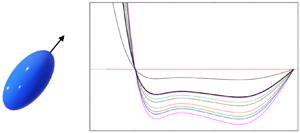
We study the cross-stream inertial migration of a torque-free neutrally buoyant spheroid, of an arbitrary aspect ratio $\kappa$, in wall-bounded plane Poiseuille flow for small particle Reynolds numbers ( $Re_p\ll 1$) and confinement ratios ( $\lambda \ll 1$), with the channel Reynolds number,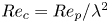 $Re_c = Re_p/\lambda ^2$, assumed to be arbitrary; here $\lambda =L/H$, where $L$ is the semi-major axis of the spheroid and $H$ denotes the separation between the channel walls. In the Stokes limit ( $Re_p =0)$, and for $\lambda \ll 1$, a spheroid rotates along any of an infinite number of Jeffery orbits parameterized by an orbit constant $C$, while translating with a time-dependent speed along a given ambient streamline. Weak inertial effects stabilize either the spinning ( $C=0$) or tumbling orbit ( $C=\infty$), or both, depending on $\kappa$. The asymptotic separation of the Jeffery rotation and orbital drift time scales, from that associated with cross-stream migration, implies that migration occurs due to a Jeffery-averaged lift velocity. Although the magnitude of this averaged lift velocity depends on $\kappa$ and $C$, the shape of the lift profiles are identical to those for a sphere, regardless of $Re_c$. In particular, the equilibrium positions for a spheroid remain identical to the classical Segre–Silberberg ones for a sphere, starting off at a distance of about $0.6(H/2)$ from the channel centreline for small $Re_c$, and migrating wallward with increasing $Re_c$. For spheroids with $\kappa \sim O(1)$, the Jeffery-averaged analysis is valid for $Re_p\ll 1$; for extreme aspect ratio spheroids, the regime of validity becomes more restrictive being given by $Re_p \kappa /\ln \kappa \ll 1$ and $Re_p/\kappa \ll 1$ for $\kappa \rightarrow \infty$ (slender fibres) and $\kappa \rightarrow 0$ (flat disks), respectively.


Methodology for shape prediction and conversion of a conventional aerofoil to an inflatable baffled aerofoil
-
- Journal:
- The Aeronautical Journal / Volume 128 / Issue 1323 / May 2024
- Published online by Cambridge University Press:
- 03 November 2023, pp. 1037-1070
-
- Article
-
- You have access
- Open access
- HTML
- Export citation
Conditional analysis on extreme wall shear stress and heat flux events in compressible turbulent boundary layers
-
- Journal:
- Journal of Fluid Mechanics / Volume 974 / 10 November 2023
- Published online by Cambridge University Press:
- 03 November 2023, A38
-
- Article
- Export citation
-
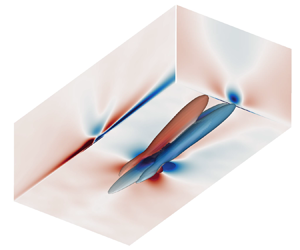
This study presents a comprehensive analysis on the extreme positive and negative events of wall shear stress and heat flux fluctuations in compressible turbulent boundary layers (TBLs) solved by direct numerical simulations. To examine the compressibility effects, we focus on the extreme events in two representative cases, i.e. a supersonic TBL of Mach number $M=2$ and a hypersonic TBL of $M=8$, by scrutinizing the coherent structures and their correlated dynamics based on conditional analysis. As characterized by the spatial distribution of wall shear stress and heat flux, the extreme events are indicated to be closely related to the structural organization of wall streaks, in addition to the occurrence of the alternating positive and negative structures (APNSs) in the hypersonic TBL. These two types of coherent structures are strikingly different, namely the nature of wall streaks and APNSs are shown to be related to the solenoidal and dilatational fluid motions, respectively. Quantitative analysis using a volumetric conditional average is performed to identify and extract the coherent structures that directly account for the extreme events. It is found that in the supersonic TBL, the essential ingredients of the conditional field are hairpin-like vortices, whose combinations can induce wall streaks, whereas in the hypersonic TBL, the essential ingredients become hairpin-like vortices as well as near-wall APNSs. To quantify the momentum and energy transport mechanisms underlying the extreme events, we proposed a novel decomposition method for extreme skin friction and heat flux, based on the integral identities of conditionally averaged governing equations. Taking advantage of this decomposition method, the dominant transport mechanisms of the hairpin-like vortices and APNSs are revealed. Specifically, the momentum and energy transports undertaken by the hairpin-like vortices are attributed to multiple comparable mechanisms, whereas those by the APNSs are convection dominated. In that, the dominant transport mechanisms in extreme events between the supersonic and hypersonic TBLs are indicated to be totally different.


Ensemble approaches for leveraging machine learning models in load estimation
- Part of
-
- Journal:
- The Aeronautical Journal / Volume 127 / Issue 1318 / December 2023
- Published online by Cambridge University Press:
- 03 November 2023, pp. 2082-2104
-
- Article
- Export citation
