To save content items to your account,
please confirm that you agree to abide by our usage policies.
If this is the first time you use this feature, you will be asked to authorise Cambridge Core to connect with your account.
Find out more about saving content to .
To save content items to your Kindle, first ensure no-reply@cambridge.org
is added to your Approved Personal Document E-mail List under your Personal Document Settings
on the Manage Your Content and Devices page of your Amazon account. Then enter the ‘name’ part
of your Kindle email address below.
Find out more about saving to your Kindle.
Note you can select to save to either the @free.kindle.com or @kindle.com variations.
‘@free.kindle.com’ emails are free but can only be saved to your device when it is connected to wi-fi.
‘@kindle.com’ emails can be delivered even when you are not connected to wi-fi, but note that service fees apply.
The realization of an electrically driven organic solid-state laser is an ambitious but highly desirable goal. Many obstacles need to be solved before a working device can be realized. One of the most challenging tasks is an incorporation of intracavity metal contacts, which, on the one hand, would not substantially degrade optical properties of the whole device and, on the other hand, would ensure sufficient current density to reach lasing. In this paper, we present different contact compositions aiming to realize high-quality intracavity metal contacts. We build a top contact consisting of 0.5 nm of aluminum and 4 nm of silver which has a conductivity of 1.9 × 10⁷ (Ω/m) and is not increasing the optical lasing threshold of an organic microcavity. To get a better understanding of charge carriers influencing the device performance, we have performed a set of measurements, where a hybrid OLED–MC device was excited both optically and electrically at the same time. These experiments suggest that the charge carriers do not degrade electrical performance, at least for current densities in the range of A/cm2. Moreover, our observations suggest that, in some cases, simultaneous optical excitation can contribute to more efficient electrical pumping of the OLED-MC device.
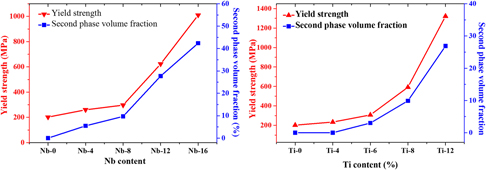
Laves phase plays a positive role in improving the strength of high-entropy alloys (HEAs); Nb and Ti elements have potential to promote Laves phase formation in some HEAs. For improving the strength of the face-centered cubic (FCC) CoCrFeMnNi HEA, a series of (CoCrFeMnNi)100−xNbx (atomic ratio: x = 0, 4, 8, 12, 16) and (CoCrFeMnNi)100−xTix (atomic ratio: x = 0, 2, 4, 6, 8, 12) HEAs were prepared by melting. The effects of Nb and Ti on the microstructure evolution and compressive properties of the CoCrFeMnNi HEAs were investigated. For (CoCrFeMnNi)100−xNbx HEAs, the second-phase (Laves and σ phase) volume fraction increased from 0 to 42%. The yield strength also increased gradually from 202 to 1010 MPa. However, the fracture strain decreased from 60% (no fracture) to 12% with increasing Nb content. For (CoCrFeMnNi)100−xTix HEAs, the yield strength increased from 202 to 1322 MPa. The Laves phase volume fraction also increased from 0 to 27%. However, the fracture strain decreased from 60% (no fracture) to 7.5% with increasing Ti content. Addition of Nb and Ti has a good effect on improving the strength of FCC CoCrFeMnNi HEA.
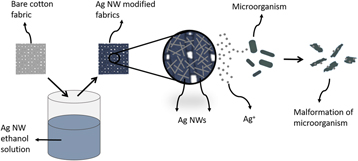
Antimicrobial textiles received considerable attention due to public health and personal hygiene concerns. On the other hand, pathogenic microorganisms gain immunity against existing antibacterial products. For these reasons, new and stronger antibacterial agents need to be developed immediately. In this work, silver nanowires (Ag NWs) were decorated onto conventional fabrics via facile and scalable dip and dry method. Antimicrobial activity of the nanowire-decorated fabrics was investigated against a Gram-positive coccus (Staphylococcus aureus), a Gram-negative bacillus (Escherichia coli), a Gram-positive and spore-forming bacillus (Bacillus cereus), and a yeast-like fungus (Candida albicans) via disk diffusion and time–dependent killing methods. The effect of Ag NW content was investigated, and the decorated fabrics showed promising antibacterial activity even with a small amount of Ag NW decoration (0.095 mg/cm2). Moreover, decorated fabrics maintained their activity for 24 h. This work shows that Ag NW-modified fabrics can be used as antimicrobial textiles against a wide spectrum of bacteria.
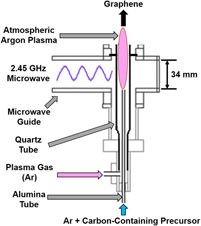
This article reviews the state of the art in the gas-phase synthesis of graphene in atmospheric plasmas. The substrate-free process involves the delivery of a carbon-containing precursor into a microwave-generated Ar plasma. Factors that influence the synthesis of graphene include precursor composition, reactor design, and the flow rates of gases. These factors have elucidated the mechanisms of graphene formation in atmospheric plasmas. Gas phase–synthesized graphene is pure and highly ordered and possesses unique features that make the material useful in applications such as catalysis, energy storage, lubrication, and the transmission electron microscopy imaging of nanomaterials. However, the main challenge in the synthesis process is the low rate of graphene production. This article anticipates future research aimed at overcoming this challenge and compares the atmospheric plasma method with contemporary graphene production techniques.
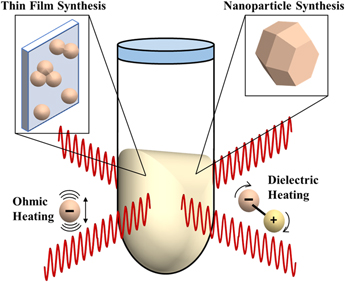
The application of microwave radiation (MWR) during materials synthesis can generate a wide range of interesting phenomena, such as rapid, low-temperature phase transitions and the formation of nonequilibrium phases. However, the underlying mechanisms by which MWR can influence processes like nucleation, crystallization, sintering, and grain growth remain unknown. A critical need for studying these mechanisms is the ability to quantitatively characterize the effects of MWR exposure on atomic structure. In this regard, synchrotron X-ray sources provide an opportunity to shed new light on electromagnetic (EM) field–assisted synthesis due to the availability of high-energy X-rays that enable a wide range of experimental characterization techniques. Here, we review the use of synchrotron X-ray sources for both ex situ and in situ studies of MWR-assisted synthesis. While many synchrotron-based tools are available to characterize the structural effects of MWR from the micron down to the atomic scale, work in this field is ongoing, and no clear consensus exists regarding the underlying mechanisms of EM field–mediated phase transitions. We discuss the instrumentation available to study field–matter interaction mechanisms and identify future needs in synchrotron characterization to better understand how EM fields can engineer advanced materials.
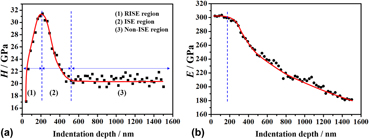
Highly dense zirconia dental ceramic coatings were fabricated by aqueous electrophoretic deposition (EPD) and subsequently sintered between 1250 and 1450 °C. Microstructural examination revealed that aqueous EPDZrO2 coatings possessed a tetragonal phase structure and the grain size increased with increasing sintering temperature. Nanoindentation study proved that the aqueous EPDZrO2 coating also had excellent mechanical properties. The effect of different applied loads on hardness and elastic modulus of the 1350 °C-sintered sample at room temperature was investigated by the method of progressive multicycle measurement nanoindentation. The simulative experiment proved that hardness of aqueous EPDZrO2 exhibited reverse indentation size effect (ISE) behavior and then displayed the normal ISE response. The analysis indicates that the reverse ISE is attributed to the relaxation of surface stresses resulting from indentation cracks at small loads and normal ISE is caused by geometrically necessary dislocations. The tetragonal–monoclinic stress-induced phase transformation during nanoindentation is the primary cause of dental zirconia failures.
Atomistic simulations of 18 silicon 〈110〉 symmetric tilt grain boundaries are performed using Stillinger Weber, Tersoff, and the optimized Modified Embedded Atom Method potentials. We define a novel structural unit classification through dislocation core analysis to characterize the relaxed GB structures. GBs with the misorientation angle θ ranging from 13.44° to 70.53° are solely composed of Lomer dislocation cores. For GBs with θ less than but close to 70.53°, GB ‘step’ appears and the equilibrated states with lowest GB energies can be attained only when such GB ‘step’ is located in the middle of each single periodic GB structure. For the misorientation angles in the range of 93.37° ≤ θ ≤ 148.41°, GB structures become complicated since they contain multiple types of dislocation cores. This work not only facilitates the structural characterization of silicon 〈110〉 STGBs, but also may provide new insights into mirco-structure design in multicrystalline silicon.
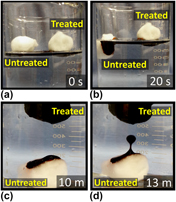
More than 1 million tons of oil is inadvertently spilled each year. The economic and environmental costs of these spills are enormous and compel further development of environmentally friendly sorbent materials. Here, we demonstrate a vapor-phase modification approach to create a new class of oil sorbents composed of cellulosic materials (cotton) coated with a subnanometer layer of inorganic oxide. This new cellulosic sorbent remains buoyant in water indefinitely and achieves a selective oil sorption capacity (23 g/g or 1.05 g/cm3) that is at least 35 times better than untreated cellulose in aqueous environments. This new sorbent particularly excels under “realistic” conditions such as continuous agitation (e.g., simulated waves) and presoaking in water (e.g., rain or forced immersion). When sorption performance is compared on a per-volume basis—which better captures use conditions than a per-mass basis—this modified natural product becomes comparable to the best sorbents reported in the literature.
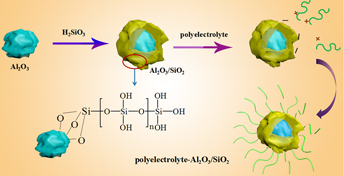
A new type of polyelectrolyte–Al2O3/SiO2 composite nanoparticle with excellent dispersibility and superior polishing performance was successfully fabricated using a facile method. Silica acted as a bifunctional molecule by attaching to alumina via covalent bond and adsorbing polyelectrolytes by electrostatic interaction. The material removal rate of the polyelectrolyte–Al2O3/SiO2 abrasive was 30% higher than that of the pure Al2O3 abrasive. In addition, the sapphire surface was much smoother. The material removal mechanism was investigated during CMP using the microcontact and wear model. The enhanced removal rate was mainly attributed to the well-dispersed particles, which can accelerate mechanical removal process. The remarkably smooth surface was due to the decrease in penetration depth of the abrasive into the wafer. The results of this study provided a feasible strategy to satisfy the high efficiency and damage-free polishing requirements for sapphire planarization.
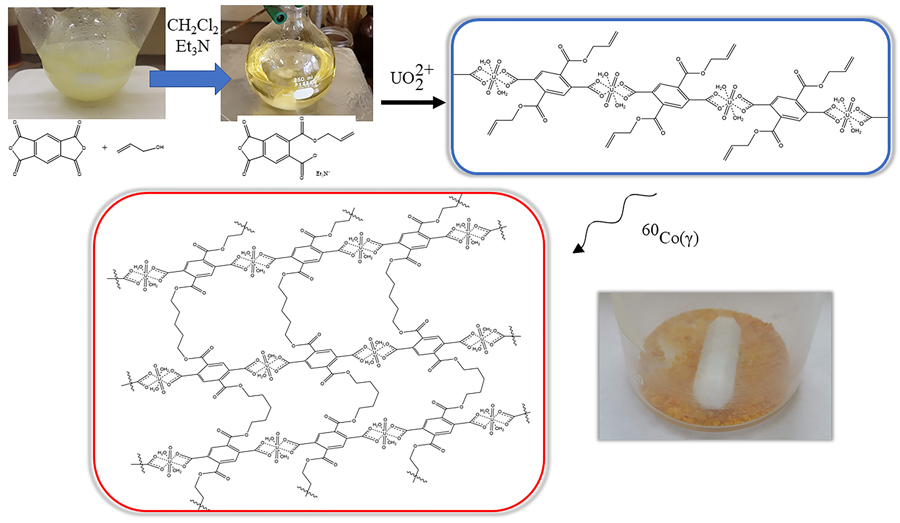
Non-conventional uranium extraction sources are not the most used mainly due to high extraction costs associated with low concentrations and chemical forms that require extra purification processes. Therefore, efforts should focus on cheaper processes and develop more effective extraction materials. In this investigation, ionic-imprinted polymers were synthesized for the selective extraction of uranyl ions in aqueous solution, using polyesters of 2,5-bis((allyloxy)carbonyl)terephthalic acid and 4,6-bis((allyloxy)carbonyl)isophthalic acid as base materials and polymerized by gamma radiation. The extraction capacity (Q) of the resins was evaluated by varying parameters such as pH, temperature, extraction time, and ionic strength.
The influence of Ag-doping on the crystallographic structure, magnetic properties, and magnetocaloric effects of Mn1−xAgxCoGe (0.01 ⩽ x ⩽ 0.10) is reported. A transformation of crystal structure from orthorhombic to hexagonal was observed at room temperature. Doping Ag in Mn sites results in a first-order magnetostructural transition near room temperature. A Curie-temperature window of 90 K was obtained between the Curie temperatures of the austenite (Ni2In-type) and martensite (TiNiSi-type) phases. Large magnetic entropy change values of ~22.0 and 9.4 J/kg/K, and refrigerant capacity of 308 and 272 J/kg, were found for x = 0.06 and 0.05, respectively, for μ0ΔH = 5 T.
There are few feasible options for sorbents, which can be quickly manufactured and deployed in the event of a major oil spill and so every oil spill is an ecological disaster. This paper aims to provide an understanding of what a realistic, full-scale crude oil spill solution would look like based on the performance of the best sorbents currently available, their costs, and their advantages.
Adsorbent materials or “sorbents” described here have been a recent target for research toward applications in environmental cleanup, remediation, and hazardous material containment. These materials contain many compositions, syntheses, and practical manufacturing parameters that make most of them practically and logistically unfit to tackle quantities much larger than a single barrel of oil. Different properties of crude oil and nonpolar materials, such as their viscosity, density, and weathering, can also make these materials seem attractive on a lab scale but underperform in field testing and in practical applications. This review addresses the challenges, advantages, and disadvantages of different technical applications of the superior sorbent materials and material types in the literature. In addition, we discuss the different costs and manufacturing challenges of sorbent materials in real oil spills and what a feasible containment sorbent material might look like.
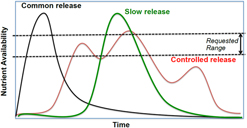
The increase of agricultural production in a sustainable scenario depends on the development of new technologies to optimize the use of resources, especially fertilizers. Novel technologies in materials can provide means to the controlled release of inputs as well as to enable strategies for using poorly soluble sources.
Modern agriculture is facing a productivity challenge due to the 9 billion people demands for the next 50 years. To that, the productivity increase requests improvements in input efficiency to fill economic requirements as well as reducing their environmental impacts. Several materials can be specially designed for an adequate release of these inputs (mainly fertilizers) including ion-exchange materials, coatings and high-adsorption capacity materials. Noteworthy materials are nanoparticulate fertilizers and nanocomposites, where their size and structure are useful to control the solubilization, and consequently, the nutrient availability for plants in a synchronized way, avoiding losses to environment. Therefore, this review aims to introduce a wide view of available and in-development technologies in materials for the best management of agricultural inputs, focused in the sustainable use of fertilizers and minimal environmental impact. These different strategies offer a portfolio of possible solutions for sustainable agriculture in the next years.