To save content items to your account,
please confirm that you agree to abide by our usage policies.
If this is the first time you use this feature, you will be asked to authorise Cambridge Core to connect with your account.
Find out more about saving content to .
To save content items to your Kindle, first ensure no-reply@cambridge.org
is added to your Approved Personal Document E-mail List under your Personal Document Settings
on the Manage Your Content and Devices page of your Amazon account. Then enter the ‘name’ part
of your Kindle email address below.
Find out more about saving to your Kindle.
Note you can select to save to either the @free.kindle.com or @kindle.com variations.
‘@free.kindle.com’ emails are free but can only be saved to your device when it is connected to wi-fi.
‘@kindle.com’ emails can be delivered even when you are not connected to wi-fi, but note that service fees apply.
Vertically aligned nitrogen-doped nanocrystalline diamond nanorods are fabricated from nitrogen-doped nanocrystalline diamond films using reactive ion etching in oxygen plasma. These nanorods show enhanced thermionic electron emission (TEE) characteristics, viz., a high current density of 12.0 mA/cm2 and a work function value of 4.5 eV with an applied voltage of 3 V at 923 K. The enhanced TEE characteristics of these nanorods are ascribed to the induction of nanographitic phases at the grain boundaries and the field penetration effect through the local field enhancement from nanorods owing to a high aspect ratio and an excellent field enhancement factor.
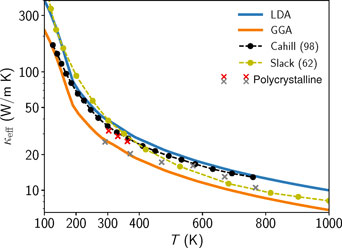
The thermal conductivities (κ) of bulk and thin-film α-Al2O3 are calculated from first principles using both the local density approximation (LDA) and the generalized gradient approximation (GGA) to exchange and correlation. The room temperature single-crystal LDA value ~39 W/m K agrees well with the experimental values ~35–39 W/m K, whereas the GGA values are much smaller ~26 W/m K. Throughout the temperature range, LDA is found to slightly overestimate κ, whereas GGA strongly underestimates it. We calculate the κ of crystalline α-Al2O3 thin films and observe a maximum of 79% reduction for 10 nm thickness.
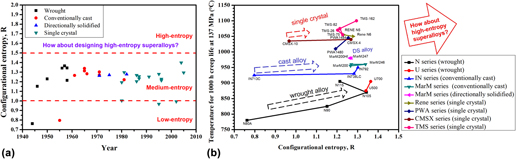
The concept of high-entropy alloys has been extended to ceramics, polymers, and composites. “High-entropy materials (HEMs)” are named to cover all these materials. Recently, HEMs has become a new emerging field through the collective efforts of many researchers. Basically, high mixing entropy can enhance the formation of solution-type phases for alloys, ceramics, and composites at high temperatures, and in general leads to simpler microstructure. Large degrees of freedom in composition design as well as process design have been found to provide a wide range of microstructure and properties for applications. There are many opportunities for HEMs to overcome the bottlenecks of conventional materials. In this article, several possible breakthrough applications are pointed out and emphasized for turbine blades, thermal spray bond coatings, high-temperature molds and dies, sintered carbides for cutting tools, hard coatings for cutting tools, hardfacings, and radiation-damage resistant materials. In addition, more possible breakthrough examples are briefly described.
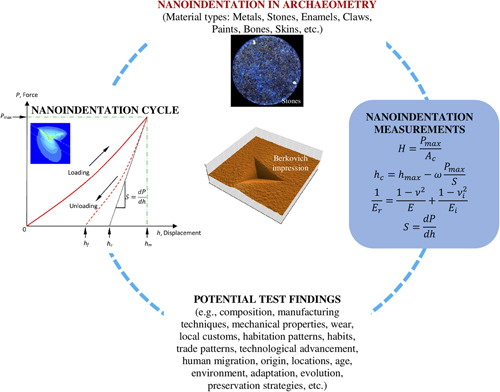
This review aims to consolidate scarce literature on the use of modern nanomechanical testing technique like instrumented nanoindentation in the field of archaeometry materials research. The review showcase on how can the nanoindentation tests provide valuable data about mechanical properties which, in turn, relate to the evolution of ancient biomaterials as well as human history and production methods. This is particularly useful when the testing is limited by confined volumes and small material samples (since the contact size is in the order of few microns). As an emerging novel application, some special considerations are warranted for characterization of archaeometry materials. In this review, potential research areas relating to how nanoindentation is expected to benefit and help improve existing practices in archaeometry are identified. It is expected that these insights will raise awareness for use of nanoindentation at various world heritage sites as well as various museums.
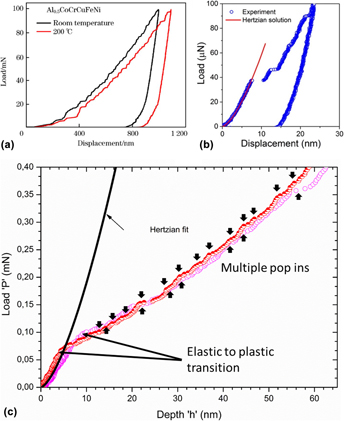
The current review outlines the size-dependent plastic behavior of high-entropy alloys (HEAs) and the underlying deformation mechanisms. Particular focus is laid upon the influence of microstructural design on the small-scale deformation characteristics. The role of defect types as carriers of plasticity is appraised and correlated with the frequently observed mechanical behavior peculiar to the breed of HEAs. Deformation response is classified on the basis of mechanical testing techniques probing intrinsic (nanoindentation techniques) as well as extrinsic size (micro/nanopillar compression) effects. The mechanisms of incipient plasticity and serrated flow behavior in HEAs are discussed. Furthermore, the role of interfaces between crystallographically dissimilar lattices on small-scale deformation behavior in these alloys is assessed. The article provides a clear overview of the existing HEA research in this avenue as well as the critical knowledge gaps that need to be addressed.
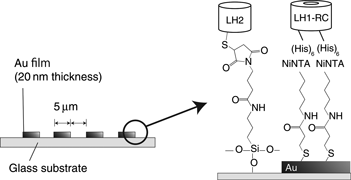
With the aim of understanding the excitation energy transfer mechanism in natural photosynthetic membranes, light-harvesting (LH)2 and LH1-reaction center, which are pigment-protein complexes separated from Rhodobacter sphaeroides, were aligned on a planar electrode surface in stripe patterns at 5 µm intervals. Observation of the absorption spectrum and fluorescence microphotographs revealed selective immobilization and conservation of the pigments. Photocurrent signals were obtained when the electrode was illuminated at either 880 or 800 nm. The fabricated structure was confirmed to function as a natural photosynthetic membrane with the highest photocurrent signal being obtained when using a co-immobilized substrate under excitation at 800 nm.
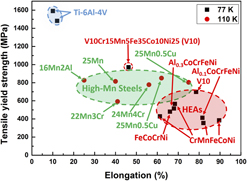
The basic principle of high-entropy alloys (HEAs) is that high mixing entropies of solid-solution phases enhance the phase stability, which renders us a new strategy on alloy design. The current research of HEAs mostly emphasizes mechanical behavior at room and higher temperatures. Relatively fewer papers are focused on low-temperature behaviors, below room temperature. However, based on the published papers, we can find that the low-temperature properties of HEAs are generally excellent. The great potential for cryogenic applications could be expected on HEAs. In this article, we summarized and discussed the mechanical behaviors and deformation mechanisms, as well as stacking-fault energies, of HEAs at low temperatures. The comparison of low-temperature properties of HEAs and conventional alloys will be provided. Future research directions will be suggested at the end.
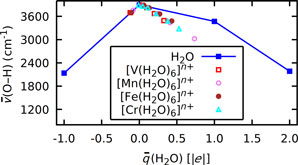
We analyze charge density transfer from water to solvated transition metal (TM) ions in different formal oxidation states (FOSs) in aqueous solution by first principles and relate the degree of stabilization of the solvated cations to the charge donation from the water ligands. We find remarkable charge stability on the metal center regardless of FOSs. This effect is similar to what has previously been shown for charges on TM cations in inorganic crystals. This ligand-to-metal charge transfer results in softening of the ligand O–H bonds, which can be used to explain the formation of higher-FOS transition metalates and oxycations.
A thermo-pH sensitive graft copolymer was successfully obtained by grafting 4-vinylpyridine and N-vinylcaprolactam onto silicone rubber ((SR-g-4VP)-g-NVCL)) in two-step using ionizing radiation as an initiator. Factors such as dose and monomer concentration remarkably affected the grafting yield. Surface grafted films were well characterized by means of infrared-attenuated total reflection, carbon-13 nuclear magnetic resonance, thermogravimetric analysis, and mechanical properties were also studied. Scanning electron microscopy demonstrated that the grafting was superficial; mechanical studies demonstrated that grafting caused loss elongation of SR films. The grafted films showed a critical pH close to physiological pH and a critical temperature (lower critical solution temperature) about 35 °C, therefore, this material presents potential biomedical applications as drug delivery.
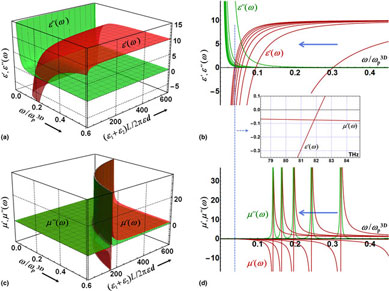
We show that the optical response of ultrathin metallic films of finite lateral size and thickness can feature peculiar magneto-optical effects resulting from the spatial confinement of the electron motion. In particular, the frequency dependence of the magnetic permeability of the film exhibits a sharp resonance structure shifting to the red as the film aspect ratio increases. The films can also be negatively refractive in the IR frequency range under proper tuning. We show that these magneto-optical properties can be controlled by adjusting the film chemical composition, plasmonic material quality, the aspect ratio, and the surroundings of the film.
We present the synthesis and the characterization of a novel cellulose-based electroactive hydrogel obtained through a simple water-based process. Its swelling and electroactive properties are here studied especially in low salinity water solutions. By combining smart materials and three-dimensional printing technique, we assessed that hydrogels can be shaped as natural algae and their motion can be controlled with electric signals to mimic natural seaweed movements under the effect of water flow. This could constitute a first step toward the development of hybrid habitats where artificial smart algae could cohabit with real living organisms or microorganisms.
Several structure–property relationships are reported in large-area MoS2 thin films to understand the effect of sulfur vacancies along with complementary first-principles calculations. X-ray diffraction and reflectivity measurements demonstrated that sputtered MoS2 followed by a high-temperature sulfurization produced sharp film–substrate interface along with high crystalline order. Spectroscopic and transport measurements showed that removal of sulfur vacancies promoted A–B excitons, strong in-plane Raman modes, a sharp increase in dc resistivity, and strong photo-conducting behavior. We have clearly demonstrated that a hybrid method using magnetron sputtering can provide high-quality few-layer transition metal dichalcogenide films.
N-(3-Carboxypropyl) triphenylphosphonium bromide chitosan (TPPB-CS) was synthesized and characterized by FTIR, 1H NMR spectrometer, and Zeta potential. TPPB-CS showed a selectivity-toxicity among cancer cell lines (MG-63 and HepG2 cells) and mouse embryonic fibroblast cells (NIH3T3 cells). A significant effect on inhibiting cell migration in HepG2 cells was observed in vitro, and TPPB-CS could effectively inhibit tumor growth in H22-bearing mice in vivo. Furthermore, the distribution of cell cycle, the level of reactive oxygen species (ROS), mitochondrial transmembrane potential (∆ψm), the expression of tumor necrosis factor α (TNF-α), and vascular endothelial growth factor (VEGF) were examined to investigate the antitumor mechanism of TPPB-CS. The results suggested that the antitumor activity of TPPB-CS may be attributed to delay the cell cycle in S phase, alter the ROS and ∆ψm level, as well as regulate the TNF-α and VEGF secretion. TPPB-CS can become a promising anticancer drug for clinical therapy.
Ti–Al alloys are established as promising candidates for aerospace applications due to their lightweight, good elevated temperature strength, and decent corrosion resistance. In this study, a Ti–51Al (at.%) alloy is fabricated by spray deposition. The effects of temperature and strain rate on the deformation behavior of the spray-deposited Ti–Al alloy are investigated. The microstructural evolution of the Ti–Al alloy with different deformation temperatures is discussed in detail. A strain-dependent constitutive equation was proposed to predict the flow stresses at the elevated temperatures for the spray-deposited Ti–Al alloy. The microstructure of the as-deposited Ti–51Al alloy exhibits a α2/γ lamellar-structure with average size 25 ± 2 μm, due to the high cooling rate observed during solidification. The lamellar structure is embedded on a γ matrix. The amount of the α2/γ lamellar-structure reduces gradually with increasing the hot deformation temperature. After hot isostatic pressing at 1523 K, the microstructure is mainly comprised of the γ matrix.
In this paper, Sm3+-doped silicate glasses containing AgNO3 were obtained by the common melting quenching method. Influence of AgNO3 concentration on the absorption and emission characteristics of Sm3+ were systematically investigated. With the increase of AgNO3 content from 0 to 3.0 wt%, the ultraviolet region absorption edge shows a slight blue-shift from 275 to 260 nm. Exciting by 255 nm, the visible emission intensity of Sm3+-doped silicate glass containing 0.5 wt% AgNO3 was about 31 times stronger than that of Sm3+ singly doped silicate glass. Fluorescence decay curves for the visible emission followed double exponential decay. Two fluorescence lifetimes were obtained, one was about 7–20 μs which was comparable with the lifetimes of 350 nm emission which derived from Ag+, another was about 2 ms which was comparable with that of the visible emission from Sm3+ excited by 401 nm. Thus, the significant enhancement visible emission of Sm3+ excited by 255 nm can be ascribed to the energy transfer from Ag+ to Sm3+.
The powder thixoforming method was used to fabricate 10 vol% silicon carbide particle (SiCp) reinforced 6061 Al matrix composites with high mechanical performances successfully. Here, we demonstrated with proof that proper solution treatment could not only enhance tensile strength of the composite: its ultimate tensile strength and yield strength increased from 230 to 128 MPa in the as-fabricated state to 275 and 212 MPa solutionized at 808 K for 6 h but also improve composite’s tensile elongation significantly with an increment of 161.5% from 2.6% to 6.8%. Corresponding toughening mechanisms are mainly investigated from the perspective of both microstructure examination and total strain to failure calculation through a modified model. The theoretical predictions are in reasonably good agreement with the experimental data. This work may provide a practical way to alleviate the inverse strength–ductility relationship of particulate reinforced metal matrix composites and provide reference for the SF calculation of similar composites subjected to solution treatment.
It has been reported that the optimal properties of materials are usually not linear to the configuration entropy of materials; in another word, the high-entropy alloys may not have the best properties among all the alloys, including medium-entropy alloys, thus all of these alloys can be universally named as entropic alloys. For entropic alloys, the design, discovery, and optimization of new materials are more complicated than conventional materials. A technique of high-throughput processing is urgently needed to improve the efficiency. In this paper, a combined method by using multitarget deposition has been proposed for parallel preparation of high-entropy to medium-entropy alloys. Films with compositional gradient were constructed in a pseudo-ternary Ti–Al–(Cr, Fe, Ni) system in this study. To facilitate the characterization of the material library, it has been divided into 144 independent units with an area of 1 cm2 and the maximum value of compositional gradient reaches ∼13 at.%/cm. The material library exhibits a high coverage of composition, and the range of element content varies from 3.3 to 89.2 at.% on average. The stability and homogeneity of the material library were analyzed from phase structure and microtopography. Preliminary screening of the phase structure and properties were performed. The phases are mainly composed of amorphous phase and body-centered cubic phase. Hardness changes nonlinearly with compositions. The material library synthesized in this study is expected to provide an effective platform for high-throughput screening of multicomponent materials.
This article focuses on the finite element modeling of toroidal microinductors, employing first-of-its-kind nanocomposite magnetic core material and superparamagnetic iron nanoparticles covalently cross-linked in an epoxy network. Energy loss mechanisms in existing inductor core materials are covered as well as discussions on how this novel core material eliminates them providing a path toward realizing these low form factor devices. Designs for both a 2 μH output and a 500 nH input microinductor are created via the model for a high-performance buck converter. Both modeled inductors have 50 wire turns, less than 1 cm3 form factors, less than 1 Ω AC resistance, and quality factors, Q’s, of 27 at 1 MHz. In addition, the output microinductor is calculated to have an average output power of 7 W and a power density of 3.9 kW/in3 by modeling with the 1st generation iron nanocomposite core material.