To save content items to your account,
please confirm that you agree to abide by our usage policies.
If this is the first time you use this feature, you will be asked to authorise Cambridge Core to connect with your account.
Find out more about saving content to .
To save content items to your Kindle, first ensure no-reply@cambridge.org
is added to your Approved Personal Document E-mail List under your Personal Document Settings
on the Manage Your Content and Devices page of your Amazon account. Then enter the ‘name’ part
of your Kindle email address below.
Find out more about saving to your Kindle.
Note you can select to save to either the @free.kindle.com or @kindle.com variations.
‘@free.kindle.com’ emails are free but can only be saved to your device when it is connected to wi-fi.
‘@kindle.com’ emails can be delivered even when you are not connected to wi-fi, but note that service fees apply.
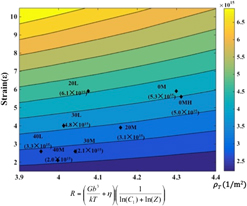
The multiplication of dislocations determines the trajectories of microstructure evolution during plastic deformation. It has been recognized that the dislocation storage and the deformation-driven subgrain formation are correlated—the principle of similitude, where the dislocation density (ρi) scales self-similarly with the subgrain size (δ): $\delta \sqrt {{\rho _{\rm{i}}}}$ ∼ constant. Here, the robustness of this concept in Cu is probed utilizing large strain machining across a swathe of severe shear deformation conditions—strains in the range 1–10 and strain-rates 10–103/s. Deformation strain, strain-rate, and temperature characterizations are juxtaposed with electron microscopy, and dislocation densities are measured by quantification of broadening of X-ray diffraction peaks of crystallographic planes. We parameterize the variation of dislocation density as a function of strain and a rate parameter R, a function of strain-rate, temperature, and material constants. We confirm the preservation of similitude between dislocation density and the subgrain structure across orders-of-magnitude of thermomechanical conditions.
Cobalt-doped ZnO (CZO) film nanocomposites have been deposited on Si(100) substrates by pulsed electron beam ablation from a single Co0.2Zn0.8O target. The films have been deposited at various electron beam repetition rates (1, 2, 4, and 8 Hz), under a background argon (Ar) pressure of ∼3 mtorr, an accelerating voltage of 16 kV, and a deposition temperature of 450 °C. The effect of beam frequency on the structural, chemical, and morphological properties of the films has been assessed. The findings reveal that film thickness, film roughness, and degree of crystallinity of the ZnO wurtzite structure increase with beam frequency, while globule size and density reach maximum and minimum values, respectively, as the beam frequency is increased. The pulse frequency does not appear to affect the average nanoparticulate size. X-ray photoelectron spectroscopy data support the co-existence of metallic cobalt (Co0), CoO, and Co2O3 in CZO films near the surface. Phase analysis by X-ray diffraction also confirms the presence of hexagonal close-packed metallic cobalt whose content in the films is practically unaffected by beam frequency.
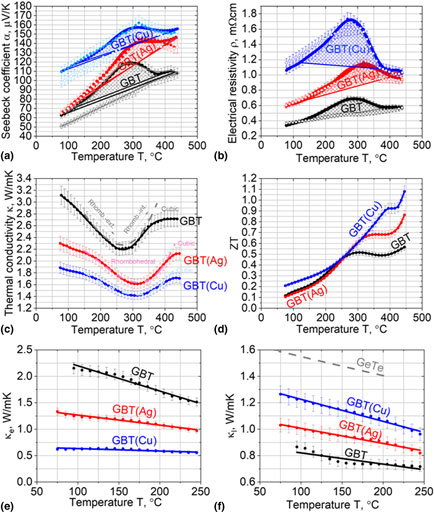
Thermoelectric (TE) is a heat-to-electricity energy conversion method with increasing attention. In recent years, novel highly efficient TE materials, including GeTe and other IV–VI based alloys, were reported, mainly due to either electronic optimization of transport properties or nanostructuring for minimization of the lattice thermal conductivity. Yet, the mechanical properties of such materials (with brittle nature), which are significant for obtaining the required durability under the associated thermo-mechanical conditions of practical applications, were much less tackled. The challenge is combining the both, upon introducing alloying elements, positively contributing both the TE figure of merit and the mechanical durability. In the current research, the TE and mechanical (mainly compression and fracture toughness) effects of Ag- and Cu-doping of the GeTe-rich (GeTe)0.96(Bi2Te3)0.04 alloy were investigated, suggesting improvement on both aspects.
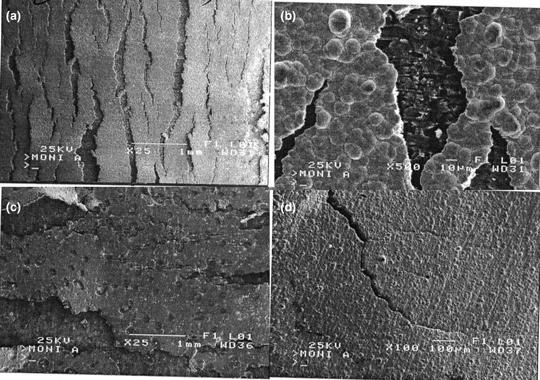
This study constitutes an attempt to characterize the microscopic strain distribution during bending in the AI6156-T61 aged alloy and in the same aluminum alloy with nickel coating. Bendability was detected in both groups by load-displacement curves, at four different strain rates (0.5, 2, 5, and 10 mm/min). In the case of the bare aluminum alloy, the terminal bending angle (without fracture occurring) was 83°. It can be suggested that hemming effect, delamination, spallation, and falling back of the coating was evident in both regions. The surface morphology of the alloys under examination was studied using a scanning electron microscope connected to an energy-dispersive spectroscope.
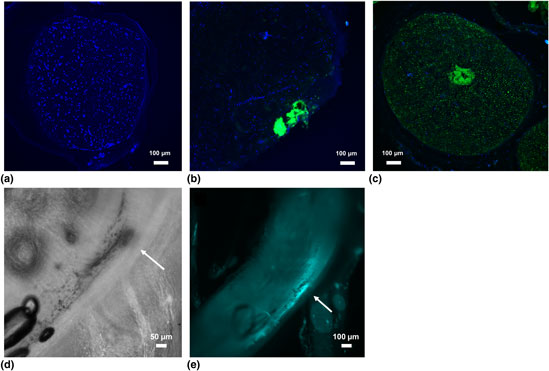
The goal of this study was to perform in situ electrochemical polymerization of poly(3,4-ethylenedioxythiophene) (PEDOT) in peripheral nerves to create a soft, precisely located injectable conductive polymer electrode for bi-directional communication. Intraneural PEDOT polymerization was performed to target both outer and inner fascicles via custom fabricated 3D printed cuff electrodes and monomer injection strategies using a combination electrode-cannula system. Electrochemistry, histology, and laser light sheet microscopy revealed the presence of PEDOT at specified locations inside of peripheral nerve. This work demonstrates the potential for using in situ PEDOT electrodeposition as an injectable electrode for recording and stimulation of peripheral nerves.
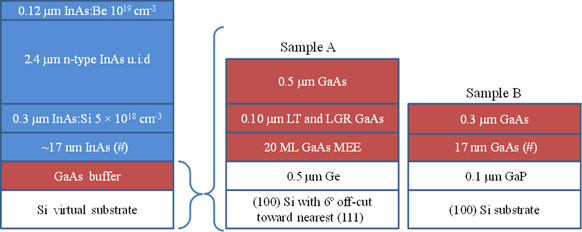
We report an epitaxy growth and characterization of InAs photodetector (PD) on virtual Ge/Si and GaP/Si substrates. The effect of different types of the virtual substrate on the structure and performance of the InAs PD was studied. Although the lattice mismatch between InAs and Si is large (11.6%), close to 100% relaxation of InAs was achieved on both virtual substrates. A higher surface roughness was observed in the InAs layer grown GaP/Si as compared with that of Ge/Si. InAs PD with room temperature blackbody specific detectivity of ~5 × 108 cm·Hz1/2/W is achieved in photovoltaic mode on both types of virtual substrate.
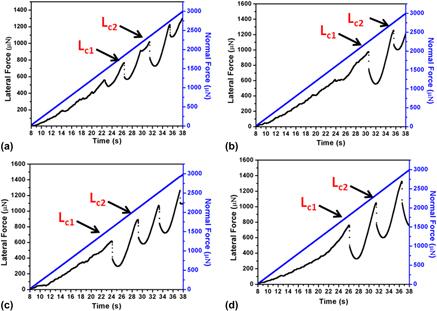
Mechanical properties of Pr (praseodymium)-doped ZnO thin films, deposited on a corning glass substrate and fused quartz at different deposition pressures using DC sputtering were investigated. Crystalline growth in Pr-doped ZnO thin films is more pronounced and improves at 10 mtorr deposition pressure. However, lower sputtering deposition pressure evoked deposition rates to the formation of polycrystalline films emerged in several crystal planes. Pr ions incorporated in the ZnO host lattice was examined by X-ray photoelectron spectroscopy (XPS), AFM, and FESEM. XPS spectroscopy revealed the presence of Pr3+ and Pr4+ at the ZnO surface layer and it was in tandem with EDS mapping. Nanoindentation prior to scratch testing is used for analyzing deformation characteristics. Pr-doped ZnO thin films exhibit better hardness (9.89 ± 0.14 GPa) and Young’s modulus (112.12 ± 3.45 GPa) on the glass substrate. The crack propagation resistance parameter of the films was evaluated using initial critical load, Lc1 ∼ 2250.5 µN for the crack initiation and upper critical load Lc2 ∼ 2754.5 µN for film failure. Better crack propagation resistance was observed for films deposited at 10 mtorr sputtering pressure on both substrates, attributed to better crystalline nature of the films.
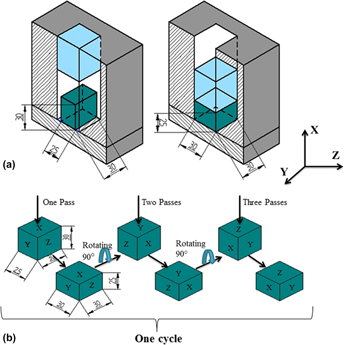
A Cu–3%Ti (wt%) alloy was processed by multiaxial forging (MAF) at cryogenic temperature up to 3 cycles, imposing a total strain of 1.6. Microstructure and mechanical properties of the unprocessed and cryo-forged samples were analyzed. X-ray diffraction results showed deviation in peak broadening and peak intensity of the cryo-forged samples in comparison to that of unprocessed, which are due to texture modification caused by grain refinement during the MAF process. Microstructural analysis showed reduction in grain size from 80 µm in the as-received condition to 250 nm after 3 cycles. Electron backscatter diffraction results indicated the transformation of high angle grain boundaries to low angle grain boundaries in all 3 cycles when compared to the as-received condition. Reduction in ductility was observed after 1 cycle, but with an increase in the number of cycles, both strength and ductility increased. After 3 cycles, ultimate tensile strength and hardness reached 1126 MPa and 427 Hv as compared to 528 MPa and 224 Hv for the as-received condition. Fractography analysis showed decrement in dimple size after 1 cycle, in comparison to that of the as-received condition. However, it kept on increasing for higher number of cycles.
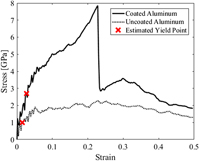
In this paper, mechanical characteristics of the aluminum layer coated with graphene are investigated by performing numerical tensile experiments through classical molecular dynamics simulations. Based on the results of the simulations, it is shown that coating with graphene enhances the Young’s modulus of aluminum by 88% while changing the tensile behavior of aluminum with hardening–softening mechanisms and significantly increased toughness. Furthermore, the effect of loading rate is examined and a transformation to an amorphous phase is observed in the coated aluminum structure as the loading rate is increased. Even though the dominant component of the coated hybrid structure is the aluminum core in the elastic region, the graphene layer shows its effects majorly in the plastic region by a 60% increase in the ultimate tensile strength. High loading rates at room temperature cause the structure transforms to an amorphous phase, as expected. Thus, effects of loading rate and temperature on amorphization are investigated by performing the same simulations at different strain rates and temperatures (i.e., 0, 300, and 600 K).
Designed for both one- and two-semester courses, this textbook provides a succinct and easy-to-read introduction to crystal structures and structure-property relations. By linking together the fundamentals of bond strength and the arrangement of atoms in space with the mechanical, optical, magnetic and electrical properties that they control, students will gain an intuitive understanding of how different materials are suited to particular applications. The systematics of crystal structures are described for both organic and inorganic materials, with coverage including small molecular crystals, polymers, metals, ceramics and semiconductors. Hundreds of figures and practice problems help students gain an advanced, 3D understanding of how structure governs behavior, and a wealth of examples throughout show how the underlying theory is translated into practical devices. With solutions, video lectures and overheads available online for instructors, this is an excellent resource for graduates and senior undergraduates studying materials science and engineering.
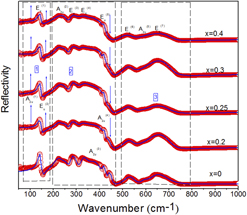
(1 − x)Ba(Mg1/3Ta2/3)O3–xBa(Co1/3Nb2/3)O3 (BMT–BCN, x = 0.0, 0.20, 0.25, 0.30, 0.40) ceramics were prepared using the traditional solid-state reaction method. X-ray diffraction patterns have shown that the intensities of (001) and (100) super-lattices decrease with the increase in the BCN content. Seven main Raman vibrational modes are observed, assigned, and illustrated, in particular. Raman shifts of Eg(O) modes and the FWHM values of F2g(O)/A1g(O) modes have close relationship with the dielectric properties. The calculated values by the four-parameter semiquantum model based on IR reflectivity match well with the measured data (@3.8 GHz), which means that most of dielectric contribution to the system may be ascribed to the absorption of structural phononic oscillations at the infrared region, and the contribution from the scattering of the defective phonons is small. The contributions of each vibrational mode on the dielectric responses were investigated in detail, indicating that the low-frequency modes (A2u(1) and Eu(1)) have a decisive role to the dielectric properties.
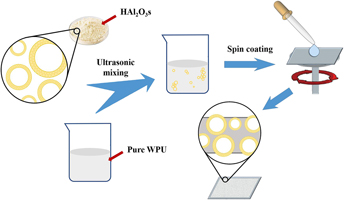
Water-based polyurethane/alumina hollow microsphere (WPU-hAl2O3) composite films were prepared via a facile spin coating method. The pristine WPU, as the matrix of the composite films, was tailor-made by hAl2O3 with the diameter of 2–5 μm to improve the mechanical and physical properties of the films. The hardness, surface morphology, infrared emissivity, wettability, and light transmittance of the WPU-hAl2O3 films with different hAl2O3 contents were investigated. The results indicate that the Vickers hardness, coefficient of friction, infrared emissivity at the wavelength of 2–22 μm, and wetting angle of the WPU-hAl2O3 films (30 wt%) increased by 53.6%, 51.7%, 21.1%, and 19.0%, respectively, compared with the pristine WPU films. Meanwhile, with the rising of hAl2O3 content, the light transmittance decreased by 75.3% at the wavelength of 400–800 nm. This work not only designs a kind of lightweight multifunctional composite film but also provides an effective route for extending further applications of hAl2O3 in the field of composite films.
A set of embedded atom method model interatomic potentials is presented to represent a high-entropy alloy with five components. The set is developed to resemble but not model precisely face-centered cubic (fcc) near-equiatomic mixtures of Fe–Ni–Cr–Co–Cu. The individual components have atomic sizes deviating up to 3%. With the heats of mixing of all binary equiatomic random fcc mixtures being less than 0.7 kJ/mol and the corresponding value for the quinary being −0.0002 kJ/mol, the potentials predict the random equiatomic fcc quinary mixture to be stable with respect to phase separation or ordering and with respect to bcc and hcp random mixtures. The details of lattice distortion, strain, and stress states in this phase are reported. The standard deviation in the individual nearest neighbor bond lengths was found to be in the range of 2%. Most importantly, individual atoms in the alloy were found to be under atomic strains up to 0.5%, corresponding to individual atomic stresses up to several GPa.
In this work, corrosion-resistant fluoridated Ca–Mg–P composite coatings were prepared on magnesium alloys via a hydrothermal assisted sol–gel process. All these coatings derived from Coating Sols with different F− concentrations are composed of fluoridated hydroxyapatite, magnesium hydroxide, and dittmarite. When F− concentration of Coating Sol is 0.03 M, the coating exhibited uniform and dense surface, and its thickness reached 32 μm, thus possessing a high charge transfer resistance of 312 ± 12.69 kΩ cm2 in simulated body fluid (SBF). Immersion test in SBF showed that this coating could quickly induce the formation of the mineralized layer, implying relatively high bioactivity. After 49 days of immersion, the original composite coating and newly formed mineralized layer reached 60 μm in thickness, providing effective long-term protection for magnesium alloys. These attractive results indicate that this fluoridated Ca–Mg–P composite coating is a promising protective coating on biodegradable magnesium and magnesium alloy implants for orthopaedic applications.
BaTiO3-based lead-free piezoelectric materials have long been known as “a mediocre class of piezoelectric materials.” However, they have seen significant renewed interest in recent years ever since the discovery of high piezoelectricity in Ba(Zr, Ti)O3-(Ba, Ca)TiO3 as well as the related Ba(Sn, Ti)O3-(Ba, Ca)TiO3 and Ba(Hf, Ti)O3-(Ba, Ca)TiO3 systems. The unexpectedly high piezoelectricity in this class of BaTiO3 (BT)-based materials is still not well understood and has stimulated significant research activity. We present a concise discussion of the notions leading to high piezoelectricity in BaTiO3-based systems. In particular, the possible role of a multiphase-coexisting point is highlighted.
High-entropy alloys (HEAs) consisting of multiprincipal elements have demonstrated many interesting structural, physical, and chemical properties for a wide range of applications. This article is a review of the current theoretical research on the elastic parameters of HEAs. The performance of various ab initio-based computational models (effective medium and supercell approaches) is carefully analyzed. Representative theoretical elastic parameters of different HEAs, including single-crystal elastic constants, polycrystalline elastic moduli, elastic anisotropy, and Debye temperature, are presented and discussed. For comparison, simple mixtures of the elastic moduli of pure elements are calculated and contrasted with the ab initio results. The present work provides a reference for future theoretical investigation of the micromechanical properties of systems based on HEAs.