To save content items to your account,
please confirm that you agree to abide by our usage policies.
If this is the first time you use this feature, you will be asked to authorise Cambridge Core to connect with your account.
Find out more about saving content to .
To save content items to your Kindle, first ensure no-reply@cambridge.org
is added to your Approved Personal Document E-mail List under your Personal Document Settings
on the Manage Your Content and Devices page of your Amazon account. Then enter the ‘name’ part
of your Kindle email address below.
Find out more about saving to your Kindle.
Note you can select to save to either the @free.kindle.com or @kindle.com variations.
‘@free.kindle.com’ emails are free but can only be saved to your device when it is connected to wi-fi.
‘@kindle.com’ emails can be delivered even when you are not connected to wi-fi, but note that service fees apply.
The reduction of cis-[CoIII(κ2N,N′-1,10-phenanthroline-5,6-dione)2Cl2]Cl into the neutral compound cis-[CoII(κ2N,N′-1,10-phenanthroline-5,6-dione)2Cl2] was observed during developmental studies of new antimalarial drugs. The crystal structure of cis-[CoII(κ2N,N′-1,10-phenanthroline-5,6-dione)2Cl2] was unveiled by powder X-ray diffraction studies (PXRD). PXRD details, unit cell parameters, and space group for cis-[CoII(κ2N,N′-1,10-phenanthroline-5,6-dione)2Cl2], C24H12Cl2CoN4O4, are reported [a = 41.4951 (13) Å, b = 8.2768 (2) Å, c = 12.4994 (3) Å, unit cell volume V = 4292.9 (2) Å3, Z = 8, and space group Fdd2]. Infrared spectroscopy features are also discussed.
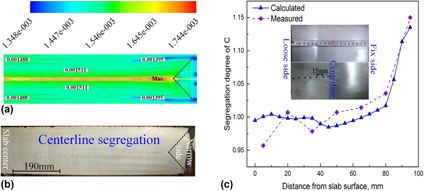
Centerline segregation is one of the typical internal defects, which occurs during slab continuous casting (CC). To investigate and predict the centerline segregation encountered in a continuously cast slab, a combined 3-D and 2-D hybrid simulation model for centerline segregation was developed. The average deviation between the calculated and experimented results reaches as low as 0.5%, which demonstrates that the hybrid simulation model has relatively high reliability. The centerline segregation of the slab was predicted accurately. The results show that macrosegregation occurring during the slab CC process has heredity. In the casting direction, the concentration of solutes in the liquid pool increases gradually until the casting has solidified completely. After complete solidification, the solutes’ concentration maintains an almost constant value. On the centerline, the maximum segregation degree occurs at a position roughly 614 mm from the slab center. The maximum centerline segregation degrees of C, Si, Mn, P, and S solutes are 1.163, 1.058, 1.045, 1.111, and 1.165, respectively.
We have performed mechanical finishing operations on Sverker 21 (traditional) and Vanadis 6 (advanced powder) steel surfaces: grinding, turning, and turning followed by slide burnishing. Then each specimen was subjected in turn to focused ion beams of helium or krypton up to fluences of 1015 ions/cm2 and finally to scratch resistance testing. Acoustic signals show that krypton implantation reduces microcracks. Helium ions act even more strongly as homogenizers—almost completely eliminating the imperfections. Optical microscopy during scratch testing shows the force level when debris formation begins. Helium ions fitting between the iron atoms increase the resistance against scratching; larger krypton ions produce the opposite effect.
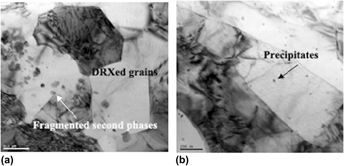
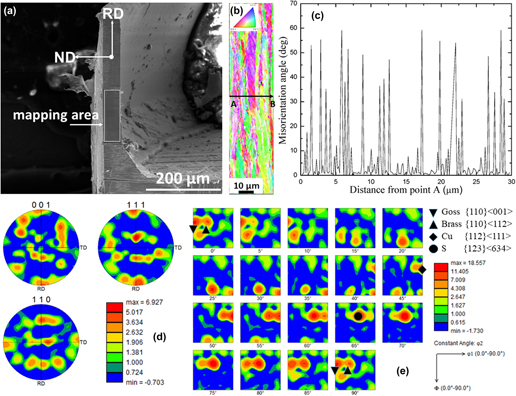
The microstructure and tensile property of extruded Mg–6Zn–1.5Ca (wt%) alloy were examined by means of electron backscattered diffraction, scanning and transmission electron microscopy. A bimodal microstructure featuring fine dynamically recrystallized (DRXed) grains with weaker texture and coarse-deformed region with strong basal texture and fine precipitates was achieved in the as-extruded Mg–Zn–Ca alloy, which resulted in a yield strength as high as 305 MPa and a moderate elongation to fracture of 8.6%. Dynamic precipitation was detected in the deformed region, which inhibited the dynamic recrystallization process. The texture intensity in the DRXed region was weakened compared with that in the deformed region, which was associated with the preferred nucleation during dynamic recrystallization. Such texture weakening effects gave rise to an obvious ductility improvement for the as-annealed alloy.
Axisymmetric reverse extrusion experiments were conducted on annealed Cu rod specimens to form cup-shaped structures with sidewall thicknesses ranging from ∼400 µm down to ∼25 µm. Changes in Cu grain morphology, size, and texture were examined through scanning electron microscopy and electron backscatter diffraction (EBSD). Pole figure and orientation distribution function analysis of EBSD data showed the same texture components in the present small-scale metal forming experiments as those observed in macroscale sheet metal rolling. The plastic deformation became inhomogeneous as the characteristic dimension for extrusion decreased to ∼25 µm, such that the deformation process involved a small number of Cu grains. Extrusion force–punch displacement curves were measured as a function of extruded cup sidewall thickness and compared to outputs of a continuum plasticity finite element analysis in corresponding geometries. The present work illustrates materials characteristics in small-scale metal forming and suggests directions of future work for bringing improved correspondence between experimentation and modeling.
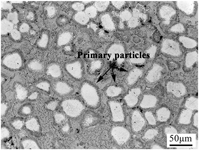
The influences of pressure and aging treatment on microstructures and mechanical properties of rheo-squeeze casting (RSC) Mg–3Nd–0.2Zn–0.4Zr alloys were studied. It was found that the nucleation rate, solid solubility of Nd and Zn in the α-Mg matrix, and dislocation density were increased with increasing applied pressure. After aging treatment, the amount of the Zn2Zr3 phase was increased with increasing pressure; β″ phase and β′ precipitates were observed in the RSC alloy and finer β′ precipitates formed in the permanent mold casting (PMC) alloy. The mechanical properties of as-cast alloys were initially increased and then decreased with increasing pressure, while the properties of T6-treated alloys were increased continuously. Due to the larger grain boundary strengthening contribution, the T6-treated RSC sample showed higher mechanical properties than the PMC sample, and the yield strength, ultimate tensile strength, and elongation could reach 165 MPa, 309 MPa, and 5.7%, respectively.
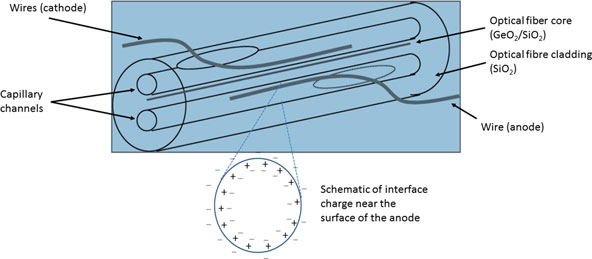
A review of the literature offers an explanation for the large anomalous electro-optic (e.o.) effect reported by Fujiwara et al. in 1994. It is based on the large e.o. coefficient of ordered water at an interface measured in recent years >1000 pm/V. More broadly, the concept of water-based photonics, where water could be a new platform material for devices and systems, is introduced, suggesting that liquid states of matter can allow ready shaping and exploitation of many processes in ways not previously considered. This paper is a commentary on the significance of this new understanding and the broader interest of water in photonics, particularly its consideration as a new platform material.
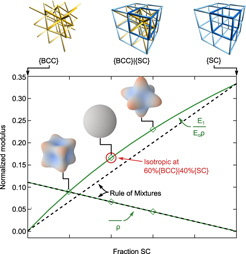
The present article addresses design of stiff, elastically isotropic trusses and their mechanical properties. Isotropic trusses are created by combining two or more elementary cubic trusses in appropriate proportions and with their respective nodes lying on a common space lattice. Two isotropic binary compound trusses and many isotropic ternary trusses are identified, all with Young’s moduli equal to the maximal possible value for isotropic strut-based structures. In finite-sized trusses, strain elevations are obtained in struts near the external free boundaries: a consequence of reduced nodal connectivity and thus reduced constraint on strut deformation and rotation. Although the boundary effects persist over distances of only about two unit cell lengths and have minimal effect on elastic properties, their manifestations in failure are more nuanced, especially when failure occurs by modes other than buckling (yielding or fracture). Exhaustive analyses are performed to glean insights into the mechanics of failure of such trusses.
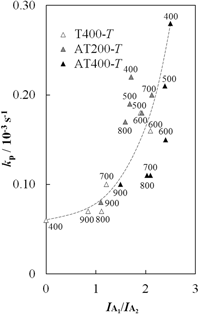
To investigate the effects of adding Au nanoparticles (AuNPs) to TiO2 films on the crystallization, phase transformation, and photocatalysis, films of both TiO2 and TiO2 embedded with AuNPs (Au–TiO2) with various characteristics were prepared by using the dip-coating method with preheating and post-heating treatments. The AuNPs acted as anatase nucleation agents and crystallized a lot of small anatase crystals with sizes of tens of nanometers, which suppressed the growth of anatase crystals that are large enough for them to transform into rutile crystals, resulting in repression of the transformation from anatase into rutile. The AuNPs affected the progress of the photocatalytic and adsorption reactions, resulting in improved photocatalytic activity. Of all the films we tested, the Au–TiO2 film preheated at 400 °C and post-heated at 400 °C (AT400-400), which consisted of small anatase crystals with high covalent character and high crystallinity, contained dispersed AuNPs with the smallest average crystallite size and showed the highest photocatalytic activity. This high activity resulted from the high reaction rate constants for adsorption and photocatalysis.
The crystal structure of MoO2(O2)H2O has been solved by analogy with the WO2(O2)H2O structure and refined with synchrotron powder diffraction data obtained from beamline 08B1-1 at the Canadian Light Source. Rietveld refinement, performed with the software package GSAS, yielded monoclinic lattice parameters of a = 12.0417(4) Å, b = 3.87003(14) Å, c = 7.38390(24) Å, and β = 78.0843(11)° (Z = 4, space group P21/n). The structure is composed of double zigzag molybdate chains running parallel to the b-axis. The Rietveld refined structure was compared with density functional theory (DFT) calculations performed with CRYSTAL14, and show strong agreement with the DFT optimized structure.
Commercially available trisodium hexachlororhodate (Na3RhCl6) was dehydrated and characterized by laboratory X-ray powder diffraction. The crystal structure is isostructural to the Na3CrCl6 structure type with space group P$\bar 31$c. Unit-cell parameters are a = 6.8116(1) Å, c = 11.9196(2) Å, V = 478.95(2) Å3, and Z = 2.
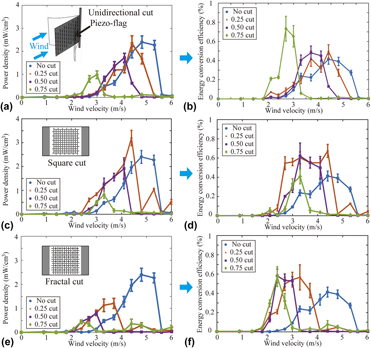
Introducing architected cuts is an attractive and simple approach to tune mechanical behaviors of planar materials like thin films for desirable or enhanced mechanical performance. However, little has been studied on the effects of architected cuts on functional materials like piezoelectric materials. We investigated how architected cut patterns affect mechanical and piezoelectric properties of polyvinylidene fluoride thin films by numerical, experimental, and analytical studies. Our results show that thin films with architected cuts can provide desired mechanical features like enhanced compliance, stretchability, and controllable Poisson’s ratio and resonance frequency, while maintaining piezoelectric performance under static loadings. Moreover, we could observe maximum ∼30% improvement in piezoelectric conversion efficiency under dynamic loadings and harvest energy from low frequency (<100 Hz) mechanical signals or low velocity (<5 m/s) winds, which are commonly existing in ambient environment. Using architected cuts doesn't require changing the material or overall dimensions, making it attractive for applications in self-powered devices with design constraints.
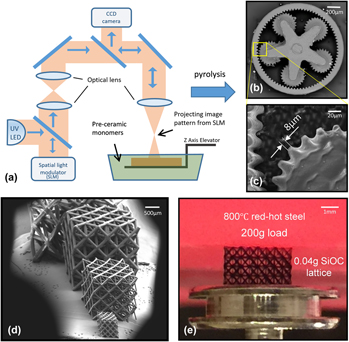
3D microarchitected metamaterials exhibit unique, desirable properties influenced by their small length scales and architected layout, unachievable by their solid counterparts and random cellular configurations. However, few of them can be used in high-temperature applications, which could benefit significantly from their ultra-lightweight, ultrastiff properties. Existing high-temperature ceramic materials are often heavy and difficult to process into complex, microscale features. Inspired by this limitation, we fabricated polymer-derived ceramic metamaterials with controlled solid strut size varying from 10-µm scale to a few millimeters with relative densities ranging from as low as 1 to 22%. We found that these high-temperature architected ceramics of identical 3D topologies exhibit size-dependent strength influenced by both strut diameter and strut length. Weibull theory is utilized to map this dependency with varying single strut volumes. These observations demonstrate the structural benefits of increasing feature resolution in additive manufacturing of ceramic materials. Through capitalizing upon the reduction of unit strut volumes within the architecture, high-temperature ceramics could achieve high specific strength with only fraction of the weight of their solid counterparts.
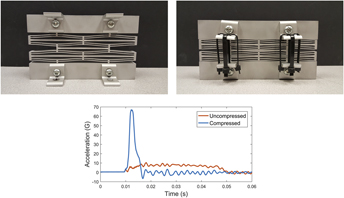
Negative stiffness honeycombs are architected metamaterials that utilize elastic buckling to absorb mechanical energy. Relative to conventional honeycomb materials, they offer several advantages, including the ability to recover their initial configuration and offer consistently repeatable mechanical energy absorption. In this paper, fully recoverable negative stiffness honeycombs are fabricated from thermoplastic and metallic parent materials. The honeycombs are subjected to quasistatic and impact loading to demonstrate the predictability and repeatability of their energy absorption characteristics across a variety of loading conditions. Results indicate that these honeycombs offer nearly ideal shock isolation by thresholding the acceleration of an isolated mass at a predetermined level and that this thresholding behavior is highly repeatable as long as the magnitude of the mechanical energy imparted to the system does not exceed the energy absorption capacity of the honeycomb.
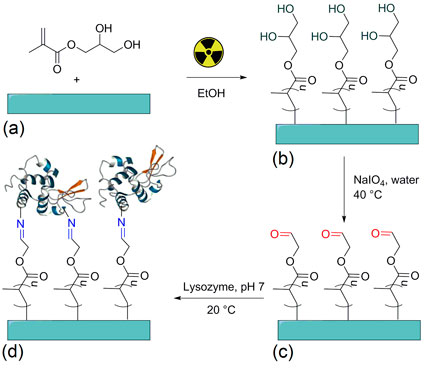
The goal of this work was the modification of silicone rubber (SR) by radiation grafting of glycerol methacrylate (GlyMA) which was limited just on the surface, allowing the control of hydrophilicity and swelling properties. The grafted SRs were activated by derivatization of GlyMA to 2-oxoethyl methacrylate using sodium periodate, enabling the chemical immobilization of lysozyme by covalent bonds. The presence of lysozyme was confirmed by non-specific assay and by the enzymatic activity at 30 °C with Micrococcus lysodeikticus (coccus, Gram-positive). The materials were characterized by Fourier transform infrared spectroscopy-attenuated total reflectance, thermogravimetric analysis, water contact angle, and by mechanical properties as well as scanning electron microscope.