To save content items to your account,
please confirm that you agree to abide by our usage policies.
If this is the first time you use this feature, you will be asked to authorise Cambridge Core to connect with your account.
Find out more about saving content to .
To save content items to your Kindle, first ensure no-reply@cambridge.org
is added to your Approved Personal Document E-mail List under your Personal Document Settings
on the Manage Your Content and Devices page of your Amazon account. Then enter the ‘name’ part
of your Kindle email address below.
Find out more about saving to your Kindle.
Note you can select to save to either the @free.kindle.com or @kindle.com variations.
‘@free.kindle.com’ emails are free but can only be saved to your device when it is connected to wi-fi.
‘@kindle.com’ emails can be delivered even when you are not connected to wi-fi, but note that service fees apply.
Microstructural and crystallographic aspects of high-velocity forming or “rapid” forming of rolled sheets of pure copper have been investigated in this work. Significant changes in crystallographic orientation and microstructure were observed when thin (0.5 mm) metal sheets of annealed copper were subjected to high strain rate deformation in a conventional shock tube at a very low impulse magnitude (∼0.2 N s), which is inconceivable in conventional metal forming. Shock-loaded samples show characteristic texture evolution with a high brass {110}〈112〉 component. A significant change in grain orientation spread was observed with increasing amount of effective strain without any drastic change in grain size. The texture after deformation was found to be strain-dependent. The path of texture evolution is dependent on the initial texture. Misorientation was limited to less than 5°. Deformation bands and deformation twins were observed. There was a decrease in twin [Σ3 coincidence site lattice (CSL)] boundary number fraction with increasing strain due to the change in twin boundary character to high-angle random boundary (HARB) as a result of dislocation pile up. The study shows the probability of a high-velocity shock wave forming pure Cu.
A Cu–0.13Cr–0.074Ag (wt%) alloy has been synthesized by the nonvacuum melting and casting followed by thermal-mechanical treatment, and microstructure and mechanical properties have been tailored to make a trade-off between the strength and the electrical conductivity. Results illuminated that the designed alloy has a tensile strength of 473 MPa, a hardness of 140 HV, a yield strength of 446 MPa, an elongation of 10.5%, and an electrical conductivity of 94.5% IACS. Microstructure observations of the samples aged at 480 °C showed that: an fcc structure Cr-phase with a cube-on-cube orientation relationship with the Cu matrix was formed as aged for 15 min, while an ordered bcc structure Cr phase with B2 structure formed as aged for 2 h. The 3DAP results revealed that the Cr was formed to be precipitates and the Ag was formed as solutes distributing evenly in matrix. The high electrical conductivity was ascribed to the Cr element precipitated from the Cu matrix, Ag dissolved in the Cu matrix had little effect on the scattering of Cu electron.
Natural rubber (NR) is expected to enhance impact strength of poly(lactic acid) (PLA). Because the polarity difference of NR and PLA leads PLA/NR blends having phase separation and poor mechanical properties, this research aimed to synthesize NR-graft-PLA (NR–PLA) via esterification of maleated NR (NR-MAH) with PLA. The role of NR–PLA used as a compatibilizer on mechanical and thermal properties of the PLA/NR blends was studied. Maximum grafted PLA level at 66.8% (w/w) was reached when NR-MAH was esterified with PLA [2/1 (w/w) PLA/NR-MAH] catalyzed by 0.05 M 4-dimethylaminopyridine at 140 °C. The addition of 5% (w/w) NR–PLA [36.6% (w/w) grafted PLA content] into PLA/NR blend [80/20 (w/w)] increased Izod impact strength of the neat PLA plate from 28.9 J/m to 62.7 J/m due to partial miscibility of blends attested by morphology analysis and Molau test. Hydrolytic degradation of PLA/NR blends with and without the addition of NR–PLA was also examined.
The influence of hot rolling on the evolution of the interface microstructure as well as mechanical properties of the Mg/Al explosive welding composite plates was investigated. The hardening phenomenon induced by explosive welding could be eliminated effectively through preheating treatment. An intermetallic compound layer consisting of Al3Mg2 and Mg17Al12 was observed at the Mg/Al interface after annealing at 400 °C. The composite plate then was hot rolled at 400 °C with different reduction ratios. The composite plates presented different degrees of warp and edge cracks with increasing the reduction ratio. At the reduction ratio of 30%, the coordination deformation ability of the constituent Mg and Al alloys is consistent with the composite plate. The results showed that the tensile strength and the elongation of the composite plates increased significantly after hot rolling owing to the dynamic recrystallization and the intermetallic compounds thickness decrease during hot rolling.
The effects of high magnetic fields on the solidification structures of ternary Al–Fe–Zr alloy were investigated. The results showed that the primary Al3Fe crystals mainly show bar-like form, whereas the unmelted Al3Zr crystals reveal tabular and the newly crystallized primary Al3Zr crystals have fine/coarse needle-like forms. When a 12 T magnetic field is applied, the primary Al3Fe crystals are distributed homogenously and the fine needle-like primary Al3Zr levitated. Moreover, the primary Al3Fe crystals align horizontally in the upper but vertically in the lower part of the specimen. The needle-like primary Al3Zr crystals align vertically, whereas the tabular ones have their two opposite corners on the large surfaces toward the positive and negative magnetic field direction. Crystallographic analysis indicates that 〈100〉 and 〈110〉 are the preferred axes of the primary Al3Fe and the Al3Zr crystals with respect to the magnetic field, respectively. The redistribution and realignments of the crystals are discussed.
High iodine containing oxides are of interest as biocidal components in energetic applications requiring fast exothermic reactions with metallic fuels. Aerosol techniques offer a convenient route and potentially direct route for preparation of small particles with high purity, and are a method proven to be amenable and economical to scale-up. Here, we demonstrate the synthesis of various iodine oxide/iodic acid microparticles by a direct one-step aerosol method from iodic acid. By varying temperature and humidity, we produced near phase pure δ-HIO3, HI3O8, and I2O5 as determined by X-ray diffraction. δ-HIO3, a previously unknown phase, was confirmed in this work. In addition, scanning electron microscopy was used to examine the morphology and size of those prepared iodine oxide/iodic acid particles and the results show that all particles have an irregularly spherical shape. Thermogravimetric/differential scanning calorimetry measurement results show that HIO3 dehydrates endothermically to HI3O8, and then to I2O. I2O5 decomposes to I2 and O2.
Phase predictions and characterizations on as-solidified septenary refractory high-entropy alloy, CrMoNbReTaVW, are presented. The simulated solidification process predicts a single body-centered-cubic (BCC) crystal structure with the tendency of compositional segregation. X-ray diffraction results confirm the “single-phase-like” BCC structure, while further experimental characterizations reveal the existence of multiple grains with significantly different compositions yet the same crystal structure and similar lattice parameters.
The program FAULTS has been used to simulate the X-ray powder diffraction (XRD), neutron powder diffraction (NPD), and electron diffraction (ED) patterns of several structural models for LiNi1/3Mn1/3Co1/3O2, including different types of ordering of the transition metal (TM) cations in the TM slabs, different amounts of Li+/NiII+ cation mixing and different amounts of stacking faults. The results demonstrate the relevance of the structural information provided by NPD and ED data as compared with XRD to characterize the microstructure of NMC (LiNi1−y-zMnyCozO2) compounds.
Polymer:fullerene nanoparticles (NPs) offer two key advantages over bulk heterojunction (BHJ) films for organic photovoltaics (OPVs), water-processability and potentially superior morphological control. Once an optimal active layer morphology is reached, maintaining this morphology at OPV operating temperatures is key to the lifetime of a device. Here we study the morphology of the PDPP-TNT (poly{3,6-dithiophene-2-yl-2,5-di(2-octyldodecyl)-pyrrolo[3,4-c]pyrrole-1,4-dione-alt-naphthalene}):PC71BM ([6,6]-phenyl C71 butyric acid methyl ester) NP system and then compare the thermal stability of NP and BHJ films to the common poly(3-hexylthiophene) (P3HT): phenyl C61 butyric acid methyl ester (PC61BM) system. We find that material Tg plays a key role in the superior thermal stability of the PDPP-TNT:PC71BM system; whereas for the P3HT:PC61BM system, domain structure is critical.
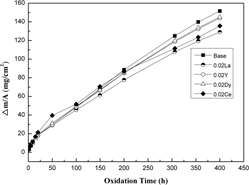
A series of oxidation experiments were carried out on these novel γ/γ′-strengthened cobalt-based alloys of the systems Co–9Al–10W and Co–9Al–10W–0.02X (X = La, Ce, Dy, Y) at 900 °C. The appropriate amounts’ addition of rare earth elements leads to improved oxidation properties at 900 °C, especially La elements show the best oxidation resistance (129.008 mg/cm2). However, the base Co–9Al–10W alloy shows the worst oxidation performance (151.544 mg/cm2). Multilayer oxide layers formed during the oxidation process, the outer were mainly CoO and Co3O4 oxides, and the middle layer contained complex oxides (containing Co, Al, and W). The inner layer consists of little discontinuous oxides, included few Al2O3 oxides. There existed a different crack width and the base alloy had the widest crack. Moreover, there exists a phase transformation (γ/γ′ to γ/Co3W) at the interface between oxide film and substrate.
This study investigated the tribological behaviors of carbon fiber (CF) reinforced epoxy (EP) composites immersed in 10 wt% sulfuric acid solution for different numbers of days. The tribological properties of the composites were evaluated as a function of their different fiber orientations (0°, 45°, 90°, and normal orientation). The CF/EP composites showed a favorable anticorrosion performance, as assessed by electrochemical corrosion tests, due to the tightly stacked CF. Meanwhile, the wear tests indicated that the CF orientation had a significant effect on the tribological performance. Composites with 45° CF orientation exhibited the lowest friction coefficient, whereas those with 90° CF orientation had lowest wear rate, which was 6 times lower than that of composites with normal CF orientation. Moreover, the surface microstructures of the worn surfaces were observed by scanning electron microscopy (SEM) to determine the corresponding wear mechanisms.
We present a novel route to fabricate 3D nanoporous α-Ti foams by dealloying of TiCu master alloy in solid state using Mg powders. Pure open-cell nanoporous α-Ti foams are fabricated with BET surface area of 34.4 ± 0.8 m2/g and pore size in the range of 2–50 nm. The dealloying using powders is a solid state chemical reaction process to form Cu2Mg phase and Ti/Mg nanocomposites. The constituent of Cu in the TiCu alloy was dissolved into Mg powders thanks to the kinetics of interface reaction and volume diffusion. The pore-forming mechanism is a solid-state interdiffusion process. The ligament coarsening is from 492 to 650 nm with increasing of the dealloying temperature. The hardness and elastic modulus in nanoporous α-Ti foam follow linear decay fit with ligament size increasing. Our results demonstrate a facile strategy for the fabrication of nanoporous Ti foams with novel nanostructures and tailored properties.
There is a need to discover new thermoelectric materials that can convert waste heat into electrical energy. In this paper, study has been done to observe the effect of shape and dimension of nanopores embedded in graphene nanoribbons (GNRs) as to tune their thermoelectric performance that can lead to enhancement of thermoelectric figure of merit (ZT). It is observed that incorporation of pores in GNRs greatly reduces the thermal conductivity. Although the Seebeck coefficient decreases with the introduction of the pore while the conductance depends upon the pore shape, the decreasing trend in thermal conductivity leads to enhancement of thermoelectric performance. The aim of this work is to study the effect of various circular and the triangular shaped dimensions so as to tune the pore to its optimal dimension that would enhance the overall thermoelectric efficiency. Ballistic transport regime and semiempirical method using Huckel basis set is used to obtain the electrical properties while the Tersoff potential is used for the phononic system.
A thin-film field-effect transistor (TFT) is a three-terminal device comprising source, drain, and gate electrodes, a dielectric layer, a semiconductor layer, and a substrate. The TFT is a fundamental building component in a variety of electronic devices. Developing an intrinsically stretchable TFT entails availability and usage of a functional material with elastomeric deformability in response to an externally applied stress. This represents a major materials challenge. In this article, we survey strategies to synthesize these elastomeric functional materials, and how these materials are assembled to fabricate intrinsically stretchable TFT devices. Developing solution-based printing technology to assemble intrinsically stretchable TFTs is considered a prospective strategy for wearable electronics for industrial adaptation in the near future.