To save content items to your account,
please confirm that you agree to abide by our usage policies.
If this is the first time you use this feature, you will be asked to authorise Cambridge Core to connect with your account.
Find out more about saving content to .
To save content items to your Kindle, first ensure no-reply@cambridge.org
is added to your Approved Personal Document E-mail List under your Personal Document Settings
on the Manage Your Content and Devices page of your Amazon account. Then enter the ‘name’ part
of your Kindle email address below.
Find out more about saving to your Kindle.
Note you can select to save to either the @free.kindle.com or @kindle.com variations.
‘@free.kindle.com’ emails are free but can only be saved to your device when it is connected to wi-fi.
‘@kindle.com’ emails can be delivered even when you are not connected to wi-fi, but note that service fees apply.
Inhibitory control can be divided into motor and cognitive inhibition. The current research is the first study exploring the impact of brief mindfulness training on motor inhibition, measured by a stop signal task in participants without any meditation experience. Motor inhibition performance was compared before and immediately after three different conditions; a brief mindfulness induction, a resting state and an active control session in which participants listened to their favorite music. Post-test learning effect on go-reaction times was seen for the resting and mindfulness conditions, but was absent in the music session, possibly due to emotional arousal might have led slower responses. Brief mindfulness training did not significantly alter inhibitory control, although marginal improvement in stop signal reaction time following the mindfulness induction was observed. Motor inhibition appears unresponsive to either short-term or long-term mindfulness practice. Future mindfulness studies should explore a broad spectrum of cognitive functions and populations.
Military operations occurring in particle-laden environments have resulted in aircraft incidents and loss of life due to sand ingestion into the engine. Sand melts in the hot combustion environment and deposits as glassy calcia–magnesia–alumino–silicates (CMAS) which leads to rapid performance degradation due to clogged air pathways in the engine. A novel, composite thermal barrier coating (TBC) consisting of yttria-stabilized zirconia (YSZ) blended with gadolinia is proposed that combines the excellent thermo-mechanical properties of YSZ together with the CMAS resistance of rare-earth oxides. YSZ was blended with 2, 8, 17, and 32 vol% gadolinia and tested under simulated engine-relevant conditions. The presence of gadolinia in the composite coating reduced the adhesion of the CMAS, and at 32 vol% gadolinia addition, the CMAS was completely delaminated. A possible CMAS adhesion mitigating mechanism is discussed. This work demonstrated the capability of a new composite TBC to significantly reduce CMAS adhesion.
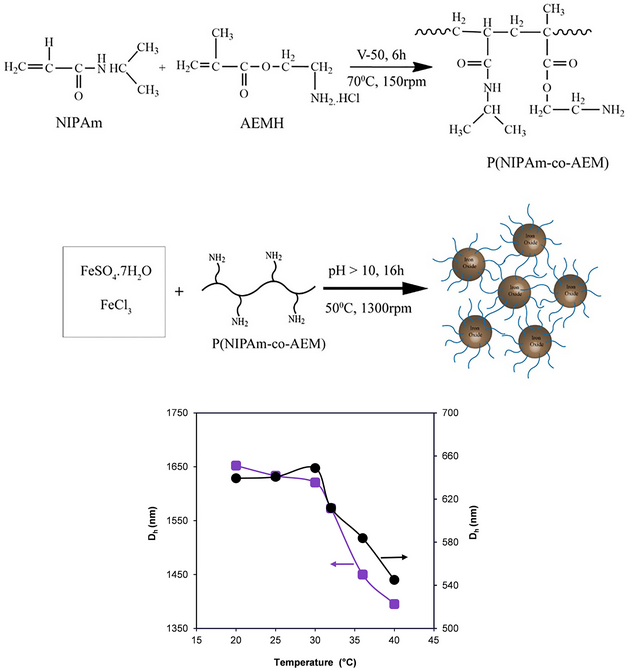
In this study, we report a simple one-pot synthesis of iron oxide nanoparticles (IONPs) modified with thermoresponsive polymers potentially applicable for nucleic acid capture. Ferrous (Fe2+) and ferric (Fe3+) ions were coprecipitated to a dispersion of previously prepared poly(N-isopropylacrylamide-co-2-aminoethyl methacrylate) P(NIPAAm-co-AEM) for in situ synthesis of magnetite (Fe3O4) and concurrent surface modification of Fe3O4 with the polymer to obtain magnetic nanocomposites. Fourier-transform infrared (FTIR) spectroscopy analysis reveals the surface modification of Fe3O4 with P(NIPAAm-co-AEM) and P(NIPAAm) as functional and control polymers, respectively. Fe3O4@P(NIPAAm-co-AEM) and Fe3O4@P(NIPAAm) nanocomposites’ surfaces contain 7.5 and 2.3 wt% of immobilized polymers, respectively. Vibrating sample magnetometry (VSM) result indicates a high saturation of magnetization value, 75 emu/g, for Fe3O4@P(NIPAAm-co-AEM) nanocomposites. The hydrodynamic diameter of Fe3O4@P(NIPAAm-co-AEM) in water changes depending on pH and temperature. A study for deoxyribonucleic acid (DNA) capture ability of Fe3O4@P(NIPAAm-co-AEM) nanocomposites shows a maximum 18.5 mg/g of DNA can be adsorbed on Fe3O4@P(NIPAAm-co-AEM).
Flood and drought events cause significant freshwater inflow fluctuations in estuaries, potentially leading to physiological stress and altered abundances of pathogens such as Vibrio vulnificus and Perkinsus marinus in oysters. To assess the effects of freshwater pulses to oyster reefs in subtropical estuaries in Texas, this study accomplished two goals: 1) reconstructed a reef-specific history of freshwater pulses through shell stable isotope analysis, 2) quantified the abundance of V. vulnificus and P. marinus through culture-dependent and culture-independent microbiology analyses. Oysters from a low-relief and high-relief reef experienced similar fluctuations in shell isotopes, indicating similar ranges of past environmental conditions. V. vulnificus and P. marinus were detected throughout the study but the abundance of these microorganisms was not correlated with environmental parameters or one another. Importantly, the P. marinus infection intensity was always lower at the high-relief reef, which suggests that high-relief reefs may experience lower infection frequencies.
The strain rate sensitivity (m) of (Ni0.92Zr0.08)100−xAlx (0 ≤ x ≤ 4 at.%) eutectic with varying average lamellae thickness (λw) in the range of 39–275 nm has been investigated in the strain rate range of 8 × 10⁻⁵ and 8 × 10⁻³ s−1 at room temperature. The microstructure of the nano-/ultrafine eutectic composites (NECs) is comprised of alternate lamellae of fcc γ-Ni and Ni5Zr along with 20–31 vol% γ-Ni dendritic phase. The m value of all the investigated NECs lies between 0.0080 and 0.0102, whereas the activation volume (V*) has been estimated to be between 29.7b3 and 49.8b3. High-resolution transmission electron microscopy studies confirm the dislocation-mediated plastic flow including dislocation–lamellae interaction, and their pile-up at the interface, which result in the narrow variation of m for a wide range of λw due to its interlocked lamellar microstructure. A mathematical model has been developed to correlate the m with λw for the experimented NECs with wide microstructure length scale and solute content.
Many of the current artificial intelligence (AI) applications that are rapidly becoming indispensable in our society rely on software-based artificial neural networks or deep learning algorithms that are powerful, but energy-inefficient. The brain in comparison is highly efficient at similar classification and pattern finding tasks. Neuromorphic engineering attempts to take advantage of the efficiency of the brain by mimicking several crucial concepts to efficiently emulate AI tasks. Organic electronic materials have been particularly successful in mimicking both the basic functionality of the brain, including important spiking phenomena, but also in low-power operation of hardware-implemented artificial neural networks as well as interfacing with physiological environments due to their biocompatible nature. This article provides an overview of the basic functional operation of the brain and its artificial counterparts, with a particular focus on organic materials and devices. We highlight efforts to mimic brain functions such as spatiotemporal processing, homeostasis, and functional connectivity and emphasize current challenges for efficient neuromorphic computing applications. Finally, we present our view of future directions in this exciting and rapidly growing field of organic neuromorphic devices.
Implantable neural interfaces are important tools to accelerate neuroscience research and translate clinical neurotechnologies. The promise of a bidirectional communication link between the nervous system of humans and computers is compelling, yet important materials challenges must be first addressed to improve the reliability of implantable neural interfaces. This perspective highlights recent progress and challenges related to arguably two of the most common failure modes for implantable neural interfaces: (1) compromised barrier layers and packaging leading to failure of electronic components; (2) encapsulation and rejection of the implant due to injurious tissue–biomaterials interactions, which erode the quality and bandwidth of signals across the biology–technology interface. Innovative materials and device design concepts could address these failure modes to improve device performance and broaden the translational prospects of neural interfaces. A brief overview of contemporary neural interfaces is presented and followed by recent progress in chemistry, materials, and fabrication techniques to improve in vivo reliability, including novel barrier materials and harmonizing the various incongruences of the tissue–device interface. Challenges and opportunities related to the clinical translation of neural interfaces are also discussed.
The main goal of the field of neuromorphic computing is to build machines that emulate aspects of the brain in its ability to perform complex tasks in parallel and with great energy efficiency. Thanks to new computing architectures, these machines could revolutionize high-performance computing and find applications to perform local, low-energy computing for sensors and robots. The use of organic and soft materials in neuromorphic computing is appealing in many respects, for instance, because it allows better integration with living matter to seamlessly meld sensing with signal processing, and ultimately, stimulation in a closed-feedback loop. Indeed, not only can the mechanical properties of organic materials match those of tissue, but also, the working mechanisms of these devices involving ions, in addition to electrons, are compatible with human physiology. Another advantage of organic materials is the potential to introduce novel fabrication techniques relying on additive manufacturing amenable to one-of-a-kind form factors. This field is still nascent, therefore many concepts are still being proposed, without a clear winner. Furthermore, the field of application of organic neuromorphics, where bioinspiration and biointegration are extremely appealing, calls for a co-design approach from materials to systems.
Fundamental materials properties are determined by electrons under the potential energy from the nuclei, the electron mass, and their mutual repulsion. The variable from material to material is the ion potential. The logical procedure of computing electronic properties is to go from the potential to the electron distribution. This enables practical computation of the material properties ranging from atoms and molecules to solids. This method has blossomed due to the effort of numerous people. The concept is analogous to changing prediction of human population distribution from the landscape of hills and dales to determination of the landscape from a population distribution. In atomic systems,quantum quirkiness allows this switch, but dictates that it is only one slice in the tomography of the quantum state. The author shares his experience in the development from this slice, but hews close to the powerful concept of switching the landscape with the population.
Hybrid organic–inorganic halide perovskites have been recently explored as memristive devices that can be programmed to two or more stable conductance states for analog computing. The wide variety and range of optoelectronic phenomena these materials portray offer immense potential to develop scaled-in neuromorphic devices and architectures with multibit memory storage and multimodal accessibility. This article provides a general summary of the structural and optoelectronic characteristics of this material class that could be utilized for neuromorphic computing, discusses insights into the underlying switching mechanisms, and reviews recent developments in the field of halide perovskite-based neuromorphic devices.
We show the design and simulation of organic neuromorphic circuits in a hybrid-computation approach that emulates Boolean and reversible logic gates based on multigate organic electrochemical transistors (OECTs). The organic neuromorphic circuits consist of input, hidden, and output layers that can carry out Boolean operations, including the Exclusive OR (XOR) function, with five or less OECTs. The multigate functionality of OECTs is harnessed to perform the summation function of the neurons. Connection weights of the networks are defined in an unconventional way that depends on the value of the drain-source current of the outputting neuron, which changes according to the input values of the circuit. The Boolean circuits can be cascaded together to build higher level circuits and are demonstrated to form a full adder circuit and the Double Feynman and Toffoli reversible logic gates. Using realistic experimental parameters, the energy per computation is estimated to be ~2.3 nJ for circuit designs with a bias voltage of 0.5 V, with ~230 fJ or less being achievable for lower bias voltages.