To save content items to your account,
please confirm that you agree to abide by our usage policies.
If this is the first time you use this feature, you will be asked to authorise Cambridge Core to connect with your account.
Find out more about saving content to .
To save content items to your Kindle, first ensure no-reply@cambridge.org
is added to your Approved Personal Document E-mail List under your Personal Document Settings
on the Manage Your Content and Devices page of your Amazon account. Then enter the ‘name’ part
of your Kindle email address below.
Find out more about saving to your Kindle.
Note you can select to save to either the @free.kindle.com or @kindle.com variations.
‘@free.kindle.com’ emails are free but can only be saved to your device when it is connected to wi-fi.
‘@kindle.com’ emails can be delivered even when you are not connected to wi-fi, but note that service fees apply.
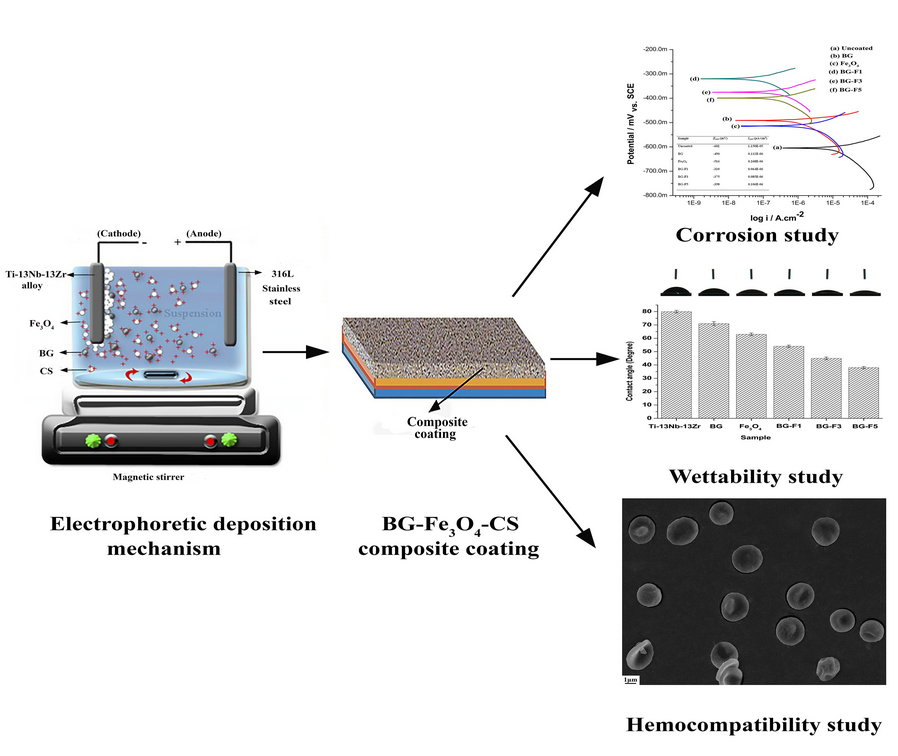
Electrophoretic deposition consisting of bioglass (BG)–chitosan (CS)–iron oxide nanoparticles (Fe3O4 NPs) on the Ti–13Nb–13Zr substrate was described. The bioactive coating was embedded in a CS matrix. The Fe3O4 NPs collected using the co-precipitation method varied at three different levels (1, 3, and 5 wt%) in the BG coating. The formulated coatings exhibited a hydrophilic character due to higher surface roughness values. The pull-off tape test was performed to check the adhesion strength of coatings. The composite coatings displayed adhesion strength of 5B class. The corrosion behavior was evaluated in Ringer's solution by the electrochemical test. The corrosion results showed that the composite coatings were more impressive as compared to pure BG and Fe3O4 coatings. The hemocompatibility results showed a hemolytic ratio (<5%), which validates them as favorable blood compatible nature of the deposited coatings. The findings exhibited that the BG–Fe3O4–CS coating can be widely employed as a favorable material for orthopedic applications.
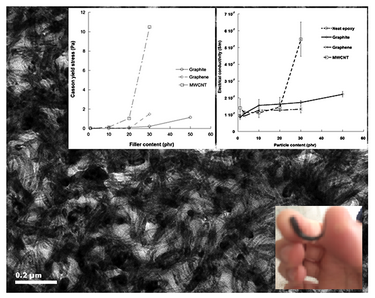
The aim of this research was to develop the UV-cured epoxy/carbon composites. The rheological properties of the uncured neat epoxy and epoxy composite with graphite, graphene, and multi-walled carbon nanotube (MWCNT) were evaluated to observe the macroscopic flow behavior and the microstructure by shear force. The results showed that epoxy/carbon composites at high filler content exhibited shear-thinning behavior with a high yield stress value and epoxy/MWCNT at 30 phr showed this characteristic obviously. The fractured surface and particle dispersion in the epoxy matrix were evaluated by scanning electron microscopy and transmission electron microscopy, respectively. Epoxy/carbon composites at high filler content displayed rough fracture surface with particle agglomeration, thus the electrical conductivity increased. The result showed that the epoxy/MWCNT composites had high potential to use as a conductive adhesive with a 3D printing process due to high electrical conductivity with high viscosity that could be formed easily during processing.
Growing in a saline environment causes changes in important physiological processes that are directly related to plant growth and development. In this study we evaluated the effect of salinity on transpiration of sorghum plants in semi-arid conditions and found that the highest rates of transpiration were observed in the hottest hours of the day, between 10 a.m. and 3 p.m., with plants subjected to the saline environment having their transpiration reduced by up to 70% when compared to the non-saline environment. This behavior can be reflected in reductions in plant growth and development due to reduced water absorption by the roots, consequently causing an imbalance of nutrients in the plant due to low absorption rate and competition between nutrients and salts in the preferred routes of absorption in the roots.
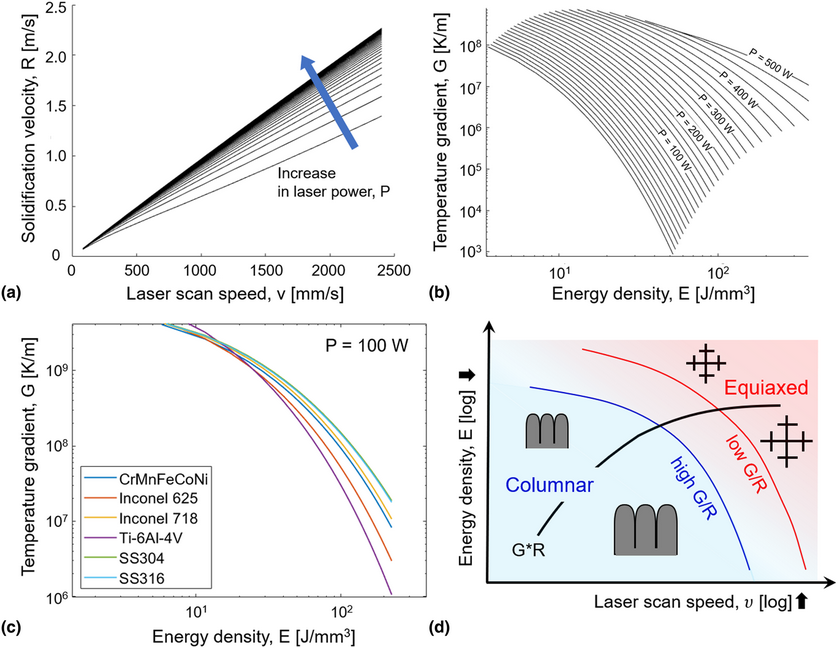
The disruptive potential of additive manufacturing (AM) relies on its ability to make customized products with considerable weight savings through geometries that are difficult or impossible to produce by conventional methods. Despite its versatility, applications of AM have been restricted due to the formation of columnar grains, resulting in solidification defects and anisotropy in properties. To achieve fine equiaxed grains in AM, alloy design and solidification conditions have been optimized in various alloy systems. In this review paper, the microstructure of high-entropy alloy (HEA) parts produced by selective laser melting and powder-based directed energy deposition is investigated. Solidification maps based on laser process parameters (as opposed to most commonly used solidification velocity and temperature gradient) are constructed by compiling available literature for single-phase face-centered cubic, body-centered cubic, and multiphase HEAs. These maps could guide printing of HEAs and provide an insight into the design of novel HEAs for AM.
In the present study, the effect of Al addition on microstructure evolution, mechanical properties, and wear performances of a newly developed Ni–Si-containing complex brass was studied. The results showed that with increasing Al content from 0 to 3 wt%, the corresponding strengthening phase evolves from δ-Ni2Si to [Ni(Al)]2Si phases. Simultaneously, it is of great interest that the increasing Al addition also brings about a remarkable change in morphology of the secondary strengthening phase from dendrite and thin rod to regular block. Additionally, the hardness, yield strength and tensile strength of complex brass effectively increase with increasing Al content, and the fracture mechanism transforms from cleavage failure and microvoids accumulation fracture to cleavage failure. It was also found that the brass with adding 3 wt% Al exhibits the solidification microstructure with the uniform distribution of the block-shaped strengthening phase and has the best wear resistance. This present study provides a potential strategy for further improving the comprehensive performance of existing complex brass.
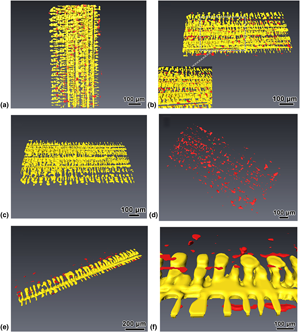
The dendrite morphologies of the cast nickel-based superalloy CMSX-4® (CMSX-4® is registered trademarks of the Cannon-Muskegon Corporation) and the austenitic stainless steel HP microalloy have been obtained via an automated serial-sectioning process which allows three-dimensional (3D) microstructural characterization. The dendrite arm spacing, volume fraction of segregation, and fraction of porosity have been determined. This technique not only increases the depth, scope, and level of detailed microstructural characterization but also delivers microstructural data for modeling and simulation.
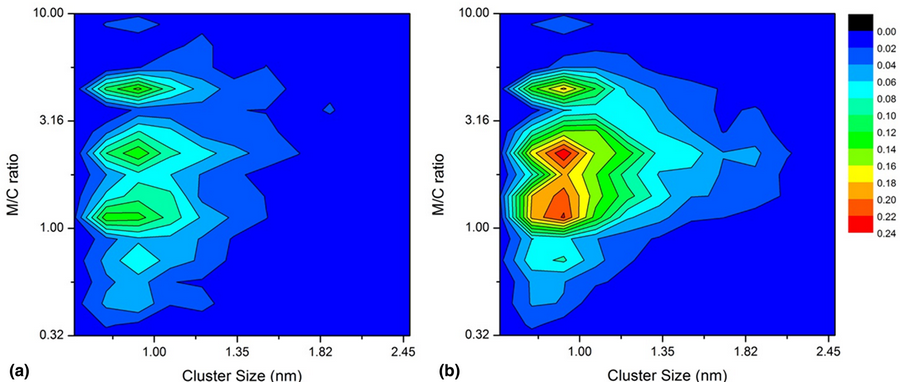
In the present study, 3D atom probe was used to study the effect of increased Mo (1–3 wt%) on clustering in secondary hardening ultra-high strength steels. Clusters have been classified into three categories, namely, Type I, Type II, and Type III with the (Cr + Mo)/C ratio of <1.5, 1.5–3.25, and >3.25, respectively. Cluster evolution suggests that size and volume fraction (Vf) of Type II clusters increase continuously from as-quenched to aged samples, while the number density (Nv) increases in 400 °C aged sample and decreases in 450 and 500 °C samples. On the other hand, Nv and Vf of both Type I and Type III clusters decrease on aging. This work clearly suggests that on aging, Type II clusters, which are close to M2C stoichiometry, become most stable, which may eventually either become M2C precipitates upon prolonged aging or act as potential nuclei for the precipitation of equilibrium M2C precipitates.
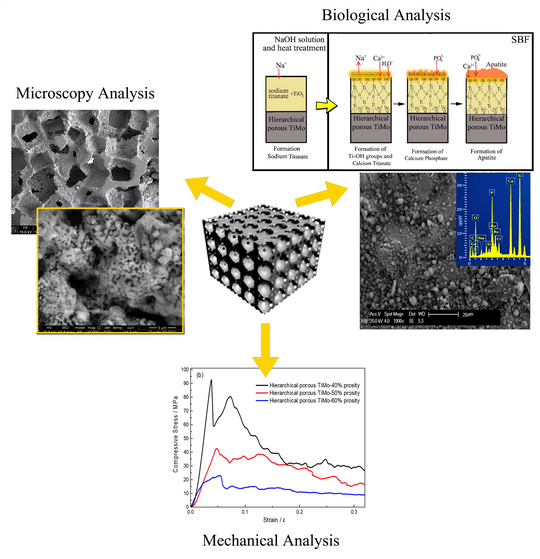
Novel three-dimensional (3D) hierarchical macro- to nano-porous titanium (Ti) and TiMo alloys with sufficient compressive strength (CS) were prepared using NaCl spacer and dealloying methods. The dealloying process was implemented by the heat treatment of TiCu and TiMoCu master alloys in Mg powders. The 3D-hierarchical porous structures were composed of large pores having a mean size of 400 μm with interconnected micro-pores in the size of 10–30 μm, where the pore walls possessed numerous nano-pores with a size range of 10–50 nm. The CS and elastic modulus values were 72.4 MPa and 2.67 GPa as well as 92.62 MPa and 3.36 GPa for Ti and TiMo, respectively. The hierarchical porous structure is beneficial for the fast nucleation of bone-like apatite after immersion in simulated body fluid (SBF). In addition, TiMo samples after NaOH and heat treatments provide better apatite formation after soaking in SBF for a week, in comparison with the samples without treatment.
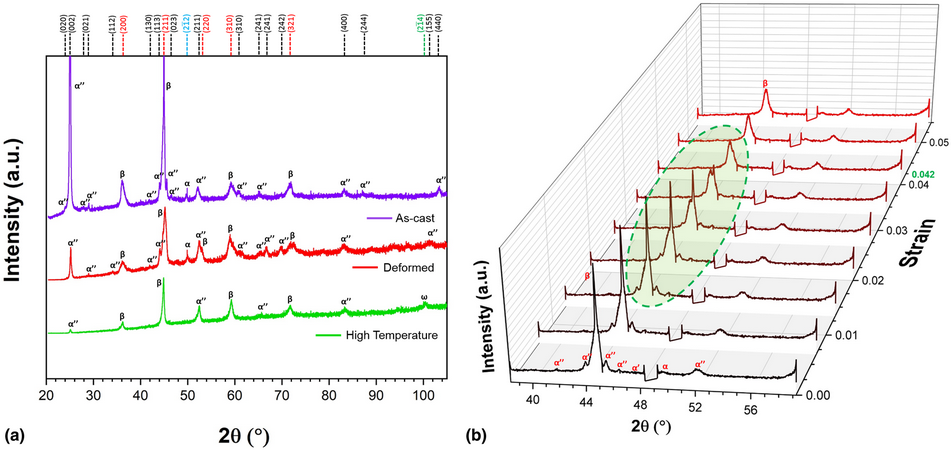
In this work, a Ti–29Nb–13Ta–4.6Zr–xO Gum Metal with two significantly different oxygen levels (388 and 3570 ppm) was investigated during deformation. The alloys were compressed during in situ high-energy X-ray diffraction using three different strain rates, 10−4, 10−3, and 10−1 s−1, in order to evaluate their influence on phase stability and mechanical properties. The influence of oxygen on the deformation process was also studied. Deformation takes place by twinning, stress-induced, and reverse martensitic transformation and was observed, for some samples, a spinodal decomposition of the β-phase during elastic deformation. The mechanical properties were similar for the different rates employed when considering the same oxygen level. The alloy with a higher amount of oxygen, however, showed a substantial increase in mechanical strength, with a yield strength of around 680 MPa, which is more than three times higher than for the specimen with 388 ppm of oxygen.
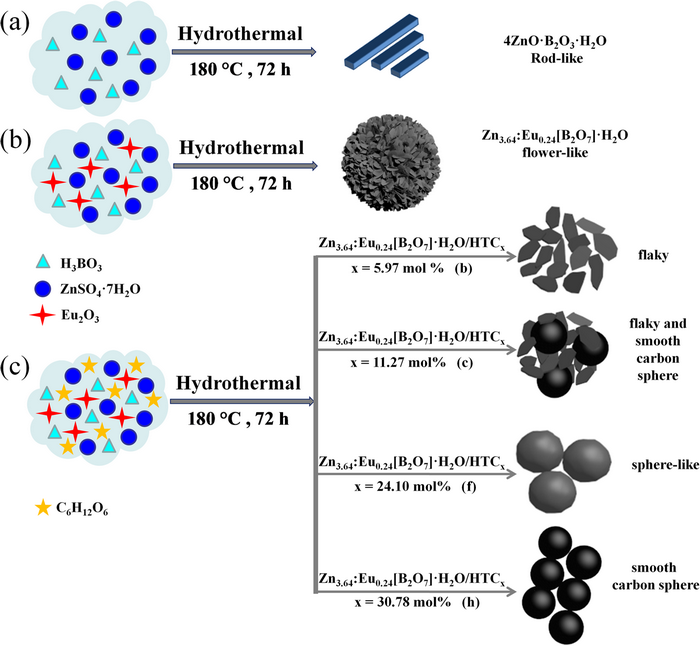
Hydrothermal carbon microsphere (HTC) is a carbon-based fluorescent material, which can be synthesized by hydrothermal carbonization of glucose. In this article, a series of 4ZnO·B2O3·H2O:Ln3+/HTC (where Ln = Eu or Tb) composites were prepared under hydrothermal conditions. The effects of the glucose concentration on the morphology, photoluminescence (PL) intensity and emission color of Zn3.64:Eu0.24[B2O7]·H2O/HTCx and Zn3.55:Tb0.3[B2O7]·H2O/HTCy were investigated. The relationship between morphology and PL intensity of composites was discussed. The results revealed that the presence of HTC did not change the original emission color of 4ZnO·B2O3·H2O:Ln3+ (where Ln = Eu or Tb) materials, but greatly increased their PL intensity, the sphere-like morphology composites have the strongest PL intensity. The Zn3.64:Eu0.24[B2O7]·H2O/HTCx and Zn3.55:Tb0.3[B2O7]·H2O/HTCy emit bright red light and green light, respectively, under respective excitation wavelengths. The present research suggests that the 4ZnO·B2O3·H2O:Ln3+/HTC (where Ln = Eu or Tb) composites may be candidates of red and green phosphors for display and lighting applications.
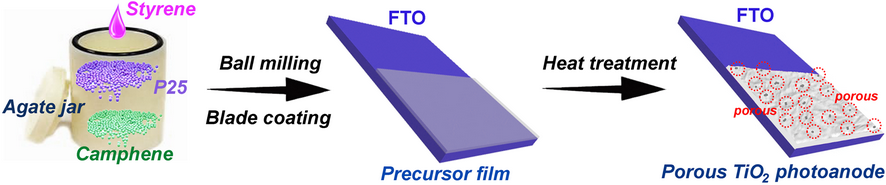
As for the efficient dye-sensitized solar cells (DSSCs), one of the important goals is to increase the light harvesting efficiency to further improve the photoelectric conversion efficiency (PCE). The excellent photoanode materials should possess a uniform porous structure, a large surface area, high crystallinity, and good stability. Herein, the porous TiO2 electrode (named as S-1.5) with the above merits had been prepared by the simple template-assisted method with camphene as the pore-forming reagent. The surface area of the porous TiO2 electrode can be tailored by introducing the amount of camphene. The porous TiO2 layer with the optimal surface area directly adhered on the top of the ultra-thin P25 dense layer had been constructed and this unique electrode with a “double layers structure”, which named as S-1.5/P25. When DSSCs assembled with this photoanode, a desirable PCE of 8.31% had been achieved, which was obviously higher than that of the commercial P25 (7.62%) in parallel. The improved PCE can be attributed to the improved utilization of sunlight, the facilitated photo-generated electron transfer, and the reduced interface resistance. Meanwhile, the related characterization including electrochemical impedance spectroscopy, intensity-modulated photovoltage spectroscopy, and intensity-modulated photocurrent spectroscopy was characterized to explore the possible mechanism.
A novel Ag/AgBr/Nb2O5 heterojunction photocatalyst was successfully developed via a facile solvothermal method combined with deposition–precipitation. The morphology and composition of the Ag/AgBr/Nb2O5 photocatalyst were investigated by transmission electron microscopy and X-ray energy-dispersive spectrometry, respectively. The results showed that metallic Ag was formed on the surface of the AgBr by an in situ photoreaction. The low crystalline Nb2O5 (L-Nb2O5) substrate provides the photocatalyst with a high specific area and numerous active sites for catalysis, while the combination of the Ag/AgBr with L-Nb2O5 effectively facilitates the separation of photo-generated charge carriers. The photocatalytic activities of the samples were measured using the degradation of an aqueous solution of rhodamine B under different LEDs with UV (365 nm), yellow (595 nm), and white (400 nm ≤ λ ≤ 800 nm) light. The Ag/AgBr/L-Nb2O5 photocatalyst displayed a much higher photocatalytic activity than bare L-Nb2O5 under UV and visible-light irradiation.
Cerium-doped lanthanum magnesium bulk aluminate (La1–xCexMgAl11O19, x = 0.03–0.50; abbreviated as LMA) was prepared via the Pechini sol–gel method after heating at 1200 °C for 2 h. The resulting single-phase ceramics was studied in terms of its structure using X-ray diffraction and optical properties using photoluminescence, its decay time, and radioluminescence spectroscopy. The diffraction and electron microscopy demonstrated LMA's plate-shaped nanocrystals with structure anisotropy and relatively broad particle size distribution. The optical measurements fully manifested the complexity of the LMA crystal structure. The radioluminescence study of cerium-doped LMA is here presented for the first time and, thus, contributes to the basic knowledge of Ce-doped materials. Additionally, the magnetic susceptibility exhibiting paramagnetic behavior of Ce3+ ions is presented. The magnetic data were interpreted in terms of local atomic Hamiltonian involving the crystal field and the Zeeman effect applied on the ground state J = 5/2 multiplet.
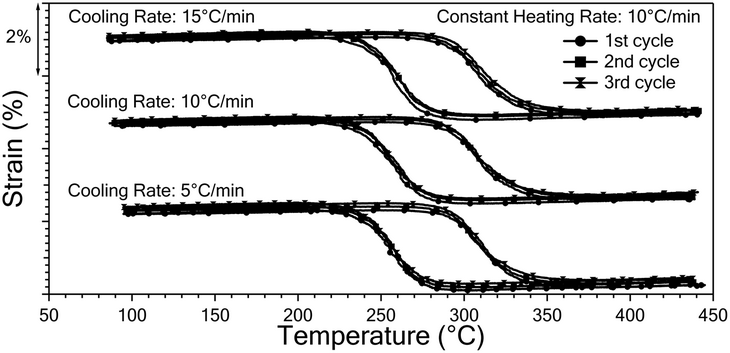
In this study, the effect of the cooling rate on the thermal and thermomechanical behavior of NiTiHf high-temperature shape memory alloy was studied by differential scanning calorimetry and via running isobaric thermal cycling experiments. The cooling rates were set to 5, 10, and 15 °C/min for each cycle in both experiments, while the heating rate was kept as 10 °C/min. It was found that the transformation temperatures and thermal hysteresis values do not depend on the change in the cooling rate. On the other hand, the austenite to martensite transformation enthalpy as measured from DSC analyses increases with the increase in the cooling rate due to the higher measurement sensitivity at higher scanning rates. Recoverable strain values which were determined from isobaric thermal cycling experiments do not differ since the transforming volume does not change with the change of the cooling rate. All these findings are explained based on the fundamental thermodynamical approach.
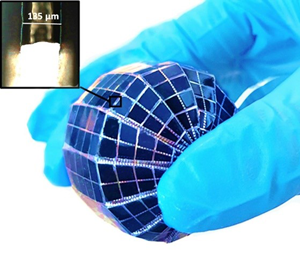
Unconventional techniques to benefit from the low-cost and high-efficiency monocrystalline silicon solar cells can lead to new device capabilities and engineering prospects. Here, a nature-inspired spherical solar cell is demonstrated, which is capable of capturing light three-dimensionally. The proposed cell architecture is based on monocrystalline silicon and is fabricated using a corrugation technique. The spherical cell shows an increase in power output by up to 101% with respect to a traditional flat cell with the same projection area using different reflective materials. Finally, the spherical cell shows advantages in terms of enhanced heat dissipation and reduced dust accumulation over conventional cells.
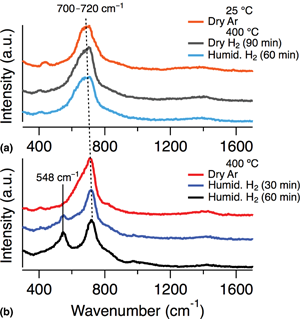
Material changes in yttrium-doped barium zirconate, BaZr0.8Y0.2O3–x, were studied using in situ Raman spectroscopy and ex situ x-ray photoelectron spectroscopy analysis. During in situ Raman analysis, samples were heated to temperatures of 300–600 °C and exposed to both dry and humidified H2 atmospheres. At the lower temperatures (300–450 °C), a new vibrational peak appears in the Raman spectra during exposure to humidified H2. The appearance of this feature is reversible, dependent on previous sample history, and possibly results from new, secondary phase formation or lattice distortion.
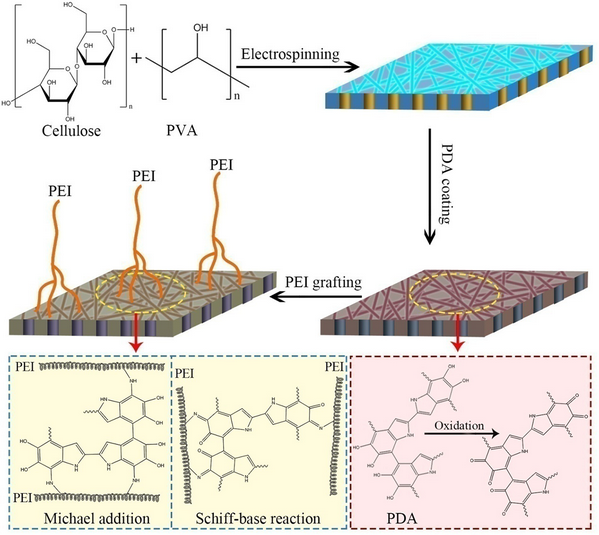
Membranes with special wettability have attracted increasing interest for oil/water separation. Herein, the cellulose-based nanofibrous membrane was fabricated in an aqueous system by an electrospinning technique. The membrane was then modified successively through coating polydopamine and polyethyleneimine on the surface, which endowed the membrane with superhydrophilic and underwater superoleophobic character. The composition and morphology of the resultant membrane were characterized by attenuated total reflectance Fourier transform infrared spectra, X-ray photoelectron spectroscopy, and field-emission scanning electron microscope, respectively. Surfactant-stabilized oil-in-water emulsions were used to evaluate the separation performance of the membrane at different pH values. It was found that the membrane displayed the excellent antifouling property and separation performance for all different emulsions, with separation efficiency above 99.1% due to the development of a hydration layer underwater on the membrane surface. The reusability study indicated that the modification coating was stable enough to effectively separate emulsions after recycling at least 20 times. The developed nanofibrous membrane, as well as the corresponding modification strategy, enriched the application of membranes with special wettability in the field of oil spills and oily wastewater treatments.