Refine search
Actions for selected content:
26077 results in Abstract analysis
Extrapolation to weighted Morrey spaces with variable exponents and applications
- Part of
-
- Journal:
- Proceedings of the Edinburgh Mathematical Society / Volume 64 / Issue 4 / November 2021
- Published online by Cambridge University Press:
- 09 November 2021, pp. 1002-1027
-
- Article
- Export citation
On the smallest singular value of symmetric random matrices
- Part of
-
- Journal:
- Combinatorics, Probability and Computing / Volume 31 / Issue 4 / July 2022
- Published online by Cambridge University Press:
- 05 November 2021, pp. 662-683
-
- Article
- Export citation
-
We show that for an $n\times n$ random symmetric matrix $A_n$, whose entries on and above the diagonal are independent copies of a sub-Gaussian random variable $\xi$ with mean 0 and variance 1, This improves a result of Vershynin, who obtained such a bound with
 \begin{equation*}\mathbb{P}[s_n(A_n) \le \epsilon/\sqrt{n}] \le O_{\xi}(\epsilon^{1/8} + \exp(\!-\Omega_{\xi}(n^{1/2}))) \quad \text{for all } \epsilon \ge 0.\end{equation*} $n^{1/2}$ replaced by $n^{c}$ for a small constant c, and $1/8$ replaced by $(1/8) - \eta$ (with implicit constants also depending on $\eta > 0$). Furthermore, when $\xi$ is a Rademacher random variable, we prove that The special case
 \begin{equation*}\mathbb{P}[s_n(A_n) \le \epsilon/\sqrt{n}] \le O(\epsilon^{1/8} + \exp(\!-\Omega((\!\log{n})^{1/4}n^{1/2}))) \quad \text{for all } \epsilon \ge 0.\end{equation*} $\epsilon = 0$ improves a recent result of Campos, Mattos, Morris, and Morrison, which showed that $\mathbb{P}[s_n(A_n) = 0] \le O(\exp(\!-\Omega(n^{1/2}))).$ Notably, in a departure from the previous two best bounds on the probability of singularity of symmetric matrices, which had relied on somewhat specialized and involved combinatorial techniques, our methods fall squarely within the broad geometric framework pioneered by Rudelson and Vershynin, and suggest the possibility of a principled geometric approach to the study of the singular spectrum of symmetric random matrices. The main innovations in our work are new notions of arithmetic structure – the Median Regularized Least Common Denominator (MRLCD) and the Median Threshold, which are natural refinements of the Regularized Least Common Denominator (RLCD)introduced by Vershynin, and should be more generally useful in contexts where one needs to combine anticoncentration information of different parts of a vector.


Editorial
- Part of
-
- Journal:
- European Journal of Applied Mathematics / Volume 32 / Issue 6 / December 2021
- Published online by Cambridge University Press:
- 05 November 2021, pp. 1033-1034
-
- Article
-
- You have access
- Export citation
On minimal log discrepancies and kollár components
- Part of
-
- Journal:
- Proceedings of the Edinburgh Mathematical Society / Volume 64 / Issue 4 / November 2021
- Published online by Cambridge University Press:
- 04 November 2021, pp. 982-1001
-
- Article
- Export citation
-
In this article, we prove a local implication of boundedness of Fano varieties. More precisely, we prove that $d$
 -dimensional $a$
 -log canonical singularities with standard coefficients, which admit an $\epsilon$
 -plt blow-up, have minimal log discrepancies belonging to a finite set which only depends on $d,\,a$
 and $\epsilon$
 . This result gives a natural geometric stratification of the possible mld's in a fixed dimension by finite sets. As an application, we prove the ascending chain condition for minimal log discrepancies of exceptional singularities. We also introduce an invariant for klt singularities related to the total discrepancy of Kollár components.


On the global existence and qualitative behaviour of one-dimensional solutions to a model for urban crime
- Part of
-
- Journal:
- European Journal of Applied Mathematics / Volume 33 / Issue 5 / October 2022
- Published online by Cambridge University Press:
- 02 November 2021, pp. 919-959
-
- Article
- Export citation
-
We consider the no-flux initial-boundary value problem for the cross-diffusive evolution system:
which was introduced by Short et al. in [40] with \begin{eqnarray*}\left\{ \begin{array}{ll}u_t = u_{xx} - \chi \big(\frac{u}{v} \partial_x v \big)_x - uv +B_1(x,t),\qquad & x\in \Omega, \ t>0, \\[1mm]v_t = v_{xx} +uv - v + B_2(x,t),\qquad & x\in \Omega, \ t>0,\end{array} \right.\end{eqnarray*} $\chi=2$ to describe the dynamics of urban crime.
In bounded intervals $\Omega\subset\mathbb{R}$ and with prescribed suitably regular non-negative functions $B_1$ and $B_2$, we first prove the existence of global classical solutions for any choice of $\chi>0$ and all reasonably regular non-negative initial data.
We next address the issue of determining the qualitative behaviour of solutions under appropriate assumptions on the asymptotic properties of $B_1$ and $B_2$. Indeed, for arbitrary $\chi>0$, we obtain boundedness of the solutions given strict positivity of the average of $B_2$ over the domain; moreover, it is seen that imposing a mild decay assumption on $B_1$ implies that u must decay to zero in the long-term limit. Our final result, valid for all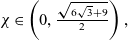 $\chi\in\left(0,\frac{\sqrt{6\sqrt{3}+9}}{2}\right),$ which contains the relevant value $\chi=2$, states that under the above decay assumption on $B_1$, if furthermore $B_2$ appropriately stabilises to a non-trivial function $B_{2,\infty}$, then (u,v) approaches the limit $(0,v_\infty)$, where $v_\infty$ denotes the solution of We conclude with some numerical simulations exploring possible effects that may arise when considering large values of
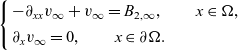 \begin{eqnarray*}\left\{ \begin{array}{l}-\partial_{xx}v_\infty + v_\infty = B_{2,\infty},\qquad x\in \Omega, \\[1mm]\partial_x v_{\infty}=0,\qquad x\in\partial\Omega.\end{array} \right.\end{eqnarray*} $\chi$ not covered by our qualitative analysis. We observe that when $\chi$ increases, solutions may grow substantially on short time intervals, whereas only on large timescales diffusion will dominate and enforce equilibration.


A spectral modelling approach for fluid flow into a line sink in a confined aquifer
- Part of
-
- Journal:
- European Journal of Applied Mathematics / Volume 33 / Issue 5 / October 2022
- Published online by Cambridge University Press:
- 01 November 2021, pp. 960-981
-
- Article
- Export citation
Anisotropic Gauss curvature flows and their associated Dual Orlicz-Minkowski problems
- Part of
-
- Journal:
- Proceedings of the Royal Society of Edinburgh. Section A: Mathematics / Volume 152 / Issue 1 / February 2022
- Published online by Cambridge University Press:
- 01 November 2021, pp. 148-162
- Print publication:
- February 2022
-
- Article
- Export citation
JMJ volume 20 Issue 6 Cover and Back matter
-
- Journal:
- Journal of the Institute of Mathematics of Jussieu / Volume 20 / Issue 6 / November 2021
- Published online by Cambridge University Press:
- 29 October 2021, pp. b1-b2
- Print publication:
- November 2021
-
- Article
-
- You have access
- Export citation
JMJ volume 20 Issue 6 Cover and Front matter
-
- Journal:
- Journal of the Institute of Mathematics of Jussieu / Volume 20 / Issue 6 / November 2021
- Published online by Cambridge University Press:
- 29 October 2021, pp. f1-f2
- Print publication:
- November 2021
-
- Article
-
- You have access
- Export citation
The Tutte polynomial and toric Nakajima quiver varieties
-
- Journal:
- Proceedings of the Royal Society of Edinburgh. Section A: Mathematics / Volume 152 / Issue 5 / October 2022
- Published online by Cambridge University Press:
- 27 October 2021, pp. 1323-1339
- Print publication:
- October 2022
-
- Article
- Export citation
-
For a quiver $Q$ with underlying graph $\Gamma$, we take $ {\mathcal {M}}$ an associated toric Nakajima quiver variety. In this article, we give a direct relation between a specialization of the Tutte polynomial of $\Gamma$, the Kac polynomial of $Q$ and the Poincaré polynomial of $ {\mathcal {M}}$. We do this by giving a cell decomposition of $ {\mathcal {M}}$ indexed by spanning trees of $\Gamma$ and ‘geometrizing’ the deletion and contraction operators on graphs. These relations have been previously established in Hausel–Sturmfels [6] and Crawley-Boevey–Van den Bergh [3], however the methods here are more hands-on.


Higher-dimensional Auslander–Reiten theory on (d+2)-angulated categories
- Part of
-
- Journal:
- Glasgow Mathematical Journal / Volume 64 / Issue 3 / September 2022
- Published online by Cambridge University Press:
- 27 October 2021, pp. 527-547
-
- Article
- Export citation
-
Let $\mathscr{C}$ be a $(d+2)$-angulated category with d-suspension functor $\Sigma^d$. Our main results show that every Serre functor on $\mathscr{C}$ is a $(d+2)$-angulated functor. We also show that $\mathscr{C}$ has a Serre functor $\mathbb{S}$ if and only if $\mathscr{C}$ has Auslander–Reiten $(d+2)$-angles. Moreover, $\tau_d=\mathbb{S}\Sigma^{-d}$ where $\tau_d$ is d-Auslander–Reiten translation. These results generalize work by Bondal–Kapranov and Reiten–Van den Bergh. As an application, we prove that for a strongly functorially finite subcategory $\mathscr{X}$ of $\mathscr{C}$, the quotient category $\mathscr{C}/\mathscr{X}$ is a $(d+2)$-angulated category if and only if $(\mathscr{C},\mathscr{C})$ is an $\mathscr{X}$-mutation pair, and if and only if $\tau_d\mathscr{X} =\mathscr{X}$.


Free quotients of fundamental groups of smooth quasi-projective varieties
- Part of
-
- Journal:
- Proceedings of the Edinburgh Mathematical Society / Volume 64 / Issue 4 / November 2021
- Published online by Cambridge University Press:
- 27 October 2021, pp. 924-946
-
- Article
- Export citation
Tilting pairs in extriangulated categories
- Part of
-
- Journal:
- Proceedings of the Edinburgh Mathematical Society / Volume 64 / Issue 4 / November 2021
- Published online by Cambridge University Press:
- 26 October 2021, pp. 947-981
-
- Article
- Export citation
-
Extriangulated categories were introduced by Nakaoka and Palu to give a unification of properties in exact categories and extension-closed subcategories of triangulated categories. A notion of tilting pairs in an extriangulated category is introduced in this paper. We give a Bazzoni characterization of tilting pairs in this setting. We also obtain the Auslander–Reiten correspondence of tilting pairs which classifies finite $\mathcal {C}$
 -tilting subcategories for a certain self-orthogonal subcategory $\mathcal {C}$
 with some assumptions. This generalizes the known results given by Wei and Xi for the categories of finitely generated modules over Artin algebras, thereby providing new insights in exact and triangulated categories.


The first $\ell ^{2}$
 -betti number and groups acting on trees
- Part of
-
- Journal:
- Proceedings of the Edinburgh Mathematical Society / Volume 64 / Issue 4 / November 2021
- Published online by Cambridge University Press:
- 25 October 2021, pp. 916-923
-
- Article
-
- You have access
- Open access
- HTML
- Export citation
-
We generalize results of Thomas, Allcock, Thom–Petersen, and Kar–Niblo to the first $\ell ^{2}$
 -Betti number of quotients of certain groups acting on trees by subgroups with free actions on the edge sets of the graphs.


Extending the Tutte and Bollobás–Riordan polynomials to rank 3 weakly coloured stranded graphs
- Part of
-
- Journal:
- Combinatorics, Probability and Computing / Volume 31 / Issue 3 / May 2022
- Published online by Cambridge University Press:
- 25 October 2021, pp. 507-549
-
- Article
- Export citation
PEM series 2 volume 64 issue 3 Cover and Front matter
-
- Journal:
- Proceedings of the Edinburgh Mathematical Society / Volume 64 / Issue 3 / August 2021
- Published online by Cambridge University Press:
- 25 October 2021, pp. f1-f2
-
- Article
-
- You have access
- Export citation
The wigner property for CL-spaces and finite-dimensional polyhedral banach spaces – RETRACTION
-
- Journal:
- Proceedings of the Edinburgh Mathematical Society / Volume 64 / Issue 3 / August 2021
- Published online by Cambridge University Press:
- 25 October 2021, p. 716
-
- Article
-
- You have access
- Open access
- HTML
- Export citation
PEM series 2 volume 64 issue 3 Cover and Back matter
-
- Journal:
- Proceedings of the Edinburgh Mathematical Society / Volume 64 / Issue 3 / August 2021
- Published online by Cambridge University Press:
- 25 October 2021, pp. b1-b2
-
- Article
-
- You have access
- Export citation
TRANSITION DENSITIES OF SUBORDINATORS OF POSITIVE ORDER
- Part of
-
- Journal:
- Journal of the Institute of Mathematics of Jussieu / Volume 22 / Issue 3 / May 2023
- Published online by Cambridge University Press:
- 22 October 2021, pp. 1119-1179
- Print publication:
- May 2023
-
- Article
-
- You have access
- Open access
- HTML
- Export citation
-
We prove the existence and asymptotic behaviour of the transition density for a large class of subordinators whose Laplace exponents satisfy lower scaling condition at infinity. Furthermore, we present lower and upper bounds for the density. Sharp estimates are provided if an additional upper scaling condition on the Laplace exponent is imposed. In particular, we cover the case when the (minus) second derivative of the Laplace exponent is a function regularly varying at infinity with regularity index bigger than $-2$.
$-2$.

Preface
-
- Book:
- Orthogonal Polynomials in the Spectral Analysis of Markov Processes
- Published online:
- 08 October 2021
- Print publication:
- 21 October 2021, pp ix-xii
-
- Chapter
- Export citation
