Refine search
Actions for selected content:
26077 results in Abstract analysis
Notation Index
-
- Book:
- Noncommutative Function-Theoretic Operator Theory and Applications
- Published online:
- 09 December 2021
- Print publication:
- 16 December 2021, pp 425-426
-
- Chapter
- Export citation
3 - Contractive Multipliers
-
- Book:
- Noncommutative Function-Theoretic Operator Theory and Applications
- Published online:
- 09 December 2021
- Print publication:
- 16 December 2021, pp 42-102
-
- Chapter
- Export citation
6 - Non-orthogonal Beurling–Lax Representations Based on Wandering Subspaces
-
- Book:
- Noncommutative Function-Theoretic Operator Theory and Applications
- Published online:
- 09 December 2021
- Print publication:
- 16 December 2021, pp 215-229
-
- Chapter
- Export citation
Subject Index
-
- Book:
- Noncommutative Function-Theoretic Operator Theory and Applications
- Published online:
- 09 December 2021
- Print publication:
- 16 December 2021, pp 427-428
-
- Chapter
- Export citation
The fragmentation equation with size diffusion: Well posedness and long-term behaviour
- Part of
-
- Journal:
- European Journal of Applied Mathematics / Volume 33 / Issue 6 / December 2022
- Published online by Cambridge University Press:
- 16 December 2021, pp. 1083-1116
-
- Article
- Export citation
-
The dynamics of the fragmentation equation with size diffusion is investigated when the size ranges in $(0,\infty)$. The associated linear operator involves three terms and can be seen as a nonlocal perturbation of a Schrödinger operator. A Miyadera perturbation argument is used to prove that it is the generator of a positive, analytic semigroup on a weighted $L_1$-space. Moreover, if the overall fragmentation rate does not vanish at infinity, then there is a unique stationary solution with given mass. Assuming further that the overall fragmentation rate diverges to infinity for large sizes implies the immediate compactness of the semigroup and that it eventually stabilizes at an exponential rate to a one-dimensional projection carrying the information of the mass of the initial value.


7 - Orthogonal Beurling–Lax Representations Based on Wandering Subspaces
-
- Book:
- Noncommutative Function-Theoretic Operator Theory and Applications
- Published online:
- 09 December 2021
- Print publication:
- 16 December 2021, pp 230-284
-
- Chapter
- Export citation
Preface
-
- Book:
- Noncommutative Function-Theoretic Operator Theory and Applications
- Published online:
- 09 December 2021
- Print publication:
- 16 December 2021, pp ix-ix
-
- Chapter
- Export citation
8 - Models for ω-Hypercontractive Operator Tuples
-
- Book:
- Noncommutative Function-Theoretic Operator Theory and Applications
- Published online:
- 09 December 2021
- Print publication:
- 16 December 2021, pp 285-314
-
- Chapter
- Export citation
1 - Introduction
-
- Book:
- Noncommutative Function-Theoretic Operator Theory and Applications
- Published online:
- 09 December 2021
- Print publication:
- 16 December 2021, pp 1-27
-
- Chapter
- Export citation
5 - Beurling–Lax Theorems Based on Contractive Multipliers
-
- Book:
- Noncommutative Function-Theoretic Operator Theory and Applications
- Published online:
- 09 December 2021
- Print publication:
- 16 December 2021, pp 180-214
-
- Chapter
- Export citation
References
-
- Book:
- Noncommutative Function-Theoretic Operator Theory and Applications
- Published online:
- 09 December 2021
- Print publication:
- 16 December 2021, pp 415-424
-
- Chapter
- Export citation
Tuning as convex optimisation: a polynomial tuner for multi-parametric combinatorial samplers
- Part of
-
- Journal:
- Combinatorics, Probability and Computing / Volume 31 / Issue 5 / September 2022
- Published online by Cambridge University Press:
- 15 December 2021, pp. 765-811
-
- Article
- Export citation
A spanning bandwidth theorem in random graphs
- Part of
-
- Journal:
- Combinatorics, Probability and Computing / Volume 31 / Issue 4 / July 2022
- Published online by Cambridge University Press:
- 13 December 2021, pp. 598-628
-
- Article
- Export citation
-
The bandwidth theorem of Böttcher, Schacht and Taraz states that any n-vertex graph G with minimum degree $\big(\tfrac{k-1}{k}+o(1)\big)n$ contains all n-vertex k-colourable graphs H with bounded maximum degree and bandwidth o(n). Recently, a subset of the authors proved a random graph analogue of this statement: for $p\gg \big(\tfrac{\log n}{n}\big)^{1/\Delta}$ a.a.s. each spanning subgraph G of G(n,p) with minimum degree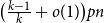 $\big(\tfrac{k-1}{k}+o(1)\big)pn$ contains all n-vertex k-colourable graphs H with maximum degree $\Delta$, bandwidth o(n), and at least $C p^{-2}$ vertices not contained in any triangle. This restriction on vertices in triangles is necessary, but limiting. In this paper, we consider how it can be avoided. A special case of our main result is that, under the same conditions, if additionally all vertex neighbourhoods in G contain many copies of $K_\Delta$ then we can drop the restriction on H that $Cp^{-2}$ vertices should not be in triangles.


A characterization of alternating links in thickened surfaces
-
- Journal:
- Proceedings of the Royal Society of Edinburgh. Section A: Mathematics / Volume 153 / Issue 1 / February 2023
- Published online by Cambridge University Press:
- 13 December 2021, pp. 177-195
- Print publication:
- February 2023
-
- Article
- Export citation
-
We use an extension of Gordon–Litherland pairing to thickened surfaces to give a topological characterization of alternating links in thickened surfaces. If $\Sigma$
 is a closed oriented surface and $F$
 is a compact unoriented surface in $\Sigma \times I$
 , then the Gordon–Litherland pairing defines a symmetric bilinear pairing on the first homology of $F$
 . A compact surface in $\Sigma \times I$
 is called definite if its Gordon–Litherland pairing is a definite form. We prove that a link $L$
 in a thickened surface is non-split, alternating, and of minimal genus if and only if it bounds two definite surfaces of opposite sign.


On the number of conjugacy classes of a primitive permutation group
- Part of
-
- Journal:
- Proceedings of the Royal Society of Edinburgh. Section A: Mathematics / Volume 153 / Issue 1 / February 2023
- Published online by Cambridge University Press:
- 13 December 2021, pp. 115-136
- Print publication:
- February 2023
-
- Article
-
- You have access
- Open access
- HTML
- Export citation
-
Let $G$
 be a primitive permutation group of degree $n$
 with nonabelian socle, and let $k(G)$
 be the number of conjugacy classes of $G$
 . We prove that either $k(G)< n/2$
 and $k(G)=o(n)$
 as $n\rightarrow \infty$
 , or $G$
 belongs to explicit families of examples.


Liouville-type results for positive solutions of pseudo-relativistic Schrödinger system
- Part of
-
- Journal:
- Proceedings of the Royal Society of Edinburgh. Section A: Mathematics / Volume 153 / Issue 1 / February 2023
- Published online by Cambridge University Press:
- 13 December 2021, pp. 196-228
- Print publication:
- February 2023
-
- Article
- Export citation
-
In this paper, we are concerned with the physically engaging pseudo-relativistic Schrödinger system:
\[ \begin{cases} \left(-\Delta+m^{2}\right)^{s}u(x)=f(x,u,v,\nabla u) & \hbox{in } \Omega,\\ \left(-\Delta+m^{2}\right)^{t}v(x)=g(x,u,v,\nabla v) & \hbox{in } \Omega,\\ u>0,v>0 & \hbox{in } \Omega, \\ u=v\equiv 0 & \hbox{in } \mathbb{R}^{N}\setminus\Omega, \end{cases} \]where $s,t\in (0,1)$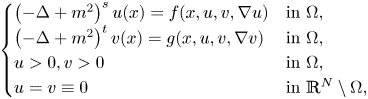
 and the mass $m>0.$
 By using the direct method of moving plane, we prove the strict monotonicity, symmetry and uniqueness for positive solutions to the above system in a bounded domain, unbounded domain, $\mathbb {R}^{N}$
 , $\mathbb {R}^{N}_{+}$
 and a coercive epigraph domain $\Omega$
 in $\mathbb {R}^{N}$
 , respectively.


QUANTUM ERGODICITY FOR COMPACT QUOTIENTS OF $\operatorname {SL}_d({\mathbb R})/\textrm {SO}(d)$ IN THE BENJAMINI–SCHRAMM LIMIT
- Part of
-
- Journal:
- Journal of the Institute of Mathematics of Jussieu / Volume 22 / Issue 5 / September 2023
- Published online by Cambridge University Press:
- 13 December 2021, pp. 2075-2115
- Print publication:
- September 2023
-
- Article
- Export citation
-
We study the limiting behavior of Maass forms on sequences of large-volume compact quotients of $\operatorname {SL}_d({\mathbb R})/\textrm {SO}(d)$, $d\ge 3$, whose spectral parameter stays in a fixed window. We prove a form of quantum ergodicity in this level aspect which extends results of Le Masson and Sahlsten to the higher rank case.

Spreading speeds and traveling wave solutions of diffusive vector-borne disease models without monotonicity
- Part of
-
- Journal:
- Proceedings of the Royal Society of Edinburgh. Section A: Mathematics / Volume 153 / Issue 1 / February 2023
- Published online by Cambridge University Press:
- 13 December 2021, pp. 137-166
- Print publication:
- February 2023
-
- Article
- Export citation
Cut cotorsion pairs
- Part of
-
- Journal:
- Glasgow Mathematical Journal / Volume 64 / Issue 3 / September 2022
- Published online by Cambridge University Press:
- 10 December 2021, pp. 548-585
-
- Article
- Export citation
Noncommutative Function-Theoretic Operator Theory and Applications
-
- Published online:
- 09 December 2021
- Print publication:
- 16 December 2021
