Refine search
Actions for selected content:
26077 results in Abstract analysis
9 - Macdonald–Koornwinder Polynomials
-
-
- Book:
- Encyclopedia of Special Functions: The Askey-Bateman Project
- Published online:
- 30 September 2020
- Print publication:
- 15 October 2020, pp 258-313
-
- Chapter
- Export citation
Frontmatter
-
- Book:
- Encyclopedia of Special Functions: The Askey-Bateman Project
- Published online:
- 30 September 2020
- Print publication:
- 15 October 2020, pp i-iv
-
- Chapter
- Export citation
Independent dominating sets in graphs of girth five
- Part of
-
- Journal:
- Combinatorics, Probability and Computing / Volume 30 / Issue 3 / May 2021
- Published online by Cambridge University Press:
- 15 October 2020, pp. 344-359
-
- Article
- Export citation
-
Let $\gamma(G)$ and
  $${\gamma _ \circ }(G)$$ denote the sizes of a smallest dominating set and smallest independent dominating set in a graph G, respectively. One of the first results in probabilistic combinatorics is that if G is an n-vertex graph of minimum degree at least d, then
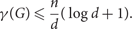 $$\begin{equation}\gamma(G) \leq \frac{n}{d}(\log d + 1).\end{equation}$$
In this paper the main result is that if G is any n-vertex d-regular graph of girth at least five, then
for some constant c independent of d. This result is sharp in the sense that as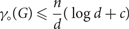 $$\begin{equation}\gamma_(G) \leq \frac{n}{d}(\log d + c)\end{equation}$$ $d \rightarrow \infty$, almost all d-regular n-vertex graphs G of girth at least five have
 $$\begin{equation}\gamma_(G) \sim \frac{n}{d}\log d.\end{equation}$$
Furthermore, if G is a disjoint union of ${n}/{(2d)}$ complete bipartite graphs $K_{d,d}$, then ${\gamma_\circ}(G) = \frac{n}{2}$. We also prove that there are n-vertex graphs G of minimum degree d and whose maximum degree grows not much faster than d log d such that ${\gamma_\circ}(G) \sim {n}/{2}$ as $d \rightarrow \infty$. Therefore both the girth and regularity conditions are required for the main result.


Frontmatter
-
- Book:
- Lectures on Orthogonal Polynomials and Special Functions
- Published online:
- 07 October 2020
- Print publication:
- 15 October 2020, pp i-iv
-
- Chapter
- Export citation
8 - Jacobi Polynomials and Hypergeometric Functions Associated with Root Systems
-
-
- Book:
- Encyclopedia of Special Functions: The Askey-Bateman Project
- Published online:
- 30 September 2020
- Print publication:
- 15 October 2020, pp 217-257
-
- Chapter
- Export citation
List of Contributors
-
- Book:
- Encyclopedia of Special Functions: The Askey-Bateman Project
- Published online:
- 30 September 2020
- Print publication:
- 15 October 2020, pp ix-x
-
- Chapter
- Export citation
1 - General Overview of Multivariable Special Functions
-
-
- Book:
- Encyclopedia of Special Functions: The Askey-Bateman Project
- Published online:
- 30 September 2020
- Print publication:
- 15 October 2020, pp 1-18
-
- Chapter
- Export citation
2 - Orthogonal Polynomials of Several Variables
-
-
- Book:
- Encyclopedia of Special Functions: The Askey-Bateman Project
- Published online:
- 30 September 2020
- Print publication:
- 15 October 2020, pp 19-78
-
- Chapter
- Export citation
List of Contributors
-
- Book:
- Lectures on Orthogonal Polynomials and Special Functions
- Published online:
- 07 October 2020
- Print publication:
- 15 October 2020, pp x-x
-
- Chapter
- Export citation
Contents
-
- Book:
- Encyclopedia of Special Functions: The Askey-Bateman Project
- Published online:
- 30 September 2020
- Print publication:
- 15 October 2020, pp v-viii
-
- Chapter
- Export citation
3 - Applications of Spectral Theory to Special Functions
-
-
- Book:
- Lectures on Orthogonal Polynomials and Special Functions
- Published online:
- 07 October 2020
- Print publication:
- 15 October 2020, pp 131-212
-
- Chapter
- Export citation
1 - Exceptional Orthogonal Polynomials via Krall Discrete Polynomials
-
-
- Book:
- Lectures on Orthogonal Polynomials and Special Functions
- Published online:
- 07 October 2020
- Print publication:
- 15 October 2020, pp 1-75
-
- Chapter
- Export citation
Semilinear elliptic equations involving mixed local and nonlocal operators
- Part of
-
- Journal:
- Proceedings of the Royal Society of Edinburgh. Section A: Mathematics / Volume 151 / Issue 5 / October 2021
- Published online by Cambridge University Press:
- 14 October 2020, pp. 1611-1641
- Print publication:
- October 2021
-
- Article
- Export citation
Covering and tiling hypergraphs with tight cycles
- Part of
-
- Journal:
- Combinatorics, Probability and Computing / Volume 30 / Issue 2 / March 2021
- Published online by Cambridge University Press:
- 13 October 2020, pp. 288-329
-
- Article
- Export citation
-
A k-uniform tight cycle $C_s^k$ is a hypergraph on s > k vertices with a cyclic ordering such that every k consecutive vertices under this ordering form an edge. The pair (k, s) is admissible if gcd (k, s) = 1 or k / gcd (k,s) is even. We prove that if $s \ge 2{k^2}$ and H is a k-uniform hypergraph with minimum codegree at least (1/2 + o(1))|V(H)|, then every vertex is covered by a copy of $C_s^k$. The bound is asymptotically sharp if (k, s) is admissible. Our main tool allows us to arbitrarily rearrange the order in which a tight path wraps around a complete k-partite k-uniform hypergraph, which may be of independent interest.
For hypergraphs F and H, a perfect F-tiling in H is a spanning collection of vertex-disjoint copies of F. For $k \ge 3$, there are currently only a handful of known F-tiling results when F is k-uniform but not k-partite. If s ≢ 0 mod k, then $C_s^k$ is not k-partite. Here we prove an F-tiling result for a family of non-k-partite k-uniform hypergraphs F. Namely, for $s \ge 5{k^2}$, every k-uniform hypergraph H with minimum codegree at least (1/2 + 1/(2s) + o(1))|V(H)| has a perfect $C_s^k$-tiling. Moreover, the bound is asymptotically sharp if k is even and (k, s) is admissible.


ON SOLVABILITY OF CERTAIN EQUATIONS OF ARBITRARY LENGTH OVER TORSION-FREE GROUPS
- Part of
-
- Journal:
- Glasgow Mathematical Journal / Volume 63 / Issue 3 / September 2021
- Published online by Cambridge University Press:
- 13 October 2020, pp. 651-659
-
- Article
- Export citation
-
Let G be a nontrivial torsion-free group and $s\left( t \right) = {g_1}{t^{{\varepsilon _1}}}{g_2}{t^{{\varepsilon _2}}} \ldots {g_n}{t^{{\varepsilon _n}}} = 1\left( {{g_i} \in G,{\varepsilon_i} = \pm 1} \right)$ be an equation over G containing no blocks of the form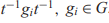 ${t^{- 1}}{g_i}{t^{ - 1}},{g_i} \in G$. In this paper, we show that $s\left( t \right) = 1$ has a solution over G provided a single relation on coefficients of s(t) holds. We also generalize our results to equations containing higher powers of t. The later equations are also related to Kaplansky zero-divisor conjecture.

Variations on results on orders of products in finite groups
- Part of
-
- Journal:
- Proceedings of the Royal Society of Edinburgh. Section A: Mathematics / Volume 151 / Issue 5 / October 2021
- Published online by Cambridge University Press:
- 12 October 2020, pp. 1443-1449
- Print publication:
- October 2021
-
- Article
- Export citation
Tight Hamilton cycles in cherry-quasirandom 3-uniform hypergraphs
- Part of
-
- Journal:
- Combinatorics, Probability and Computing / Volume 30 / Issue 3 / May 2021
- Published online by Cambridge University Press:
- 12 October 2020, pp. 412-443
-
- Article
-
- You have access
- Open access
- Export citation
-
We employ the absorbing-path method in order to prove two results regarding the emergence of tight Hamilton cycles in the so-called two-path or cherry-quasirandom 3-graphs.
Our first result asserts that for any fixed real α > 0, cherry-quasirandom 3-graphs of sufficiently large order n having minimum 2-degree at least α(n – 2) have a tight Hamilton cycle.
Our second result concerns the minimum 1-degree sufficient for such 3-graphs to have a tight Hamilton cycle. Roughly speaking, we prove that for every d, α > 0 satisfying d + α > 1, any sufficiently large n-vertex such 3-graph H of density d and minimum 1-degree at least $\alpha \left({\matrix{{n - 1} \cr 2 \cr } } \right)$ has a tight Hamilton cycle.

Sharp bounds for decomposing graphs into edges and triangles
- Part of
-
- Journal:
- Combinatorics, Probability and Computing / Volume 30 / Issue 2 / March 2021
- Published online by Cambridge University Press:
- 12 October 2020, pp. 271-287
-
- Article
-
- You have access
- Open access
- Export citation
-
For a real constant α, let $\pi _3^\alpha (G)$ be the minimum of twice the number of K2’s plus α times the number of K3’s over all edge decompositions of G into copies of K2 and K3, where Kr denotes the complete graph on r vertices. Let $\pi _3^\alpha (n)$ be the maximum of $\pi _3^\alpha (G)$ over all graphs G with n vertices.
The extremal function $\pi _3^3(n)$ was first studied by Győri and Tuza (Studia Sci. Math. Hungar. 22 (1987) 315–320). In recent progress on this problem, Král’, Lidický, Martins and Pehova (Combin. Probab. Comput. 28 (2019) 465–472) proved via flag algebras that $\pi _3^3(n) \le (1/2 + o(1)){n^2}$. We extend their result by determining the exact value of $\pi _3^\alpha (n)$ and the set of extremal graphs for all α and sufficiently large n. In particular, we show for α = 3 that Kn and the complete bipartite graph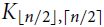 ${K_{\lfloor n/2 \rfloor,\lceil n/2 \rceil }}$ are the only possible extremal examples for large n.


Newman's identities, lucas sequences and congruences for certain partition functions
- Part of
-
- Journal:
- Proceedings of the Edinburgh Mathematical Society / Volume 63 / Issue 3 / August 2020
- Published online by Cambridge University Press:
- 08 October 2020, pp. 709-736
-
- Article
- Export citation
-
Let r be an integer with 2 ≤ r ≤ 24 and let pr(n) be defined by $\sum _{n=0}^\infty p_r(n) q^n = \prod _{k=1}^\infty (1-q^k)^r$. In this paper, we provide uniform methods for discovering infinite families of congruences and strange congruences for pr(n) by using some identities on pr(n) due to Newman. As applications, we establish many infinite families of congruences and strange congruences for certain partition functions, such as Andrews's smallest parts function, the coefficients of Ramanujan's ϕ function and p-regular partition functions. For example, we prove that for n ≥ 0,and for k ≥ 0,
 \[ \textrm{spt}\bigg( \frac{1991n(3n+1) }{2} +83\bigg) \equiv \textrm{spt}\bigg(\frac{1991n(3n+5)}{2} +2074\bigg) \equiv 0\ (\textrm{mod} \ 11), \]where spt(n) denotes Andrews's smallest parts function.
 \[ \textrm{spt}\bigg( \frac{143\times 5^{6k} +1 }{24}\bigg)\equiv 2^{k+2} \ (\textrm{mod}\ 11), \]
PEM series 2 volume 63 issue 3 Cover and Front matter
-
- Journal:
- Proceedings of the Edinburgh Mathematical Society / Volume 63 / Issue 3 / August 2020
- Published online by Cambridge University Press:
- 08 October 2020, pp. f1-f2
-
- Article
-
- You have access
- Export citation
