Refine search
Actions for selected content:
26077 results in Abstract analysis
Nilpotent n-tuples in SU(2)
- Part of
-
- Journal:
- Proceedings of the Edinburgh Mathematical Society / Volume 63 / Issue 4 / November 2020
- Published online by Cambridge University Press:
- 30 September 2020, pp. 1005-1030
-
- Article
- Export citation
-
We describe the connected components of the space $\text {Hom}(\Gamma ,SU(2))$
 of homomorphisms for a discrete nilpotent group $\Gamma$
 . The connected components arising from homomorphisms with non-abelian image turn out to be homeomorphic to $\mathbb {RP}^{3}$
 . We give explicit calculations when $\Gamma$
 is a finitely generated free nilpotent group. In the second part of the paper, we study the filtration $B_{\text {com}} SU(2)=B(2,SU(2))\subset \cdots \subset B(q,SU(2))\subset \cdots$
 of the classifying space $BSU(2)$
 (introduced by Adem, Cohen and Torres-Giese), showing that for every $q\geq 2$
 , the inclusions induce a homology isomorphism with coefficients over a ring in which 2 is invertible. Most of the computations are done for $SO(3)$
 and $U(2)$
 as well.


CONGRUENCE PRIMES FOR SIEGEL MODULAR FORMS OF PARAMODULAR LEVEL AND APPLICATIONS TO THE BLOCH–KATO CONJECTURE
- Part of
-
- Journal:
- Glasgow Mathematical Journal / Volume 63 / Issue 3 / September 2021
- Published online by Cambridge University Press:
- 29 September 2020, pp. 660-681
-
- Article
- Export citation
Eigenvalues and triangles in graphs
- Part of
-
- Journal:
- Combinatorics, Probability and Computing / Volume 30 / Issue 2 / March 2021
- Published online by Cambridge University Press:
- 28 September 2020, pp. 258-270
-
- Article
- Export citation
-
Bollobás and Nikiforov (J. Combin. Theory Ser. B. 97 (2007) 859–865) conjectured the following. If G is a Kr+1-free graph on at least r+1 vertices and m edges, then ${\rm{\lambda }}_1^2(G) + {\rm{\lambda }}_2^2(G) \le (r - 1)/r \cdot 2m$, where λ1 (G)and λ2 (G) are the largest and the second largest eigenvalues of the adjacency matrix A(G), respectively. In this paper we confirm the conjecture in the case r=2, by using tools from doubly stochastic matrix theory, and also characterize all families of extremal graphs. Motivated by classic theorems due to Erdös and Nosal respectively, we prove that every non-bipartite graph of order and size contains a triangle if one of the following is true: (i) ${{\rm{\lambda }}_1}(G) \ge \sqrt {m - 1} $ and $G \ne {C_5} \cup (n - 5){K_1}$, and (ii) ${{\rm{\lambda }}_1}(G) \ge {{\rm{\lambda }}_1}(S({K_{[(n - 1)/2],[(n - 1)/2]}}))$ and $G \ne S({K_{[(n - 1)/2],[(n - 1)/2]}})$, where $S({K_{[(n - 1)/2],[(n - 1)/2]}})$ is obtained from ${K_{[(n - 1)/2],[(n - 1)/2]}}$ by subdividing an edge. Both conditions are best possible. We conclude this paper with some open problems.
Inessential directed maps and directed homotopy equivalences
- Part of
-
- Journal:
- Proceedings of the Royal Society of Edinburgh. Section A: Mathematics / Volume 151 / Issue 4 / August 2021
- Published online by Cambridge University Press:
- 25 September 2020, pp. 1383-1406
- Print publication:
- August 2021
-
- Article
- Export citation
-
A directed space is a topological space $X$ together with a subspace $\vec {P}(X)\subset X^I$ of directed paths on $X$. A symmetry of a directed space should therefore respect both the topology of the underlying space and the topology of the associated spaces $\vec {P}(X)_-^+$ of directed paths between a source ( $-$) and a target ( $+$)—up to homotopy. If it is, moreover, homotopic to the identity map—in a directed sense—such a symmetry will be called an inessential d-map, and the paper explores the algebra and topology of inessential d-maps. Comparing two d-spaces $X$ and $Y$ ‘up to symmetry’ yields the notion of a directed homotopy equivalence between them. Under appropriate conditions, all directed homotopy equivalences are shown to satisfy a 2-out-of-3 property. Our notion of directed homotopy equivalence does not agree completely with the one defined in Goubault (2017, arxiv:1709:05702v2) and Goubault, Farber and Sagnier (2020, J. Appl. Comput. Topol. 4, 11–27); the deviation is motivated by examples. Nevertheless, directed topological complexity, introduced in Goubault, Farber and Sagnier (2020) is shown to be invariant under our notion of directed homotopy equivalence. Finally, we show that directed homotopy equivalences result in isomorphisms on the pair component categories of directed spaces introduced in Goubault, Farber and Sagnier (2020).


A reaction–diffusion epidemic model with incubation period in almost periodic environments
- Part of
-
- Journal:
- European Journal of Applied Mathematics / Volume 32 / Issue 6 / December 2021
- Published online by Cambridge University Press:
- 25 September 2020, pp. 1153-1176
-
- Article
- Export citation
The amyloid cascade hypothesis and Alzheimer’s disease: A mathematical model
- Part of
-
- Journal:
- European Journal of Applied Mathematics / Volume 32 / Issue 5 / October 2021
- Published online by Cambridge University Press:
- 25 September 2020, pp. 749-768
-
- Article
- Export citation
Asymptotic variational analysis of incompressible elastic strings
- Part of
-
- Journal:
- Proceedings of the Royal Society of Edinburgh. Section A: Mathematics / Volume 151 / Issue 5 / October 2021
- Published online by Cambridge University Press:
- 25 September 2020, pp. 1487-1514
- Print publication:
- October 2021
-
- Article
-
- You have access
- Open access
- Export citation
PRM volume 150 issue 5 Cover and Front matter
-
- Journal:
- Proceedings of the Royal Society of Edinburgh. Section A: Mathematics / Volume 150 / Issue 5 / October 2020
- Published online by Cambridge University Press:
- 24 September 2020, pp. f1-f2
- Print publication:
- October 2020
-
- Article
-
- You have access
- Export citation
REAL HYPERSURFACES IN COMPLEX SPACE FORMS ATTAINING EQUALITY IN AN INEQUALITY INVOLVING A CONTACT δ-INVARIANT
- Part of
-
- Journal:
- Glasgow Mathematical Journal / Volume 63 / Issue 3 / September 2021
- Published online by Cambridge University Press:
- 24 September 2020, pp. 724-731
-
- Article
- Export citation
Deep learning models for global coordinate transformations that linearise PDEs
- Part of
-
- Journal:
- European Journal of Applied Mathematics / Volume 32 / Issue 3 / June 2021
- Published online by Cambridge University Press:
- 24 September 2020, pp. 515-539
-
- Article
- Export citation
PRM volume 150 issue 5 Cover and Back matter
-
- Journal:
- Proceedings of the Royal Society of Edinburgh. Section A: Mathematics / Volume 150 / Issue 5 / October 2020
- Published online by Cambridge University Press:
- 24 September 2020, pp. b1-b2
- Print publication:
- October 2020
-
- Article
-
- You have access
- Export citation
Finding tight Hamilton cycles in random hypergraphs faster
- Part of
-
- Journal:
- Combinatorics, Probability and Computing / Volume 30 / Issue 2 / March 2021
- Published online by Cambridge University Press:
- 23 September 2020, pp. 239-257
-
- Article
- Export citation
-
In an r-uniform hypergraph on n vertices, a tight Hamilton cycle consists of n edges such that there exists a cyclic ordering of the vertices where the edges correspond to consecutive segments of r vertices. We provide a first deterministic polynomial-time algorithm, which finds a.a.s. tight Hamilton cycles in random r-uniform hypergraphs with edge probability at least C log3 n/n.
Our result partially answers a question of Dudek and Frieze, who proved that tight Hamilton cycles exist already for p = ω(1/n) for r = 3 and p = (e + o(1))/n for $r \ge 4$ using a second moment argument. Moreover our algorithm is superior to previous results of Allen, Böttcher, Kohayakawa and Person, and Nenadov and Škorić, in various ways: the algorithm of Allen et al. is a randomized polynomial-time algorithm working for edge probabilities $p \ge {n^{ - 1 + \varepsilon}}$, while the algorithm of Nenadov and Škorić is a randomized quasipolynomial-time algorithm working for edge probabilities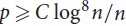 $p \ge C\mathop {\log }\nolimits^8 n/n$.


SPECTRAL CONDITIONS FOR UNIFORM P-ERGODICITIES OF MARKOV OPERATORS ON ABSTRACT STATES SPACES
- Part of
-
- Journal:
- Glasgow Mathematical Journal / Volume 63 / Issue 3 / September 2021
- Published online by Cambridge University Press:
- 23 September 2020, pp. 682-696
-
- Article
- Export citation
-
In the present paper, we deal with asymptotical stability of Markov operators acting on abstract state spaces (i.e. an ordered Banach space, where the norm has an additivity property on the cone of positive elements). Basically, we are interested in the rate of convergence when a Markov operator T satisfies the uniform P-ergodicity, i.e. $\|T^n-P\|\to 0$, here P is a projection. We have showed that T is uniformly P-ergodic if and only if $\|T^n-P\|\leq C\beta^n$, $0<\beta<1$. In this paper, we prove that such a β is characterized by the spectral radius of T − P. Moreover, we give Deoblin’s kind of conditions for the uniform P-ergodicity of Markov operators.

Global solution to a three-dimensional spherical piston problem for the relativistic Euler equations
- Part of
-
- Journal:
- European Journal of Applied Mathematics / Volume 33 / Issue 1 / February 2022
- Published online by Cambridge University Press:
- 23 September 2020, pp. 1-26
-
- Article
- Export citation
Coarse graining of a Fokker–Planck equation with excluded volume effects preserving the gradient flow structure
- Part of
-
- Journal:
- European Journal of Applied Mathematics / Volume 32 / Issue 4 / August 2021
- Published online by Cambridge University Press:
- 22 September 2020, pp. 711-745
-
- Article
-
- You have access
- Open access
- Export citation
The Lp Minkowski problem for q-capacity
- Part of
-
- Journal:
- Proceedings of the Royal Society of Edinburgh. Section A: Mathematics / Volume 151 / Issue 4 / August 2021
- Published online by Cambridge University Press:
- 21 September 2020, pp. 1247-1277
- Print publication:
- August 2021
-
- Article
- Export citation
Pull out all the stops: Textual analysis via punctuation sequences
- Part of
-
- Journal:
- European Journal of Applied Mathematics / Volume 32 / Issue 6 / December 2021
- Published online by Cambridge University Press:
- 21 September 2020, pp. 1069-1105
-
- Article
- Export citation
Domain formation via phase separation for spherical biomembranes with small deformations
- Part of
-
- Journal:
- European Journal of Applied Mathematics / Volume 32 / Issue 6 / December 2021
- Published online by Cambridge University Press:
- 18 September 2020, pp. 1127-1152
-
- Article
- Export citation
RECOVERY OF ZEROTH ORDER COEFFICIENTS IN NON-LINEAR WAVE EQUATIONS
- Part of
-
- Journal:
- Journal of the Institute of Mathematics of Jussieu / Volume 21 / Issue 2 / March 2022
- Published online by Cambridge University Press:
- 18 September 2020, pp. 367-393
- Print publication:
- March 2022
-
- Article
- Export citation
-
This paper is concerned with the resolution of an inverse problem related to the recovery of a function $V$ from the source to solution map of the semi-linear equation $(\Box _{g}+V)u+u^{3}=0$ on a globally hyperbolic Lorentzian manifold $({\mathcal{M}},g)$. We first study the simpler model problem, where $({\mathcal{M}},g)$ is the Minkowski space, and prove the unique recovery of $V$ through the use of geometric optics and a three-fold wave interaction arising from the cubic non-linearity. Subsequently, the result is generalized to globally hyperbolic Lorentzian manifolds by using Gaussian beams.


11 - The Moment Problem
-
- Book:
- Encyclopedia of Special Functions: The Askey-Bateman Project
- Published online:
- 14 September 2020
- Print publication:
- 17 September 2020, pp 269-306
-
- Chapter
- Export citation
