Refine search
Actions for selected content:
26077 results in Abstract analysis
There are no universal ternary quadratic forms over biquadratic fields
- Part of
-
- Journal:
- Proceedings of the Edinburgh Mathematical Society / Volume 63 / Issue 3 / August 2020
- Published online by Cambridge University Press:
- 16 September 2020, pp. 861-912
-
- Article
- Export citation
-
We study totally positive definite quadratic forms over the ring of integers $\mathcal {O}_K$ of a totally real biquadratic field $K=\mathbb {Q}(\sqrt {m}, \sqrt {s})$. We restrict our attention to classic forms (i.e. those with all non-diagonal coefficients in $2\mathcal {O}_K$) and prove that no such forms in three variables are universal (i.e. represent all totally positive elements of $\mathcal {O}_K$). Moreover, we show the same result for totally real number fields containing at least one non-square totally positive unit and satisfying some other mild conditions. These results provide further evidence towards Kitaoka's conjecture that there are only finitely many number fields over which such forms exist. One of our main tools are additively indecomposable elements of $\mathcal {O}_K$; we prove several new results about their properties.


Invariant Gibbs dynamics for the dynamical sine-Gordon model
- Part of
-
- Journal:
- Proceedings of the Royal Society of Edinburgh. Section A: Mathematics / Volume 151 / Issue 5 / October 2021
- Published online by Cambridge University Press:
- 16 September 2020, pp. 1450-1466
- Print publication:
- October 2021
-
- Article
- Export citation
Global well-posedness and decay estimates of strong solutions to the nonhomogeneous Boussinesq equations for magnetohydrodynamics convection
- Part of
-
- Journal:
- Proceedings of the Royal Society of Edinburgh. Section A: Mathematics / Volume 151 / Issue 5 / October 2021
- Published online by Cambridge University Press:
- 15 September 2020, pp. 1543-1567
- Print publication:
- October 2021
-
- Article
- Export citation
Non-monotone waves of a stage-structured SLIRM epidemic model with latent period
- Part of
-
- Journal:
- Proceedings of the Royal Society of Edinburgh. Section A: Mathematics / Volume 151 / Issue 5 / October 2021
- Published online by Cambridge University Press:
- 15 September 2020, pp. 1407-1442
- Print publication:
- October 2021
-
- Article
- Export citation
-
We propose and investigate a stage-structured SLIRM epidemic model with latent period in a spatially continuous habitat. We first show the existence of semi-travelling waves that connect the unstable disease-free equilibrium as the wave coordinate goes to − ∞, provided that the basic reproduction number $\mathcal {R}_0 > 1$ and $c > c_*$ for some positive number $c_*$. We then use a combination of asymptotic estimates, Laplace transform and Cauchy's integral theorem to show the persistence of semi-travelling waves. Based on the persistent property, we construct a Lyapunov functional to prove the convergence of the semi-travelling wave to an endemic (positive) equilibrium as the wave coordinate goes to + ∞. In addition, by the Laplace transform technique, the non-existence of bounded semi-travelling wave is also proved when $\mathcal {R}_0 > 1$ and $0 < c < c_*$. This indicates that $c_*$ is indeed the minimum wave speed. Finally simulations are given to illustrate the evolution of profiles.


Envelopes of families of framed surfaces and singular solutions of first-order partial differential equations
- Part of
-
- Journal:
- Proceedings of the Royal Society of Edinburgh. Section A: Mathematics / Volume 151 / Issue 5 / October 2021
- Published online by Cambridge University Press:
- 15 September 2020, pp. 1515-1542
- Print publication:
- October 2021
-
- Article
- Export citation
Maker–Breaker percolation games I: crossing grids
- Part of
-
- Journal:
- Combinatorics, Probability and Computing / Volume 30 / Issue 2 / March 2021
- Published online by Cambridge University Press:
- 15 September 2020, pp. 200-227
-
- Article
-
- You have access
- Open access
- Export citation

Encyclopedia of Special Functions: The Askey-Bateman Project
-
- Published online:
- 14 September 2020
- Print publication:
- 17 September 2020
On solvable groups with one vanishing class size
- Part of
-
- Journal:
- Proceedings of the Royal Society of Edinburgh. Section A: Mathematics / Volume 151 / Issue 5 / October 2021
- Published online by Cambridge University Press:
- 14 September 2020, pp. 1467-1486
- Print publication:
- October 2021
-
- Article
- Export citation
Matrix Positivity
-
- Published online:
- 11 September 2020
- Print publication:
- 01 October 2020
Continuity of solutions for the Δϕ-Laplacian operator
- Part of
-
- Journal:
- Proceedings of the Royal Society of Edinburgh. Section A: Mathematics / Volume 151 / Issue 4 / August 2021
- Published online by Cambridge University Press:
- 11 September 2020, pp. 1355-1382
- Print publication:
- August 2021
-
- Article
- Export citation
Triangle-degrees in graphs and tetrahedron coverings in 3-graphs
- Part of
-
- Journal:
- Combinatorics, Probability and Computing / Volume 30 / Issue 2 / March 2021
- Published online by Cambridge University Press:
- 09 September 2020, pp. 175-199
-
- Article
-
- You have access
- Open access
- Export citation
-
We investigate a covering problem in 3-uniform hypergraphs (3-graphs): Given a 3-graph F, what is c1(n, F), the least integer d such that if G is an n-vertex 3-graph with minimum vertex-degree $\delta_1(G)>d$ then every vertex of G is contained in a copy of F in G?
We asymptotically determine c1(n, F) when F is the generalized triangle $K_4^{(3)-}$, and we give close to optimal bounds in the case where F is the tetrahedron $K_4^{(3)}$ (the complete 3-graph on 4 vertices).
This latter problem turns out to be a special instance of the following problem for graphs: Given an n-vertex graph G with $m> n^2/4$ edges, what is the largest t such that some vertex in G must be contained in t triangles? We give upper bound constructions for this problem that we conjecture are asymptotically tight. We prove our conjecture for tripartite graphs, and use flag algebra computations to give some evidence of its truth in the general case.


Hamiltonian Berge cycles in random hypergraphs
- Part of
-
- Journal:
- Combinatorics, Probability and Computing / Volume 30 / Issue 2 / March 2021
- Published online by Cambridge University Press:
- 08 September 2020, pp. 228-238
-
- Article
- Export citation
-
In this note we study the emergence of Hamiltonian Berge cycles in random r-uniform hypergraphs. For $r\geq 3$ we prove an optimal stopping time result that if edges are sequentially added to an initially empty r-graph, then as soon as the minimum degree is at least 2, the hypergraph with high probability has such a cycle. In particular, this determines the threshold probability for Berge Hamiltonicity of the Erdős–Rényi random r-graph, and we also show that the 2-out random r-graph with high probability has such a cycle. We obtain similar results for weak Berge cycles as well, thus resolving a conjecture of Poole.

Instanton sheaves and representations of quivers
- Part of
-
- Journal:
- Proceedings of the Edinburgh Mathematical Society / Volume 63 / Issue 4 / November 2020
- Published online by Cambridge University Press:
- 04 September 2020, pp. 984-1004
-
- Article
- Export citation
ALGEBRAIC FIBER SPACES AND CURVATURE OF HIGHER DIRECT IMAGES
- Part of
-
- Journal:
- Journal of the Institute of Mathematics of Jussieu / Volume 21 / Issue 3 / May 2022
- Published online by Cambridge University Press:
- 03 September 2020, pp. 973-1028
- Print publication:
- May 2022
-
- Article
- Export citation
-
Let $p:X\rightarrow Y$ be an algebraic fiber space, and let $L$ be a line bundle on $X$. In this article, we obtain a curvature formula for the higher direct images of $\unicode[STIX]{x1D6FA}_{X/Y}^{i}\otimes L$ restricted to a suitable Zariski open subset of $X$. Our results are particularly meaningful if $L$ is semi-negatively curved on $X$ and strictly negative or trivial on smooth fibers of $p$. Several applications are obtained, including a new proof of a result by Viehweg–Zuo in the context of a canonically polarized family of maximal variation and its version for Calabi–Yau families. The main feature of our approach is that the general curvature formulas we obtain allow us to bypass the use of ramified covers – and the complications that are induced by them.


GLOBALLY REALIZABLE COMPONENTS OF LOCAL DEFORMATION RINGS
- Part of
-
- Journal:
- Journal of the Institute of Mathematics of Jussieu / Volume 21 / Issue 2 / March 2022
- Published online by Cambridge University Press:
- 03 September 2020, pp. 533-602
- Print publication:
- March 2022
-
- Article
- Export citation
-
Let $n$ be either $2$ or an odd integer greater than $1$, and fix a prime $p>2(n+1)$. Under standard ‘adequate image’ assumptions, we show that the set of components of $n$-dimensional $p$-adic potentially semistable local Galois deformation rings that are seen by potentially automorphic compatible systems of polarizable Galois representations over some CM field is independent of the particular global situation. We also (under the same assumption on $n$) improve on the main potential automorphy result of Barnet-Lamb et al. [Potential automorphy and change of weight, Ann. of Math. (2) 179(2) (2014), 501–609], replacing ‘potentially diagonalizable’ by ‘potentially globally realizable’.


On the policy improvement algorithm for ergodic risk-sensitive control
- Part of
-
- Journal:
- Proceedings of the Royal Society of Edinburgh. Section A: Mathematics / Volume 151 / Issue 4 / August 2021
- Published online by Cambridge University Press:
- 02 September 2020, pp. 1305-1330
- Print publication:
- August 2021
-
- Article
- Export citation
Stochastic differential equations driven by fractional Brownian motion with locally Lipschitz drift and their implicit Euler approximation
- Part of
-
- Journal:
- Proceedings of the Royal Society of Edinburgh. Section A: Mathematics / Volume 151 / Issue 4 / August 2021
- Published online by Cambridge University Press:
- 02 September 2020, pp. 1278-1304
- Print publication:
- August 2021
-
- Article
- Export citation
-
In this paper, we study a class of one-dimensional stochastic differential equations driven by fractional Brownian motion with Hurst parameter $ H \gt \frac{1}{2}$. The drift term of the equation is locally Lipschitz and unbounded in the neighbourhood of the origin. We show the existence, uniqueness and positivity of the solutions. The estimates of moments, including the negative power moments, are given. We also develop the implicit Euler scheme, proved that the scheme is positivity preserving and strong convergent, and obtain rate of convergence. Furthermore, by using Lamperti transformation, we show that our results can be applied to stochastic interest rate models such as mean-reverting stochastic volatility model and strongly nonlinear Aït-Sahalia type model.

Immediate smoothing and global solutions for initial data in L1 × W1,2 in a Keller–Segel system with logistic terms in 2D
- Part of
-
- Journal:
- Proceedings of the Royal Society of Edinburgh. Section A: Mathematics / Volume 151 / Issue 4 / August 2021
- Published online by Cambridge University Press:
- 02 September 2020, pp. 1204-1224
- Print publication:
- August 2021
-
- Article
- Export citation
-
This paper deals with the logistic Keller–Segel model
in bounded two-dimensional domains (with homogeneous Neumann boundary conditions and for parameters χ, κ ∈ ℝ and μ > 0), and shows that any nonnegative initial data (u0, v0) ∈ L1 × W1,2 lead to global solutions that are smooth in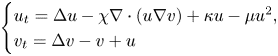 \[ \begin{cases} u_t = \Delta u - \chi \nabla\cdot(u\nabla v) + \kappa u - \mu u^2, \\ v_t = \Delta v - v + u \end{cases} \] $\bar {\Omega }\times (0,\infty )$.

Continuous-domain assignment flows
- Part of
-
- Journal:
- European Journal of Applied Mathematics / Volume 32 / Issue 3 / June 2021
- Published online by Cambridge University Press:
- 01 September 2020, pp. 570-597
-
- Article
- Export citation
Dirac’s theorem for random regular graphs
- Part of
-
- Journal:
- Combinatorics, Probability and Computing / Volume 30 / Issue 1 / January 2021
- Published online by Cambridge University Press:
- 28 August 2020, pp. 17-36
-
- Article
- Export citation
-
We prove a ‘resilience’ version of Dirac’s theorem in the setting of random regular graphs. More precisely, we show that whenever d is sufficiently large compared to $\epsilon > 0$, a.a.s. the following holds. Let $G'$ be any subgraph of the random n-vertex d-regular graph $G_{n,d}$ with minimum degree at least
  $$(1/2 + \epsilon )d$$. Then $G'$ is Hamiltonian.
This proves a conjecture of Ben-Shimon, Krivelevich and Sudakov. Our result is best possible: firstly the condition that d is large cannot be omitted, and secondly the minimum degree bound cannot be improved.


