Refine search
Actions for selected content:
26076 results in Abstract analysis
2 - Basic Concepts
-
- Book:
- Introduction to Approximate Groups
- Published online:
- 31 October 2019
- Print publication:
- 14 November 2019, pp 11-34
-
- Chapter
- Export citation
9 - Soluble Approximate Subgroups of GLn(C)
-
- Book:
- Introduction to Approximate Groups
- Published online:
- 31 October 2019
- Print publication:
- 14 November 2019, pp 147-169
-
- Chapter
- Export citation
Preface
-
- Book:
- Introduction to Approximate Groups
- Published online:
- 31 October 2019
- Print publication:
- 14 November 2019, pp xi-xiv
-
- Chapter
- Export citation
10 - Arbitrary Approximate Subgroups of GLn(C)
-
- Book:
- Introduction to Approximate Groups
- Published online:
- 31 October 2019
- Print publication:
- 14 November 2019, pp 170-177
-
- Chapter
- Export citation
1 - Introduction
-
- Book:
- Introduction to Approximate Groups
- Published online:
- 31 October 2019
- Print publication:
- 14 November 2019, pp 1-10
-
- Chapter
- Export citation
Index
-
- Book:
- Introduction to Approximate Groups
- Published online:
- 31 October 2019
- Print publication:
- 14 November 2019, pp 202-205
-
- Chapter
- Export citation
11 - Applications to Growth in Groups
-
- Book:
- Introduction to Approximate Groups
- Published online:
- 31 October 2019
- Print publication:
- 14 November 2019, pp 178-197
-
- Chapter
- Export citation
REDUCTIONS OF POINTS ON ALGEBRAIC GROUPS
- Part of
-
- Journal:
- Journal of the Institute of Mathematics of Jussieu / Volume 20 / Issue 5 / September 2021
- Published online by Cambridge University Press:
- 14 November 2019, pp. 1637-1669
- Print publication:
- September 2021
-
- Article
- Export citation
-
Let $A$ be the product of an abelian variety and a torus defined over a number field $K$. Fix some prime number $\ell$. If $\unicode[STIX]{x1D6FC}\in A(K)$ is a point of infinite order, we consider the set of primes $\mathfrak{p}$ of $K$ such that the reduction $(\unicode[STIX]{x1D6FC}\hspace{0.2em}{\rm mod}\hspace{0.2em}\mathfrak{p})$ is well-defined and has order coprime to $\ell$. This set admits a natural density. By refining the method of Jones and Rouse [Galois theory of iterated endomorphisms, Proc. Lond. Math. Soc. (3) 100(3) (2010), 763–794. Appendix A by Jeffrey D. Achter], we can express the density as an $\ell$-adic integral without requiring any assumption. We also prove that the density is always a rational number whose denominator (up to powers of $\ell$) is uniformly bounded in a very strong sense. For elliptic curves, we describe a strategy for computing the density which covers every possible case.


Edge-statistics on large graphs
- Part of
-
- Journal:
- Combinatorics, Probability and Computing / Volume 29 / Issue 2 / March 2020
- Published online by Cambridge University Press:
- 14 November 2019, pp. 163-189
-
- Article
- Export citation
-
The inducibility of a graph H measures the maximum number of induced copies of H a large graph G can have. Generalizing this notion, we study how many induced subgraphs of fixed order k and size ℓ a large graph G on n vertices can have. Clearly, this number is $\left( {\matrix{n \cr k}}\right)$ for every n, k and $\ell \in \left\{ {0,\left( {\matrix{k \cr 2}} \right)}\right\}$. We conjecture that for every n, k and $0 \lt \ell \lt \left( {\matrix{k \cr 2}}\right)$ this number is at most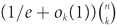 $ (1/e + {o_k}(1)) {\left( {\matrix{n \cr k}} \right)}$. If true, this would be tight for ℓ ∈ {1, k − 1}.
In support of our ‘Edge-statistics Conjecture’, we prove that the corresponding density is bounded away from 1 by an absolute constant. Furthermore, for various ranges of the values of ℓ we establish stronger bounds. In particular, we prove that for ‘almost all’ pairs (k, ℓ) only a polynomially small fraction of the k-subsets of V(G) have exactly ℓ edges, and prove an upper bound of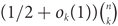 $ (1/2 + {o_k}(1)){\left( {\matrix{n \cr k}}\right)}$ for ℓ = 1.
Our proof methods involve probabilistic tools, such as anti-concentration results relying on fourth moment estimates and Brun’s sieve, as well as graph-theoretic and combinatorial arguments such as Zykov’s symmetrization, Sperner’s theorem and various counting techniques.


6 - Nilpotent Approximate Groups
-
- Book:
- Introduction to Approximate Groups
- Published online:
- 31 October 2019
- Print publication:
- 14 November 2019, pp 109-129
-
- Chapter
- Export citation
Contents
-
- Book:
- Introduction to Approximate Groups
- Published online:
- 31 October 2019
- Print publication:
- 14 November 2019, pp vii-x
-
- Chapter
- Export citation
3 - Coset Progressions and Bohr Sets
-
- Book:
- Introduction to Approximate Groups
- Published online:
- 31 October 2019
- Print publication:
- 14 November 2019, pp 35-53
-
- Chapter
-
- You have access
- Export citation
Frontmatter
-
- Book:
- Introduction to Approximate Groups
- Published online:
- 31 October 2019
- Print publication:
- 14 November 2019, pp i-iv
-
- Chapter
- Export citation
5 - Nilpotent Groups, Commutators and Nilprogressions
-
- Book:
- Introduction to Approximate Groups
- Published online:
- 31 October 2019
- Print publication:
- 14 November 2019, pp 81-108
-
- Chapter
- Export citation
There are no proper topological hyperbolic homoclinic classes for area-preserving maps
- Part of
-
- Journal:
- Proceedings of the Edinburgh Mathematical Society / Volume 63 / Issue 1 / February 2020
- Published online by Cambridge University Press:
- 12 November 2019, pp. 217-228
-
- Article
- Export citation
Additive n-commuting maps on semiprime rings
- Part of
-
- Journal:
- Proceedings of the Edinburgh Mathematical Society / Volume 63 / Issue 1 / February 2020
- Published online by Cambridge University Press:
- 11 November 2019, pp. 193-216
-
- Article
- Export citation
Cops-on-the-dots: The linear stability of crime hotspots for a 1-D reaction-diffusion model of urban crime
- Part of
-
- Journal:
- European Journal of Applied Mathematics / Volume 31 / Issue 5 / October 2020
- Published online by Cambridge University Press:
- 11 November 2019, pp. 871-917
-
- Article
- Export citation
-
In a singularly perturbed limit, we analyse the existence and linear stability of steady-state hotspot solutions for an extension of the 1-D three-component reaction-diffusion (RD) system formulated and studied numerically in Jones et. al. [Math. Models. Meth. Appl. Sci., 20, Suppl., (2010)], which models urban crime with police intervention. In our extended RD model, the field variables are the attractiveness field for burglary, the criminal population density and the police population density. Our model includes a scalar parameter that determines the strength of the police drift towards maxima of the attractiveness field. For a special choice of this parameter, we recover the ‘cops-on-the-dots’ policing strategy of Jones et. al., where the police mimic the drift of the criminals towards maxima of the attractiveness field. For our extended model, the method of matched asymptotic expansions is used to construct 1-D steady-state hotspot patterns as well as to derive nonlocal eigenvalue problems (NLEPs) that characterise the linear stability of these hotspot steady states to ${\cal O}$(1) timescale instabilities. For a cops-on-the-dots policing strategy, we prove that a multi-hotspot steady state is linearly stable to synchronous perturbations of the hotspot amplitudes. Alternatively, for asynchronous perturbations of the hotspot amplitudes, a hybrid analytical–numerical method is used to construct linear stability phase diagrams in the police vs. criminal diffusivity parameter space. In one particular region of these phase diagrams, the hotspot steady states are shown to be unstable to asynchronous oscillatory instabilities in the hotspot amplitudes that arise from a Hopf bifurcation. Within the context of our model, this provides a parameter range where the effect of a cops-on-the-dots policing strategy is to only displace crime temporally between neighbouring spatial regions. Our hybrid approach to study the NLEPs combines rigorous spectral results with a numerical parameterisation of any Hopf bifurcation threshold. For the cops-on-the-dots policing strategy, our linear stability predictions for steady-state hotspot patterns are confirmed from full numerical PDE simulations of the three-component RD system.

THE $\ell$-MODULAR LOCAL LANGLANDS CORRESPONDENCE AND LOCAL CONSTANTS
- Part of
-
- Journal:
- Journal of the Institute of Mathematics of Jussieu / Volume 20 / Issue 5 / September 2021
- Published online by Cambridge University Press:
- 08 November 2019, pp. 1585-1635
- Print publication:
- September 2021
-
- Article
- Export citation
-
Let $F$ be a non-archimedean local field of residual characteristic $p$,
$p$,  $\ell \neq p$ be a prime number, and $\text{W}_{F}$ the Weil group of $F$. We classify equivalence classes of $\text{W}_{F}$-semisimple Deligne $\ell$-modular representations of $\text{W}_{F}$ in terms of irreducible $\ell$-modular representations of $\text{W}_{F}$, and extend constructions of Artin–Deligne local constants to this setting. Finally, we define a variant of the $\ell$-modular local Langlands correspondence which satisfies a preservation of local constants statement for pairs of generic representations.


GEOMETRY OF KOTTWITZ–VIEHMANN VARIETIES
- Part of
-
- Journal:
- Journal of the Institute of Mathematics of Jussieu / Volume 21 / Issue 1 / January 2022
- Published online by Cambridge University Press:
- 08 November 2019, pp. 1-65
- Print publication:
- January 2022
-
- Article
- Export citation
Editorial
- Part of
-
- Journal:
- European Journal of Applied Mathematics / Volume 30 / Issue 6 / December 2019
- Published online by Cambridge University Press:
- 07 November 2019, pp. 1039-1040
-
- Article
-
- You have access
- Export citation
