Refine search
Actions for selected content:
26076 results in Abstract analysis
RIGIDITY FOR RIGID ANALYTIC MOTIVES
- Part of
-
- Journal:
- Journal of the Institute of Mathematics of Jussieu / Volume 20 / Issue 4 / July 2021
- Published online by Cambridge University Press:
- 27 September 2019, pp. 1341-1369
- Print publication:
- July 2021
-
- Article
- Export citation
-
In this paper we prove the Rigidity Theorem for motives of rigid analytic varieties over a non-Archimedean valued field $K$. We prove this theorem both for motives with transfers and without transfers in a relative setting. Applications include the construction of étale realization functors, an upgrade of the known comparison between motives with and without transfers and an upgrade of the rigid analytic motivic tilting equivalence, extending them to $\mathbb{Z}[1/p]$-coefficients.


Two components is too simple: an example of oscillatory Fisher–KPP system with three components
- Part of
-
- Journal:
- Proceedings of the Royal Society of Edinburgh. Section A: Mathematics / Volume 150 / Issue 6 / December 2020
- Published online by Cambridge University Press:
- 24 September 2019, pp. 3097-3120
- Print publication:
- December 2020
-
- Article
- Export citation
PRM volume 149 issue 5 Cover and Front matter
-
- Journal:
- Proceedings of the Royal Society of Edinburgh. Section A: Mathematics / Volume 149 / Issue 5 / October 2019
- Published online by Cambridge University Press:
- 23 September 2019, pp. f1-f2
- Print publication:
- October 2019
-
- Article
-
- You have access
- Export citation
Weighted estimates for the Calderón commutator
- Part of
-
- Journal:
- Proceedings of the Edinburgh Mathematical Society / Volume 63 / Issue 1 / February 2020
- Published online by Cambridge University Press:
- 23 September 2019, pp. 169-192
-
- Article
- Export citation
-
In this paper the authors consider the weighted estimates for the Calderón commutator defined by
with P2(A;x, y) = A(x) − A(y) − A′(y)(x − y) and A′ ∈ BMO(ℝ). Dominating this operator by multi(sub)linear sparse operators, the authors establish the weighted bounds from \mathcal{C}_{m+1, A}(a_1,\ldots,a_{m};f)(x)={\rm p. v.} \displaystyle\int_{\mathbb{R}}\displaystyle\frac{P_2(A; x, y)\prod\nolimits_{j=1}^m(A_j(x)-A_j(y))}{(x-y)^{m+2}}f(y){\rm d}y, $L^{p_1}(\mathbb {R},w_1) \times \cdots \times L^{p_{m+1}}(\mathbb {R},w_{m+1})$ to $L^{p}(\mathbb {R},\nu _{\vec {\kern 1pt w}})$, with p1, …, pm+1 ∈ (1, ∞), 1/p = 1/p1 + · · · + 1/pm+1, and $\vec {\kern 1pt w}=(w_1, \ldots , w_{m+1})\in A_{\vec {P}}(\mathbb {R}^{m+1})$. The authors also obtain the weighted weak type endpoint estimates for $\mathcal {C}_{m+1, A}$.


PRM volume 149 issue 5 Cover and Back matter
-
- Journal:
- Proceedings of the Royal Society of Edinburgh. Section A: Mathematics / Volume 149 / Issue 5 / October 2019
- Published online by Cambridge University Press:
- 23 September 2019, pp. b1-b2
- Print publication:
- October 2019
-
- Article
-
- You have access
- Export citation
On pathological properties of fixed point algebras in Kirchberg algebras
- Part of
-
- Journal:
- Proceedings of the Royal Society of Edinburgh. Section A: Mathematics / Volume 150 / Issue 6 / December 2020
- Published online by Cambridge University Press:
- 20 September 2019, pp. 3087-3096
- Print publication:
- December 2020
-
- Article
- Export citation
-
We investigate how the fixed point algebra of a C*-dynamical system can differ from the underlying C*-algebra. For any exact group Γ and any infinite group Λ, we construct an outer action of Λ on the Cuntz algebra 𝒪2 whose fixed point algebra is almost equal to the reduced group C*-algebra ${\rm C}_{\rm r}^* (\Gamma)$. Moreover, we show that every infinite group admits outer actions on all Kirchberg algebras whose fixed point algebras fail the completely bounded approximation property.

Cauchy problem and periodic homogenization for nonlocal Hamilton–Jacobi equations with coercive gradient terms
- Part of
-
- Journal:
- Proceedings of the Royal Society of Edinburgh. Section A: Mathematics / Volume 150 / Issue 6 / December 2020
- Published online by Cambridge University Press:
- 17 September 2019, pp. 3028-3059
- Print publication:
- December 2020
-
- Article
- Export citation
TATE’S CONJECTURE AND THE TATE–SHAFAREVICH GROUP OVER GLOBAL FUNCTION FIELDS
- Part of
-
- Journal:
- Journal of the Institute of Mathematics of Jussieu / Volume 20 / Issue 3 / May 2021
- Published online by Cambridge University Press:
- 17 September 2019, pp. 1001-1022
- Print publication:
- May 2021
-
- Article
- Export citation
-
Let ${\mathcal{X}}$ be a regular variety, flat and proper over a complete regular curve over a finite field such that the generic fiber $X$ is smooth and geometrically connected. We prove that the Brauer group of ${\mathcal{X}}$ is finite if and only Tate’s conjecture for divisors on $X$ holds and the Tate–Shafarevich group of the Albanese variety of $X$ is finite, generalizing a theorem of Artin and Grothendieck for surfaces to arbitrary relative dimension. We also give a formula relating the orders of the group under the assumption that they are finite, generalizing the known formula for a surface.


Existence of solution for quasilinear equations involving local conditions
- Part of
-
- Journal:
- Proceedings of the Royal Society of Edinburgh. Section A: Mathematics / Volume 150 / Issue 6 / December 2020
- Published online by Cambridge University Press:
- 17 September 2019, pp. 3074-3086
- Print publication:
- December 2020
-
- Article
- Export citation
-
In this paper, we study the existence of weak solutions of the quasilinear equation
where a : ℝ → [0, ∞) is C1 and a nonincreasing continuous function near the origin, the nonlinear term f : Ω × ℝ → ℝ is a Carathéodory function verifying certain superlinear conditions only at zero, and λ is a positive parameter. The existence of the solution relies on C1-estimates and variational arguments. \begin{cases} -{\rm div} (a(\vert \nabla u \vert ^2)\nabla u)=\lambda f(x,u) &{\rm in} \ \Omega,\\ u=0 &{\rm on} \ \partial\Omega, \end{cases}
Liouville theorem for fractional Hénon–Lane–Emden systems on a half space
- Part of
-
- Journal:
- Proceedings of the Royal Society of Edinburgh. Section A: Mathematics / Volume 150 / Issue 6 / December 2020
- Published online by Cambridge University Press:
- 17 September 2019, pp. 3060-3073
- Print publication:
- December 2020
-
- Article
- Export citation
-
This paper is concerned with the fractional system
where n ⩾ 2, 0 < α, β < 2, a > −α, b > −β and p, q ⩾ 1. By exploiting a direct method of scaling spheres for fractional systems, we prove that if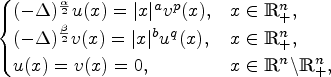 \begin{cases} (-\Delta)^{\frac{\alpha}{2}} u(x) = \vert x \vert ^a v^p(x), &x\in\mathbb{R}^n_+,\\ (-\Delta)^{\frac{\beta}{2}} v(x) = \vert x \vert ^b u^q(x), &x\in\mathbb{R}^n_+,\\ u(x)=v(x)=0, &x\in\mathbb{R}^n{\setminus}\mathbb{R}^n_+, \end{cases} $p \leqslant \frac {n+\alpha +2a}{n-\beta }$, $q \leqslant \frac {n+\beta +2b}{n-\alpha }$, $p+q<\frac {n+\alpha +2a}{n-\beta }+\frac {n+\beta +2b}{n-\alpha }$ and (u, v) is a nonnegative strong solution of the system, then u ≡ v ≡ 0.



Lebesgue Integration and Measure
-
- Published online:
- 13 September 2019
- Print publication:
- 10 May 1973
Poincaré duality and resonance varieties
- Part of
-
- Journal:
- Proceedings of the Royal Society of Edinburgh. Section A: Mathematics / Volume 150 / Issue 6 / December 2020
- Published online by Cambridge University Press:
- 13 September 2019, pp. 3001-3027
- Print publication:
- December 2020
-
- Article
- Export citation
-
We explore the constraints imposed by Poincaré duality on the resonance varieties of a graded algebra. For a three-dimensional Poincaré duality algebra A, we obtain a fairly precise geometric description of the resonance varieties ${\cal R}^i_k(A)$.

A switched server system semiconjugate to a minimal interval exchange
- Part of
-
- Journal:
- European Journal of Applied Mathematics / Volume 31 / Issue 4 / August 2020
- Published online by Cambridge University Press:
- 13 September 2019, pp. 682-708
-
- Article
- Export citation
On the Chromatic Number of Matching Kneser Graphs
- Part of
-
- Journal:
- Combinatorics, Probability and Computing / Volume 29 / Issue 1 / January 2020
- Published online by Cambridge University Press:
- 12 September 2019, pp. 1-21
-
- Article
- Export citation
Higher homotopy associativity in the Harris decomposition of Lie groups
- Part of
-
- Journal:
- Proceedings of the Royal Society of Edinburgh. Section A: Mathematics / Volume 150 / Issue 6 / December 2020
- Published online by Cambridge University Press:
- 11 September 2019, pp. 2982-3000
- Print publication:
- December 2020
-
- Article
- Export citation
Editorial
- Part of
-
- Journal:
- European Journal of Applied Mathematics / Volume 30 / Issue 5 / October 2019
- Published online by Cambridge University Press:
- 09 September 2019, p. 829
-
- Article
-
- You have access
- Export citation
Mathematical analysis of a credit default swap with counterparty risks
- Part of
-
- Journal:
- European Journal of Applied Mathematics / Volume 31 / Issue 5 / October 2020
- Published online by Cambridge University Press:
- 09 September 2019, pp. 737-762
-
- Article
- Export citation
BANACH ALGEBRAS OF VECTOR-VALUED FUNCTIONS – CORRIGENDUM
-
- Journal:
- Glasgow Mathematical Journal / Volume 62 / Issue 3 / September 2020
- Published online by Cambridge University Press:
- 06 September 2019, p. 746
-
- Article
-
- You have access
- Export citation
Potential flow over a submerged rectangular obstacle: Consequences for initiation of boulder motion
- Part of
-
- Journal:
- European Journal of Applied Mathematics / Volume 31 / Issue 4 / August 2020
- Published online by Cambridge University Press:
- 05 September 2019, pp. 646-681
-
- Article
- Export citation
Small Péclet-number mass transport to a finite strip: An advection–diffusion–reaction model of surface-based biosensors
- Part of
-
- Journal:
- European Journal of Applied Mathematics / Volume 31 / Issue 5 / October 2020
- Published online by Cambridge University Press:
- 05 September 2019, pp. 763-781
-
- Article
- Export citation
-
We consider two-dimensional mass transport to a finite absorbing strip in a uniform shear flow as a model of surface-based biosensors. The quantity of interest is the Sherwood number Sh, namely the dimensionless net flux onto the strip. Considering early-time absorption, it is a function of the Péclet number Pe and the Damköhler number Da, which, respectively, represent the characteristic magnitude of advection and reaction relative to diffusion. With a view towards modelling nanoscale biosensors, we consider the limit Pe«1. This singular limit is handled using matched asymptotic expansions, with an inner region on the scale of the strip, where mass transport is diffusively dominated, and an outer region at distances that scale as Pe-1/2, where advection enters the dominant balance. At the inner region, the mass concentration possesses a point-sink behaviour at large distances, proportional to Sh. A rescaled concentration, normalised using that number, thus possesses a universal logarithmic divergence; its leading-order correction represents a uniform background concentration. At the outer region, where advection by the shear flow enters the leading-order balance, the strip appears as a point singularity. Asymptotic matching with the concentration field in that region provides the Sherwood number as
wherein β is the background concentration. The latter is determined by the solution of the canonical problem governing the rescaled inner concentration, and is accordingly a function of Da alone. Using elliptic-cylinder coordinates, we have obtained an exact solution of the canonical problem, valid for arbitrary values of Da. It is supplemented by approximate solutions for both small and large Da values, representing the respective limits of reaction- and transport-limited conditions. $${\rm{Sh}} = {\pi \over {\ln (2/{\rm{P}}{{\rm{e}}^{1/2}}) + 1.0559 + \beta }},$$
