Refine search
Actions for selected content:
26063 results in Abstract analysis
Dynamic and stochastic propagation of the Brenier optimal mass transport
- Part of
-
- Journal:
- European Journal of Applied Mathematics / Volume 30 / Issue 6 / December 2019
- Published online by Cambridge University Press:
- 20 March 2019, pp. 1264-1299
-
- Article
- Export citation
-
Similar to how Hopf–Lax–Oleinik-type formula yield variational solutions for Hamilton–Jacobi equations on Euclidean space, optimal mass transportations can sometimes provide variational formulations for solutions of certain mean-field games. We investigate here the particular case of transports that maximize and minimize the following ‘ballistic’ cost functional on phase space TM, which propagates Brenier’s transport along a Lagrangian L,
where $$b_T(v, x):=\inf\left\{\langle v, \gamma (0)\rangle +\int_0^TL(t, \gamma (t), {\dot \gamma}(t))\, dt; \gamma \in C^1([0, T], M);\gamma(T)=x\right\}\!,$$ $M = \mathbb{R}^d$, and T >0. We also consider the stochastic counterpart:where
 \begin{align*}\underline{B}_T^s(\mu,\nu):=\inf\left\{\mathbb{E}\left[\langle V,X_0\rangle +\int_0^T L(t, X,\beta(t,X))\,dt\right]\!; X\in \mathcal{A}, V\sim\mu,X_T\sim \nu\right\}\!,\end{align*} $\mathcal{A}$ is the set of stochastic processes satisfying dX = βX (t, X) dt + dWt, for some drift βX (t, X), and where Wt is σ(Xs: 0 ≤ s ≤ t)-Brownian motion. Both cases lead to Lax–Oleinik-type formulas on Wasserstein space that relate optimal ballistic transports to those associated with dynamic fixed-end transports studied by Bernard–Buffoni and Fathi–Figalli in the deterministic case, and by Mikami–Thieullen in the stochastic setting. While inf-convolution easily covers cost minimizing transports, this is not the case for total cost maximizing transports, which actually are sup-inf problems. However, in the case where the Lagrangian L is jointly convex on phase space, Bolza-type dualities – well known in the deterministic case but novel in the stochastic case – transform sup-inf problems to sup–sup settings. We also write Eulerian formulations and point to links with the theory of mean-field games.


Bilinear forms on potential spaces in the unit circle
- Part of
-
- Journal:
- Proceedings of the Royal Society of Edinburgh. Section A: Mathematics / Volume 150 / Issue 4 / August 2020
- Published online by Cambridge University Press:
- 19 March 2019, pp. 2117-2154
- Print publication:
- August 2020
-
- Article
- Export citation
-
In this paper we characterize the boundedness on the product of Sobolev spaces Hs(𝕋) × Hs(𝕋) on the unit circle 𝕋, of the bilinear form Λb with symbol b ∈ Hs(𝕋) given by
 $${{\Lambda}_b} (\varphi, \psi): = \int_{\open T} {\left( {{{( - {\Delta })}^s} + I} \right)(\varphi \psi )(\eta )b(\eta ) {\rm d}\sigma (\eta ).}$$
Positivity and continued fractions from the binomial transformation
- Part of
-
- Journal:
- Proceedings of the Royal Society of Edinburgh. Section A: Mathematics / Volume 149 / Issue 3 / June 2019
- Published online by Cambridge University Press:
- 18 March 2019, pp. 831-847
- Print publication:
- June 2019
-
- Article
- Export citation
-
Given a sequence of polynomials $\{x_k(q)\}_{k \ges 0}$, define the transformationfor
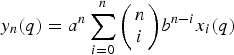 $$y_n(q) = a^n\sum\limits_{i = 0}^n {\left( \matrix{n \cr i} \right)} b^{n-i}x_i(q)$$ $n\ges 0$. In this paper, we obtain the relation between the Jacobi continued fraction of the ordinary generating function of yn(q) and that of xn(q). We also prove that the transformation preserves q-TPr+1 (q-TP) property of the Hankel matrix $[x_{i+j}(q)]_{i,j \ges 0}$, in particular for r = 2,3, implying the r-q-log-convexity of the sequence $\{y_n(q)\}_{n\ges 0}$. As applications, we can give the continued fraction expressions of Eulerian polynomials of types A and B, derangement polynomials types A and B, general Eulerian polynomials, Dowling polynomials and Tanny-geometric polynomials. In addition, we also prove the strong q-log-convexity of derangement polynomials type B, Dowling polynomials and Tanny-geometric polynomials and 3-q-log-convexity of general Eulerian polynomials, Dowling polynomials and Tanny-geometric polynomials. We also present a new proof of the result of Pólya and Szegö about the binomial convolution preserving the Stieltjes moment property and a new proof of the result of Zhu and Sun on the binomial transformation preserving strong q-log-convexity.


Evolution of interfaces for the nonlinear parabolic p-Laplacian-type reaction-diffusion equations. II. Fast diffusion vs. absorption
- Part of
-
- Journal:
- European Journal of Applied Mathematics / Volume 31 / Issue 3 / June 2020
- Published online by Cambridge University Press:
- 18 March 2019, pp. 385-406
-
- Article
- Export citation
-
We present a full classification of the short-time behaviour of the interfaces and local solutions to the nonlinear parabolic p-Laplacian-type reaction-diffusion equation of non-Newtonian elastic filtration
If the interface is finite, it may expand, shrink or remain stationary as a result of the competition of the diffusion and reaction terms near the interface, expressed in terms of the parameters p, β, sign b, and asymptotics of the initial function near its support. In some range of parameters, strong domination of the diffusion causes infinite speed of propagation and interfaces are absent. In all cases with finite interfaces, we prove the explicit formula for the interface and the local solution with accuracy up to constant coefficients. We prove explicit asymptotics of the local solution at infinity in all cases with infinite speed of propagation. The methods of the proof are based on nonlinear scaling laws and a barrier technique using special comparison theorems in irregular domains with characteristic boundary curves. A full description of small-time behaviour of the interfaces and local solutions near the interfaces for slow diffusion case when p>2 is presented in a recent paper by Abdulla and Jeli [(2017) Europ. J. Appl. Math.28(5), 827–853]. $$u_t-\Big(|u_x|^{p-2}u_x\Big)_x+bu^{\beta}=0, \ 1 \lt p \lt 2, \beta \gt 0.$$
Sharp estimates of semistable radial solutions of k-Hessian equations
- Part of
-
- Journal:
- Proceedings of the Royal Society of Edinburgh. Section A: Mathematics / Volume 150 / Issue 4 / August 2020
- Published online by Cambridge University Press:
- 15 March 2019, pp. 2083-2115
- Print publication:
- August 2020
-
- Article
- Export citation
-
We consider semistable, radially symmetric and increasing solutions of Sk(D2u) = g(u) in the unit ball of ℝn, where Sk(D2u) is the k-Hessian operator of u and g ∈ C1 is a general positive nonlinearity. We establish sharp pointwise estimates for such solutions in a proper weighted Sobolev space, which are optimal and do not depend on the specific nonlinearity g. As an application of these results, we obtain pointwise estimates for the extremal solution and its derivatives (up to order three) of the equation Sk(D2u) = λg(u), posed in B1, with Dirichlet data $u\arrowvert _{B_1}=0$, where g is a continuous, positive, nonincreasing function such that lim t→−∞g(t)/|t|k = +∞.

Division algebras of slice functions
- Part of
-
- Journal:
- Proceedings of the Royal Society of Edinburgh. Section A: Mathematics / Volume 150 / Issue 4 / August 2020
- Published online by Cambridge University Press:
- 15 March 2019, pp. 2055-2082
- Print publication:
- August 2020
-
- Article
- Export citation
An asymptotic bound for the strong chromatic number
- Part of
-
- Journal:
- Combinatorics, Probability and Computing / Volume 28 / Issue 5 / September 2019
- Published online by Cambridge University Press:
- 15 March 2019, pp. 768-776
-
- Article
- Export citation
-
The strong chromatic number χs(G) of a graph G on n vertices is the least number r with the following property: after adding $r\lceil n/r\rceil-n$ isolated vertices to G and taking the union with any collection of spanning disjoint copies of Kr in the same vertex set, the resulting graph has a proper vertex colouring with r colours. We show that for every c > 0 and every graph G on n vertices with Δ(G) ≥ cn, χs(G) ≤ (2+o(1))Δ(G), which is asymptotically best possible.

8 - Convolution and Beyond
-
- Book:
- Symmetrization in Analysis
- Published online:
- 22 February 2019
- Print publication:
- 14 March 2019, pp 254-298
-
- Chapter
- Export citation
Foreword
-
- Book:
- Symmetrization in Analysis
- Published online:
- 22 February 2019
- Print publication:
- 14 March 2019, pp xiii-xvi
-
- Chapter
- Export citation
Contents
-
- Book:
- Symmetrization in Analysis
- Published online:
- 22 February 2019
- Print publication:
- 14 March 2019, pp v-viii
-
- Chapter
- Export citation
11 - The ⋆-Function in Complex Analysis
-
- Book:
- Symmetrization in Analysis
- Published online:
- 22 February 2019
- Print publication:
- 14 March 2019, pp 398-453
-
- Chapter
- Export citation
Preface
-
- Book:
- Symmetrization in Analysis
- Published online:
- 22 February 2019
- Print publication:
- 14 March 2019, pp xvii-xviii
-
- Chapter
- Export citation
Introduction
-
- Book:
- Symmetrization in Analysis
- Published online:
- 22 February 2019
- Print publication:
- 14 March 2019, pp 1-15
-
- Chapter
- Export citation
1 - Rearrangements
-
- Book:
- Symmetrization in Analysis
- Published online:
- 22 February 2019
- Print publication:
- 14 March 2019, pp 16-53
-
- Chapter
- Export citation
9 - The ⋆-Function
-
- Book:
- Symmetrization in Analysis
- Published online:
- 22 February 2019
- Print publication:
- 14 March 2019, pp 299-355
-
- Chapter
- Export citation
10 - Comparison Principles for Semilinear Poisson PDEs
-
- Book:
- Symmetrization in Analysis
- Published online:
- 22 February 2019
- Print publication:
- 14 March 2019, pp 356-397
-
- Chapter
- Export citation
6 - Steiner Symmetrization
-
- Book:
- Symmetrization in Analysis
- Published online:
- 22 February 2019
- Print publication:
- 14 March 2019, pp 182-215
-
- Chapter
- Export citation
3 - Dirichlet Integral Inequalities
-
- Book:
- Symmetrization in Analysis
- Published online:
- 22 February 2019
- Print publication:
- 14 March 2019, pp 92-118
-
- Chapter
- Export citation
On non-autonomously forced Burgers equation with periodic and Dirichlet boundary conditions
- Part of
-
- Journal:
- Proceedings of the Royal Society of Edinburgh. Section A: Mathematics / Volume 150 / Issue 4 / August 2020
- Published online by Cambridge University Press:
- 14 March 2019, pp. 2025-2054
- Print publication:
- August 2020
-
- Article
- Export citation
-
We study the non-autonomously forced Burgers equation
on the space interval (0, 1) with two sets of the boundary conditions: the Dirichlet and periodic ones. For both situations we prove that there exists the unique H1 bounded trajectory of this equation defined for all t ∈ ℝ. Moreover we demonstrate that this trajectory attracts all trajectories both in pullback and forward sense. We also prove that for the Dirichlet case this attraction is exponential. $$u_t(x,t) + u(x,t)u_x(x,t)-u_{xx}(x,t) = f(x,t)$$
4 - Geometric Isoperimetric and Sharp Sobolev Inequalities
-
- Book:
- Symmetrization in Analysis
- Published online:
- 22 February 2019
- Print publication:
- 14 March 2019, pp 119-152
-
- Chapter
- Export citation
