Refine search
Actions for selected content:
26080 results in Abstract analysis
Global solutions to norm-preserving non-local flows of porous media type
-
- Journal:
- Proceedings of the Royal Society of Edinburgh. Section A: Mathematics / Volume 143 / Issue 4 / August 2013
- Published online by Cambridge University Press:
- 17 July 2013, pp. 871-880
- Print publication:
- August 2013
-
- Article
- Export citation
-
In this paper, we study the global existence of positive solutions to the norm-preserving non-local heat flow of the porous-media type equations
 on the compact Riemannian manifold (M, g) with the Cauchy data u0 > 0 on M, where r ≥ 1, p >1 and λ(t) is chosen to make the L2-norm of the solution u (or a power of u) constant. We show that the limit is an eigenfunction for the Laplacian operator. We use some tricky estimates through the Sobolev imbedding theorem and the Moser iteration method.
Homotopy commutativity in p-localized gauge groups
-
- Journal:
- Proceedings of the Royal Society of Edinburgh. Section A: Mathematics / Volume 143 / Issue 4 / August 2013
- Published online by Cambridge University Press:
- 17 July 2013, pp. 851-870
- Print publication:
- August 2013
-
- Article
- Export citation
-
Let G be a simple, compact Lie group and let
 be the gauge group of the principal G-bundle over S4 with second Chern class k. McGibbon classified the groups G that are homotopy commutative when localized at a prime p. We show that in many cases the homotopy commutativity of G, or its failure, determines that of .
 be the gauge group of the principal G-bundle over S
A uniqueness result for a singular nonlinear eigenvalue problem
-
- Journal:
- Proceedings of the Royal Society of Edinburgh. Section A: Mathematics / Volume 143 / Issue 4 / August 2013
- Published online by Cambridge University Press:
- 17 July 2013, pp. 739-744
- Print publication:
- August 2013
-
- Article
- Export citation
-
We consider the positive solutions to singular boundary-value problems of the form
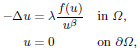 where λ > 0, β ∈ (0,1) and Ω is a bounded domain in ℝN, N ≥ 1, with smooth boundary ∂Ω. Here, we assume that f: [0, ∞) → (0, ∞) is a C1 non-decreasing function and f(s)/sβ is decreasing for s large. We establish the uniqueness of the positive solution when λ is large.
Forbidden Subgraphs Generating Almost the Same Sets
-
- Journal:
- Combinatorics, Probability and Computing / Volume 22 / Issue 5 / September 2013
- Published online by Cambridge University Press:
- 11 July 2013, pp. 733-748
-
- Article
- Export citation
-
Let $\mathcal{H}$ be a set of connected graphs. A graph G is said to be $\mathcal{H}$-free if G does not contain any element of $\mathcal{H}$ as an induced subgraph. Let $\mathcal{F}_{k}(\mathcal{H})$ be the set of k-connected $\mathcal{H}$-free graphs. When we study the relationship between forbidden subgraphs and a certain graph property, we often allow a finite exceptional set of graphs. But if the symmetric difference of $\mathcal{F}_{k}(\mathcal{H}_{1})$ and $\mathcal{F}_{k}(\mathcal{H}_{2})$ is finite and we allow a finite number of exceptions, no graph property can distinguish them. Motivated by this observation, we study when we obtain a finite symmetric difference. In this paper, our main aim is the following. If $|\mathcal{H}|\leq 3$ and the symmetric difference of $\mathcal{F}_{1}(\{H\})$ and $\mathcal{F}_{1}(\mathcal{H})$ is finite, then either $H\in \mathcal{H}$ or $|\mathcal{H}|=3$ and H=C3. Furthermore, we prove that if the symmetric difference of $\mathcal{F}_{k}(\{H_{1}\})$ and $\mathcal{F}_{k}(\{H_{2}\})$ is finite, then H1=H2.


Cohomological finiteness properties of the Brin–Thompson–Higman groups 2V and 3V
- Part of
-
- Journal:
- Proceedings of the Edinburgh Mathematical Society / Volume 56 / Issue 3 / October 2013
- Published online by Cambridge University Press:
- 10 July 2013, pp. 777-804
-
- Article
-
- You have access
- Export citation
Compactness of embeddings of function spaces on quasi-bounded domains and the distribution of eigenvalues of related elliptic operators
- Part of
-
- Journal:
- Proceedings of the Edinburgh Mathematical Society / Volume 56 / Issue 3 / October 2013
- Published online by Cambridge University Press:
- 10 July 2013, pp. 829-851
-
- Article
-
- You have access
- Export citation
Fusion systems and group actions with abelian isotropy subgroups
- Part of
-
- Journal:
- Proceedings of the Edinburgh Mathematical Society / Volume 56 / Issue 3 / October 2013
- Published online by Cambridge University Press:
- 10 July 2013, pp. 873-886
-
- Article
-
- You have access
- Export citation
-
We prove that if a finite group G acts smoothly on a manifold M such that all the isotropy subgroups are abelian groups with rank ≤ k, then G acts freely and smoothly on M ×
 × … ×
× … ×  for some positive integers n1, …, nk. We construct these actions using a recursive method, introduced in an earlier paper, that involves abstract fusion systems on finite groups. As another application of this method, we prove that every finite solvable group acts freely and smoothly on some product of spheres, with trivial action on homology.
 × … ×
× … ×  for some positive integers n1, …, nk. We construct these actions using a recursive method, introduced in an earlier paper, that involves abstract fusion systems on finite groups. As another application of this method, we prove that every finite solvable group acts freely and smoothly on some product of spheres, with trivial action on homology.
Topological flatness of local models for ramified unitary groups. II. The even dimensional case
- Part of
-
- Journal:
- Journal of the Institute of Mathematics of Jussieu / Volume 13 / Issue 2 / April 2014
- Published online by Cambridge University Press:
- 10 July 2013, pp. 303-393
- Print publication:
- April 2014
-
- Article
- Export citation
-
Local models are schemes, defined in terms of linear-algebraic moduli problems, which are used to model the étale-local structure of integral models of certain $p$ -adic PEL Shimura varieties defined by Rapoport and Zink. In the case of a unitary similitude group whose localization at ${ \mathbb{Q} }_{p} $ is ramified, quasi-split $G{U}_{n} $ , Pappas has observed that the original local models are typically not flat, and he and Rapoport have introduced new conditions to the original moduli problem which they conjecture to yield a flat scheme. In a previous paper, we proved that their new local models are topologically flat when $n$ is odd. In the present paper, we prove topological flatness when $n$ is even. Along the way, we characterize the $\mu $ -admissible set for certain cocharacters $\mu $ in types $B$ and $D$ , and we show that for these cocharacters admissibility can be characterized in a vertexwise way, confirming a conjecture of Pappas and Rapoport.


Rainbow Perfect Matchings in Complete Bipartite Graphs: Existence and Counting
-
- Journal:
- Combinatorics, Probability and Computing / Volume 22 / Issue 5 / September 2013
- Published online by Cambridge University Press:
- 09 July 2013, pp. 783-799
-
- Article
- Export citation
On singularly perturbed Filippov systems
-
- Journal:
- European Journal of Applied Mathematics / Volume 24 / Issue 6 / December 2013
- Published online by Cambridge University Press:
- 08 July 2013, pp. 835-856
-
- Article
- Export citation
Excluded Forest Minors and the Erdős–Pósa Property
-
- Journal:
- Combinatorics, Probability and Computing / Volume 22 / Issue 5 / September 2013
- Published online by Cambridge University Press:
- 08 July 2013, pp. 700-721
-
- Article
- Export citation
Regular Variation
-
- Published online:
- 05 July 2013
- Print publication:
- 11 June 1987
Non-Deterministic Graph Property Testing
-
- Journal:
- Combinatorics, Probability and Computing / Volume 22 / Issue 5 / September 2013
- Published online by Cambridge University Press:
- 03 July 2013, pp. 749-762
-
- Article
-
- You have access
- Export citation
MTK VOLUME 59 ISSUE 2 COVER AND FRONT MATTER
-
- Journal:
- Mathematika / Volume 59 / Issue 2 / July 2013
- Published online by Cambridge University Press:
- 05 July 2013, pp. f1-f2
- Print publication:
- July 2013
-
- Article
-
- You have access
- Export citation
EJM volume 24 issue 4 Cover and Front matter
-
- Journal:
- European Journal of Applied Mathematics / Volume 24 / Issue 4 / August 2013
- Published online by Cambridge University Press:
- 01 July 2013, pp. f1-f2
-
- Article
-
- You have access
- Export citation
EJM volume 24 issue 4 Cover and Back matter
-
- Journal:
- European Journal of Applied Mathematics / Volume 24 / Issue 4 / August 2013
- Published online by Cambridge University Press:
- 01 July 2013, pp. b1-b2
-
- Article
-
- You have access
- Export citation
MTK VOLUME 59 ISSUE 2 COVER AND BACK MATTER
-
- Journal:
- Mathematika / Volume 59 / Issue 2 / July 2013
- Published online by Cambridge University Press:
- 05 July 2013, pp. b1-b3
- Print publication:
- July 2013
-
- Article
-
- You have access
- Export citation
Solutions and multiple solutions for superlinear perturbations of the periodic scalar p-Laplacian
- Part of
-
- Journal:
- Proceedings of the Edinburgh Mathematical Society / Volume 56 / Issue 3 / October 2013
- Published online by Cambridge University Press:
- 28 June 2013, pp. 805-827
-
- Article
-
- You have access
- Export citation
Intersecting families in classical Coxeter groups
- Part of
-
- Journal:
- Proceedings of the Edinburgh Mathematical Society / Volume 56 / Issue 3 / October 2013
- Published online by Cambridge University Press:
- 28 June 2013, pp. 887-908
-
- Article
-
- You have access
- Export citation
Spectral and dynamical properties of sparse one-dimensional continuous Schrödinger and Dirac operators
- Part of
-
- Journal:
- Proceedings of the Edinburgh Mathematical Society / Volume 56 / Issue 3 / October 2013
- Published online by Cambridge University Press:
- 28 June 2013, pp. 667-700
-
- Article
-
- You have access
- Export citation
