Refine search
Actions for selected content:
26080 results in Abstract analysis
Optimal control of a class of piecewise deterministic processes
-
- Journal:
- European Journal of Applied Mathematics / Volume 25 / Issue 1 / February 2014
- Published online by Cambridge University Press:
- 30 July 2013, pp. 1-25
-
- Article
- Export citation
GMJ volume 55 issue 3 Cover and Back matter
-
- Journal:
- Glasgow Mathematical Journal / Volume 55 / Issue 3 / September 2013
- Published online by Cambridge University Press:
- 25 July 2013, pp. b1-b2
-
- Article
-
- You have access
- Export citation
GMJ volume 55 issue 3 Cover and Front matter
-
- Journal:
- Glasgow Mathematical Journal / Volume 55 / Issue 3 / September 2013
- Published online by Cambridge University Press:
- 25 July 2013, pp. f1-f2
-
- Article
-
- You have access
- Export citation
Counting Plane Graphs: Cross-Graph Charging Schemes
-
- Journal:
- Combinatorics, Probability and Computing / Volume 22 / Issue 6 / November 2013
- Published online by Cambridge University Press:
- 25 July 2013, pp. 935-954
-
- Article
- Export citation $K$ -theory of one-dimensional rings via pro-excision
- Part of
-
- Journal:
- Journal of the Institute of Mathematics of Jussieu / Volume 13 / Issue 2 / April 2014
- Published online by Cambridge University Press:
- 23 July 2013, pp. 225-272
- Print publication:
- April 2014
-
- Article
- Export citation
-
This paper studies ‘pro-excision’ for the $K$ -theory of one-dimensional, usually semi-local, rings and its various applications. In particular, we prove Geller’s conjecture for equal characteristic rings over a perfect field of finite characteristic, give results towards Geller’s conjecture in mixed characteristic, and we establish various finiteness results for the $K$ -groups of singularities, covering both orders in number fields and singular curves over finite fields.


On the Non-Planarity of a Random Subgraph
-
- Journal:
- Combinatorics, Probability and Computing / Volume 22 / Issue 5 / September 2013
- Published online by Cambridge University Press:
- 22 July 2013, pp. 722-732
-
- Article
- Export citation
-
Let G be a finite graph with minimum degree r. Form a random subgraph Gp of G by taking each edge of G into Gp independently and with probability p. We prove that for any constant ε > 0, if $p=\frac{1+\epsilon}{r}$, then Gp is non-planar with probability approaching 1 as r grows. This generalizes classical results on planarity of binomial random graphs.

The Min Mean-Weight Cycle in a Random Network
-
- Journal:
- Combinatorics, Probability and Computing / Volume 22 / Issue 5 / September 2013
- Published online by Cambridge University Press:
- 22 July 2013, pp. 763-782
-
- Article
- Export citation
Global well-posedness for 3D Navier–Stokes equations with ill-prepared initial data
-
- Journal:
- Journal of the Institute of Mathematics of Jussieu / Volume 13 / Issue 2 / April 2014
- Published online by Cambridge University Press:
- 19 July 2013, pp. 395-411
- Print publication:
- April 2014
-
- Article
- Export citation
-
We study the global well-posedness of 3D Navier–Stokes equations for a class of large initial data. This type of data slowly varies in the vertical direction (expressed as a function of $\varepsilon {x}_{3} $ ), and it is ill-prepared in the sense that its norm in ${C}^{- 1} $ will blow up at the rate ${\varepsilon }^{- \alpha } $ for $\frac{1}{2} \lt \alpha \lt 1$ as $\varepsilon $ tends to zero.


Determinants of subquotients of Galois representations associated with abelian varieties
- Part of
-
- Journal:
- Journal of the Institute of Mathematics of Jussieu / Volume 13 / Issue 3 / July 2014
- Published online by Cambridge University Press:
- 18 July 2013, pp. 517-559
- Print publication:
- July 2014
-
- Article
- Export citation
-
Given an abelian variety $A$ of dimension $g$ over a number field $K$ , and a prime $\ell $ , the ${\ell }^{n} $ -torsion points of $A$ give rise to a representation ${\rho }_{A, {\ell }^{n} } : \mathrm{Gal} ( \overline{K} / K)\rightarrow {\mathrm{GL} }_{2g} ( \mathbb{Z} / {\ell }^{n} \mathbb{Z} )$ . In particular, we get a mod- $\ell $ representation ${\rho }_{A, \ell } : \mathrm{Gal} ( \overline{K} / K)\rightarrow {\mathrm{GL} }_{2g} ({ \mathbb{F} }_{\ell } )$ and an $\ell $ -adic representation ${\rho }_{A, {\ell }^{\infty } } : \mathrm{Gal} ( \overline{K} / K)\rightarrow {\mathrm{GL} }_{2g} ({ \mathbb{Z} }_{\ell } )$ . In this paper, we describe the possible determinants of subquotients of these two representations. These two lists turn out to be remarkably similar.
Applying our results in dimension $g= 1$ , we recover a generalized version of a theorem of Momose on isogeny characters of elliptic curves over number fields, and obtain, conditionally on the Generalized Riemann Hypothesis, a generalization of Mazur’s bound on rational isogenies of prime degree to number fields.


The unified method for the heat equation: I. non-separable boundary conditions and non-local constraints in one dimension
-
- Journal:
- European Journal of Applied Mathematics / Volume 24 / Issue 6 / December 2013
- Published online by Cambridge University Press:
- 18 July 2013, pp. 857-886
-
- Article
- Export citation
Microlocal Euler classes and Hochschild homology
- Part of
-
- Journal:
- Journal of the Institute of Mathematics of Jussieu / Volume 13 / Issue 3 / July 2014
- Published online by Cambridge University Press:
- 18 July 2013, pp. 487-516
- Print publication:
- July 2014
-
- Article
-
- You have access
- Export citation
-
We define the notion of a trace kernel on a manifold $M$ . Roughly speaking, it is a sheaf on $M\times M$ for which the formalism of Hochschild homology applies. We associate a microlocal Euler class with such a kernel, a cohomology class with values in the relative dualizing complex of the cotangent bundle ${T}^{\ast } M$ over $M$ , and we prove that this class is functorial with respect to the composition of kernels.
This generalizes, unifies and simplifies various results from (relative) index theorems for constructible sheaves, $\mathscr{D}$ -modules and elliptic pairs.


Unipotent differential algebraic groups as parameterized differential Galois groups
- Part of
-
- Journal:
- Journal of the Institute of Mathematics of Jussieu / Volume 13 / Issue 4 / October 2014
- Published online by Cambridge University Press:
- 18 July 2013, pp. 671-700
- Print publication:
- October 2014
-
- Article
- Export citation
-
We deal with aspects of direct and inverse problems in parameterized Picard–Vessiot (PPV) theory. It is known that, for certain fields, a linear differential algebraic group (LDAG) $G$ is a PPV Galois group over these fields if and only if $G$ contains a Kolchin-dense finitely generated group. We show that, for a class of LDAGs $G$, including unipotent groups, $G$ is such a group if and only if it has differential type $0$. We give a procedure to determine if a parameterized linear differential equation has a PPV Galois group in this class and show how one can calculate the PPV Galois group of a parameterized linear differential equation if its Galois group has differential type $0$.
$0$.


Analytic obstructions to isochronicity in codimension 1*
-
- Journal:
- Proceedings of the Royal Society of Edinburgh. Section A: Mathematics / Volume 143 / Issue 4 / August 2013
- Published online by Cambridge University Press:
- 17 July 2013, pp. 669-688
- Print publication:
- August 2013
-
- Article
- Export citation
On semiclassical states of a nonlinear Dirac equation
-
- Journal:
- Proceedings of the Royal Society of Edinburgh. Section A: Mathematics / Volume 143 / Issue 4 / August 2013
- Published online by Cambridge University Press:
- 17 July 2013, pp. 765-790
- Print publication:
- August 2013
-
- Article
- Export citation
-
We study the semiclassical limit of the least energy solutions to the nonlinear Dirac equation
 for x ∈ ℝ3. We prove that the equation has least energy solutions for all ħ > 0 small, and, in addition, that the solutions converge in a certain sense to the least energy solution of the associated limit problem as ħ → 0.
Norm resolvent convergence of singularly scaled Schrödinger operators and δ′-potentials
-
- Journal:
- Proceedings of the Royal Society of Edinburgh. Section A: Mathematics / Volume 143 / Issue 4 / August 2013
- Published online by Cambridge University Press:
- 17 July 2013, pp. 791-816
- Print publication:
- August 2013
-
- Article
- Export citation
-
For a real-valued function V of the Faddeev–Marchenko class, we prove the norm-resolvent convergence, as ε → 0, of a family Sε of one-dimensional Schrödinger operators on the line of the form
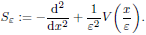
Under certain conditions, the functions ε−2V (x/ε) converge in the sense of distributions as ε → 0 to δ′ (x), and then the limit S0 of Sε may be considered as a ‘physically motivated’ interpretation of the one-dimensional Schrödinger operator with potential δ′.
On quasi-conformal self-mappings of the unit disc and elliptic PDEs in the plane
-
- Journal:
- Proceedings of the Royal Society of Edinburgh. Section A: Mathematics / Volume 143 / Issue 4 / August 2013
- Published online by Cambridge University Press:
- 17 July 2013, pp. 831-849
- Print publication:
- August 2013
-
- Article
- Export citation
-
We prove the following theorem: if w is a quasi-conformal mapping of the unit disc onto itself satisfying elliptic partial differential inequality
![$|L[w]|\le\mathcal{B}|\nabla w|^2+\varGamma$](//static.cambridge.org/binary/version/id/urn:cambridge.org:id:binary:20151127090445415-0610:S0308210511000862_inline1.gif?pub-status=live) , then w is Lipschitz continuous. This result extends some recent results where, instead of an elliptic differential operator, only the Laplace operator is considered.
, then w is Lipschitz continuous. This result extends some recent results where, instead of an elliptic differential operator, only the Laplace operator is considered.
![$|L[w]|\le\mathcal{B}|\nabla w|^2+\varGamma$](http://static.cambridge.org/binary/version/id/urn:cambridge.org:id:binary:20151127090445415-0610:S0308210511000862_inline1.gif?pub-status=live) , then w is Lipschitz continuous. This result extends some recent results where, instead of an elliptic differential operator, only the Laplace operator is considered.
, then w is Lipschitz continuous. This result extends some recent results where, instead of an elliptic differential operator, only the Laplace operator is considered.Large-time behaviour of the higher-dimensional logarithmic diffusion equation
-
- Journal:
- Proceedings of the Royal Society of Edinburgh. Section A: Mathematics / Volume 143 / Issue 4 / August 2013
- Published online by Cambridge University Press:
- 17 July 2013, pp. 817-830
- Print publication:
- August 2013
-
- Article
- Export citation
Existence and multiplicity of positive solutions for the nonlinear Schrödinger–Poisson equations
-
- Journal:
- Proceedings of the Royal Society of Edinburgh. Section A: Mathematics / Volume 143 / Issue 4 / August 2013
- Published online by Cambridge University Press:
- 17 July 2013, pp. 745-764
- Print publication:
- August 2013
-
- Article
- Export citation
-
We study the existence and multiplicity of positive solutions for the following nonlinear Schrödinger–Poisson equations:
 where 2 < p ≤ 3 or 4 ≤ p < 6, λ > 0 and Q ∈ C(ℝ3). We show that the number of positive solutions is dependent on the profile of Q(x).
Non-canonical extension of θ-functions and modular integrability of ϑ-constants
-
- Journal:
- Proceedings of the Royal Society of Edinburgh. Section A: Mathematics / Volume 143 / Issue 4 / August 2013
- Published online by Cambridge University Press:
- 17 July 2013, pp. 689-738
- Print publication:
- August 2013
-
- Article
- Export citation
On spacelike surfaces in four-dimensional Lorentz–Minkowski spacetime through a light cone
-
- Journal:
- Proceedings of the Royal Society of Edinburgh. Section A: Mathematics / Volume 143 / Issue 4 / August 2013
- Published online by Cambridge University Press:
- 17 July 2013, pp. 881-892
- Print publication:
- August 2013
-
- Article
- Export citation
