Refine search
Actions for selected content:
26080 results in Abstract analysis
A removal lemma for linear configurations in subsets of the circle
- Part of
-
- Journal:
- Proceedings of the Edinburgh Mathematical Society / Volume 56 / Issue 3 / October 2013
- Published online by Cambridge University Press:
- 28 June 2013, pp. 657-666
-
- Article
-
- You have access
- Export citation
Limiting cases of Boardman's five halves theorem
- Part of
-
- Journal:
- Proceedings of the Edinburgh Mathematical Society / Volume 56 / Issue 3 / October 2013
- Published online by Cambridge University Press:
- 28 June 2013, pp. 723-732
-
- Article
-
- You have access
- Export citation
-
The famous five halves theorem of Boardman states that, if T: Mm → Mm is a smooth involution defined on a non-bounding closed smooth m-dimensional manifold Mm (m > 1) and if
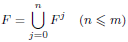
is the fixed-point set of T, where Fj denotes the union of those components of F having dimension j, then 2m ≤ 5n. If the dimension m is written as m = 5k − c, where k ≥ 1 and 0 ≤ c < 5, the theorem states that the dimension n of the fixed submanifold is at least β(m), where β(m) = 2k if c = 0, 1, 2 and β(m) = 2k − 1 if c = 3, 4. In this paper, we give, for each m > 1, the equivariant cobordism classification of involutions (Mm, T), for which the fixed submanifold F attains the minimal dimension β(m).
On the existence of global weak solutions to an integrable two-component Camassa–Holm shallow-water system
- Part of
-
- Journal:
- Proceedings of the Edinburgh Mathematical Society / Volume 56 / Issue 3 / October 2013
- Published online by Cambridge University Press:
- 28 June 2013, pp. 755-775
-
- Article
-
- You have access
- Export citation
On the exponential behaviour of non-autonomous difference equations
- Part of
-
- Journal:
- Proceedings of the Edinburgh Mathematical Society / Volume 56 / Issue 3 / October 2013
- Published online by Cambridge University Press:
- 28 June 2013, pp. 643-656
-
- Article
-
- You have access
- Export citation
ON WARING’S PROBLEM: TWO SQUARES AND THREE BIQUADRATES
- Part of
-
- Journal:
- Mathematika / Volume 60 / Issue 1 / January 2014
- Published online by Cambridge University Press:
- 28 June 2013, pp. 153-165
- Print publication:
- January 2014
-
- Article
- Export citation
-
We investigate sums of mixed powers involving two squares and three biquadrates. In particular, subject to the truth of the Generalised Riemann Hypothesis and the Elliott–Halberstam conjecture, we show that all large natural numbers $n$ with $8\nmid n$, $n\not\equiv 2~(\text{mod} ~3)$ and $n\not\equiv 14~(\text{mod} ~16)$ are the sum of two squares and three biquadrates.


Formal derivation of a bilayer model coupling shallow water and Reynolds lubrication equations: evolution of a thin pollutant layer over water
-
- Journal:
- European Journal of Applied Mathematics / Volume 24 / Issue 6 / December 2013
- Published online by Cambridge University Press:
- 27 June 2013, pp. 803-833
-
- Article
- Export citation
A geometric perspective on the Breuil–Mézard conjecture
- Part of
-
- Journal:
- Journal of the Institute of Mathematics of Jussieu / Volume 13 / Issue 1 / January 2014
- Published online by Cambridge University Press:
- 26 June 2013, pp. 183-223
- Print publication:
- January 2014
-
- Article
- Export citation
-
Let $p\gt 2$ be prime. We state and prove (under mild hypotheses on the residual representation) a geometric refinement of the Breuil–Mézard conjecture for two-dimensional mod $p$ representations of the absolute Galois group of ${ \mathbb{Q} }_{p} $. We also state a conjectural generalization to $n$-dimensional representations of the absolute Galois group of an arbitrary finite extension of ${ \mathbb{Q} }_{p} $, and give a conditional proof of this conjecture, subject to a certain $R= \mathbb{T} $-type theorem together with a strong version of the weight part of Serre’s conjecture for rank $n$ unitary groups. We deduce an unconditional result in the case of two-dimensional potentially Barsotti–Tate representations.


NEGATIVE VALUES OF THE RIEMANN ZETA FUNCTION ON THE CRITICAL LINE
- Part of
-
- Journal:
- Mathematika / Volume 59 / Issue 2 / July 2013
- Published online by Cambridge University Press:
- 17 June 2013, pp. 443-462
- Print publication:
- July 2013
-
- Article
- Export citation
-
We investigate the intersections of the curve $ \mathbb{R} \ni t\mapsto \zeta (\frac{1}{2} + \mathrm{i} t)$ with the real axis. We show unconditionally that the zeta function takes arbitrarily large positive and negative values on the critical line.
Size Ramsey Number of Bounded Degree Graphs for Games
-
- Journal:
- Combinatorics, Probability and Computing / Volume 22 / Issue 4 / July 2013
- Published online by Cambridge University Press:
- 11 June 2013, pp. 499-516
-
- Article
- Export citation
-
We study Maker/Breaker games on the edges of sparse graphs. Maker and Breaker take turns at claiming previously unclaimed edges of a given graph H. Maker aims to occupy a given target graph G and Breaker tries to prevent Maker from achieving his goal. We show that for every d there is a constant c = c(d) with the property that for every graph G on n vertices of maximum degree d there is a graph H on at most cn edges such that Maker has a strategy to occupy a copy of G in the game on H.
This is a result about a game-theoretic variant of the size Ramsey number. For a given graph G, $\hat{r}'(G)$ is defined as the smallest number M for which there exists a graph H with M edges such that Maker has a strategy to occupy a copy of G in the game on H. In this language, our result yields that for every connected graph G of constant maximum degree, $\hat{r}'(G) = \Theta(n)$.
Moreover, we can also use our method to settle the corresponding extremal number for universal graphs: for a constant d and for the class ${\cal G}_{n}$ of n-vertex graphs of maximum degree d, $s({\cal G}_{n})$ denotes the minimum number such that there exists a graph H with M edges where, for everyG ∈ ${\cal G}_{n}$, Maker has a strategy to build a copy of G in the game on H. We obtain that $s({\cal G}_{n}) = \Theta(n^{2 - \frac{2}{d}})$.


CPC volume 22 issue 4 Cover and Back matter
-
- Journal:
- Combinatorics, Probability and Computing / Volume 22 / Issue 4 / July 2013
- Published online by Cambridge University Press:
- 11 June 2013, pp. b1-b3
-
- Article
-
- You have access
- Export citation
CPC volume 22 issue 4 Cover and Front matter
-
- Journal:
- Combinatorics, Probability and Computing / Volume 22 / Issue 4 / July 2013
- Published online by Cambridge University Press:
- 11 June 2013, pp. f1-f2
-
- Article
-
- You have access
- Export citation
Freiman Homomorphisms of Random Subsets of $\mathbb{Z}_{N}$
-
- Journal:
- Combinatorics, Probability and Computing / Volume 22 / Issue 4 / July 2013
- Published online by Cambridge University Press:
- 11 June 2013, pp. 592-611
-
- Article
- Export citation
-
Given a set $A\subset\mathbb{Z}_{N}$, we say that a function $f\colon A \to \mathbb{Z}_{N}$ is a Freiman homomorphism if f(a)+f(b)=f(c)+f(d) whenever a,b,c,d ∈ A satisfy a+b=c+d. This notion was introduced by Freiman in the 1970s, and plays an important role in the field of additive combinatorics. We say that A is linear if the only Freiman homomorphisms are functions of the form f(x) = ax+b.
Suppose the elements of A are chosen independently at random, each with probability p. We shall look at the following question: For which values of p=p(N) is A linear with high probability as N → ∞? We show that if p=(2logN − ω(N))1/3N−2/3, where ω(N) → ∞ as N → ∞, then A is not linear with high probability, whereas if p=N−1/2+ε for any ε>0 then A is linear with high probability.


Lipschitz Functions on Expanders are Typically Flat
-
- Journal:
- Combinatorics, Probability and Computing / Volume 22 / Issue 4 / July 2013
- Published online by Cambridge University Press:
- 11 June 2013, pp. 566-591
-
- Article
- Export citation
Reimer's Inequality on a Finite Distributive Lattice
-
- Journal:
- Combinatorics, Probability and Computing / Volume 22 / Issue 4 / July 2013
- Published online by Cambridge University Press:
- 11 June 2013, pp. 612-621
-
- Article
- Export citation

Representation Theorems in Hardy Spaces
-
- Published online:
- 05 June 2013
- Print publication:
- 19 March 2009

Product Integration with Application to Differential Equations
-
- Published online:
- 05 June 2013
- Print publication:
- 28 December 1984

Analysis at Urbana
-
- Published online:
- 05 June 2013
- Print publication:
- 30 March 1989

An Introduction to Topological Groups
-
- Published online:
- 05 June 2013
- Print publication:
- 23 January 1975

Mathematical Theory of Entropy
-
- Published online:
- 05 June 2013
- Print publication:
- 28 December 1984
Conservation laws for plane steady potential barotropic flow
-
- Journal:
- European Journal of Applied Mathematics / Volume 24 / Issue 6 / December 2013
- Published online by Cambridge University Press:
- 03 June 2013, pp. 789-801
-
- Article
- Export citation
