Refine search
Actions for selected content:
26079 results in Abstract analysis
Monochromatic Cycles in 2-Coloured Graphs
-
- Journal:
- Combinatorics, Probability and Computing / Volume 21 / Issue 1-2 / March 2012
- Published online by Cambridge University Press:
- 19 March 2012, pp. 57-87
-
- Article
- Export citation
CPC volume 21 issue 1-2 Cover and Front matter
-
- Journal:
- Combinatorics, Probability and Computing / Volume 21 / Issue 1-2 / March 2012
- Published online by Cambridge University Press:
- 19 March 2012, pp. f1-f2
-
- Article
-
- You have access
- Export citation
CPC volume 21 issue 1-2 Cover and Back matter
-
- Journal:
- Combinatorics, Probability and Computing / Volume 21 / Issue 1-2 / March 2012
- Published online by Cambridge University Press:
- 19 March 2012, pp. b1-b8
-
- Article
-
- You have access
- Export citation
A universality result for endomorphism monoids of some ultrahomogeneous structures
- Part of
-
- Journal:
- Proceedings of the Edinburgh Mathematical Society / Volume 55 / Issue 3 / October 2012
- Published online by Cambridge University Press:
- 16 March 2012, pp. 635-656
-
- Article
-
- You have access
- Export citation
Invariants of hyperplane groups and vanishing ideals of finite sets of points
- Part of
-
- Journal:
- Proceedings of the Edinburgh Mathematical Society / Volume 55 / Issue 2 / June 2012
- Published online by Cambridge University Press:
- 16 March 2012, pp. 355-367
-
- Article
-
- You have access
- Export citation
-
We define a hyperplane group to be a finite group generated by reflections fixing a single hyperplane pointwise. Landweber and Stong proved that the invariant ring of a hyperplane group is again a polynomial ring in any characteristic. Recently, Hartmann and Shepler gave a constructive proof of this result. By their algorithm, one can always construct generators that are additive. In this paper, we study hyperplane groups of order a power of a prime p in characteristic p and give a slightly different construction of the generators than Hartmann and Shepler. We then show that such generators have a particular form. Furthermore, we show that if the group is defined by a finite additive subgroup W ⊆
 , the vanishing ideal of W is generated by polynomials obtained from a set of generators of the invariant ring that are additive. Finally, we give a shorter proof of the fact that the module of the invariant differential 1-forms is free in our situation.
 , the vanishing ideal of W is generated by polynomials obtained from a set of generators of the invariant ring that are additive. Finally, we give a shorter proof of the fact that the module of the invariant differential 1-forms is free in our situation.
Gröbner bases for quadratic algebras of skew type
- Part of
-
- Journal:
- Proceedings of the Edinburgh Mathematical Society / Volume 55 / Issue 2 / June 2012
- Published online by Cambridge University Press:
- 16 March 2012, pp. 387-401
-
- Article
-
- You have access
- Export citation
-
Non-degenerate monoids of skew type are considered. This is a class of monoids S defined by n generators and
 quadratic relations of certain type, which includes the class of monoids yielding set-theoretic solutions of the quantum Yang–Baxter equation, also called binomial monoids (or monoids of I-type with square-free defining relations). It is shown that under any degree-lexicographic order on the associated free monoid FMn. of rank n the set of normal forms of elements of S is a regular language in FMn. As one of the key ingredients of the proof, it is shown that an identity of the form xN yN = yN xN holds in S. The latter is derived via an investigation of the structure of S viewed as a semigroup of matrices over a field. It also follows that the semigroup algebra K[S] is a finite module over a finitely generated commutative subalgebra of the form K[A] for a submonoid A of S.
 quadratic relations of certain type, which includes the class of monoids yielding set-theoretic solutions of the quantum Yang–Baxter equation, also called binomial monoids (or monoids of I-type with square-free defining relations). It is shown that under any degree-lexicographic order on the associated free monoid FM
Reconstructing schemes from the derived category
- Part of
-
- Journal:
- Proceedings of the Edinburgh Mathematical Society / Volume 55 / Issue 3 / October 2012
- Published online by Cambridge University Press:
- 16 March 2012, pp. 781-796
-
- Article
-
- You have access
- Export citation
Space Crossing Numbers
-
- Journal:
- Combinatorics, Probability and Computing / Volume 21 / Issue 3 / May 2012
- Published online by Cambridge University Press:
- 16 March 2012, pp. 358-373
-
- Article
- Export citation
Non-Three-Colourable Common Graphs Exist
-
- Journal:
- Combinatorics, Probability and Computing / Volume 21 / Issue 5 / September 2012
- Published online by Cambridge University Press:
- 16 March 2012, pp. 734-742
-
- Article
- Export citation
Projective dynamics of homogeneous systems: local invariants, syzygies and the Global Residue Theorem
- Part of
-
- Journal:
- Proceedings of the Edinburgh Mathematical Society / Volume 55 / Issue 3 / October 2012
- Published online by Cambridge University Press:
- 16 March 2012, pp. 577-589
-
- Article
-
- You have access
- Export citation
EJM volume 23 issue 2 Cover and Back matter
-
- Journal:
- European Journal of Applied Mathematics / Volume 23 / Issue 2 / April 2012
- Published online by Cambridge University Press:
- 13 March 2012, pp. b1-b4
-
- Article
-
- You have access
- Export citation
EJM volume 23 issue 2 Cover and Front matter
-
- Journal:
- European Journal of Applied Mathematics / Volume 23 / Issue 2 / April 2012
- Published online by Cambridge University Press:
- 13 March 2012, pp. f1-f2
-
- Article
-
- You have access
- Export citation
Measurable Events Indexed by Trees
-
- Journal:
- Combinatorics, Probability and Computing / Volume 21 / Issue 3 / May 2012
- Published online by Cambridge University Press:
- 12 March 2012, pp. 374-411
-
- Article
- Export citation
-
A tree T is said to be homogeneous if it is uniquely rooted and there exists an integer b ≥ 2, called the branching number of T, such that every t ∈ T has exactly b immediate successors. We study the behaviour of measurable events in probability spaces indexed by homogeneous trees.
Precisely, we show that for every integer b ≥ 2 and every integer n ≥ 1 there exists an integer q(b,n) with the following property. If T is a homogeneous tree with branching number b and {At:t ∈ T} is a family of measurable events in a probability space (Ω,Σ,μ) satisfying μ(At)≥ϵ>0 for every t ∈ T, then for every 0<θ<ϵ there exists a strong subtree S of T of infinite height, such that for every finite subset F of S of cardinality n ≥ 1 we have
![\[ \mu\biggl( \bigcap_{t\in F} A_t\biggr) \meg \theta^{q(b,n)}. \]](//static.cambridge.org/content/id/urn%3Acambridge.org%3Aid%3Aarticle%3AS0963548312000053/resource/name/S0963548312000053_eqnU1.gif?pub-status=live) In fact, we can take q(b,n)= ((2b−1)2n−1−1)·(2b−2)−1. A finite version of this result is also obtained.
In fact, we can take q(b,n)= ((2b−1)2n−1−1)·(2b−2)−1. A finite version of this result is also obtained.
![\[ \mu\biggl( \bigcap_{t\in F} A_t\biggr) \meg \theta^{q(b,n)}. \]](http://static.cambridge.org/content/id/urn%3Acambridge.org%3Aid%3Aarticle%3AS0963548312000053/resource/name/S0963548312000053_eqnU1.gif?pub-status=live)
Trends in Stochastic Analysis
-
- Published online:
- 05 March 2012
- Print publication:
- 09 April 2009
Random Matrices: High Dimensional Phenomena
-
- Published online:
- 05 March 2012
- Print publication:
- 08 October 2009
The Density Turán Problem
-
- Journal:
- Combinatorics, Probability and Computing / Volume 21 / Issue 4 / July 2012
- Published online by Cambridge University Press:
- 29 February 2012, pp. 531-553
-
- Article
- Export citation
-
Let H be a graph on n vertices and let the blow-up graph G[H] be defined as follows. We replace each vertex vi of H by a cluster Ai and connect some pairs of vertices of Ai and Aj if (vi,vj) is an edge of the graph H. As usual, we define the edge density between Ai and Aj as
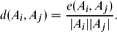 We study the following problem. Given densities γij for each edge (i,j) ∈ E(H), one has to decide whether there exists a blow-up graph G[H], with edge densities at least γij, such that one cannot choose a vertex from each cluster, so that the obtained graph is isomorphic to H, i.e., no H appears as a transversal in G[H]. We call dcrit(H) the maximal value for which there exists a blow-up graph G[H] with edge densities d(Ai,Aj)=dcrit(H) ((vi,vj) ∈ E(H)) not containing H in the above sense. Our main goal is to determine the critical edge density and to characterize the extremal graphs.
First, in the case of tree T we give an efficient algorithm to decide whether a given set of edge densities ensures the existence of a transversal T in the blow-up graph. Then we give general bounds on dcrit(H) in terms of the maximal degree. In connection with the extremal structure, the so-called star decomposition is proved to give the best construction for H-transversal-free blow-up graphs for several graph classes. Our approach applies algebraic graph-theoretical, combinatorial and probabilistic tools.
Detachments of Hypergraphs I: The Berge–Johnson Problem
-
- Journal:
- Combinatorics, Probability and Computing / Volume 21 / Issue 4 / July 2012
- Published online by Cambridge University Press:
- 27 February 2012, pp. 483-495
-
- Article
- Export citation
-
A detachment of a hypergraph is formed by splitting each vertex into one or more subvertices, and sharing the incident edges arbitrarily among the subvertices. For a given edge-coloured hypergraph


Let
 be a hypergraph with vertex partition {V1,. . .,Vn}, |Vi| = pi for 1 ≤ i ≤ n such that there are λi edges of size hi incident with every hi vertices, at most one vertex from each part for 1 ≤ i ≤ m (so no edge is incident with more than one vertex of a part). We use our detachment theorem to show that the obvious necessary conditions for
  to be expressed as the union


 be a hypergraph with vertex partition {V
 to be expressed as the union
 WINNING AN INFINITE COMBINATION OF GAMES
- Part of
-
- Journal:
- Mathematika / Volume 58 / Issue 2 / July 2012
- Published online by Cambridge University Press:
- 24 February 2012, pp. 419-431
- Print publication:
- July 2012
-
- Article
- Export citation
SPECTRAL STABILITY ESTIMATES FOR ELLIPTIC OPERATORS SUBJECT TO DOMAIN TRANSFORMATIONS WITH NON-UNIFORMLY BOUNDED GRADIENTS
- Part of
-
- Journal:
- Mathematika / Volume 58 / Issue 2 / July 2012
- Published online by Cambridge University Press:
- 24 February 2012, pp. 324-348
- Print publication:
- July 2012
-
- Article
- Export citation
A quantitative version of James's Compactness Theorem
- Part of
-
- Journal:
- Proceedings of the Edinburgh Mathematical Society / Volume 55 / Issue 2 / June 2012
- Published online by Cambridge University Press:
- 23 February 2012, pp. 369-386
-
- Article
-
- You have access
- Export citation
-
We introduce two measures of weak non-compactness JaE and Ja that quantify, via distances, the idea of boundary that lies behind James's Compactness Theorem. These measures tell us, for a bounded subset C of a Banach space E and for given x* ∈ E*, how far from E or C one needs to go to find x** ∈
 ⊂ E** with x**(x*) = sup x*(C). A quantitative version of James's Compactness Theorem is proved using JaE and Ja, and in particular it yields the following result. Let C be a closed convex bounded subset of a Banach space E and r > 0. If there is an element
 inwhose distance to C is greater than r, then there is x* ∈ E* such that each x** ∈at which sup x*(C) is attained has distance to E greater than ½r. We indeed establish that JaE and Ja are equivalent to other measures of weak non-compactness studied in the literature. We also collect particular cases and examples showing when the inequalities between the different measures of weak non-compactness can be equalities and when the inequalities are sharp.
 ⊂ E
⊂ E in
in