Refine search
Actions for selected content:
26079 results in Abstract analysis
Homogenisation of a locally periodic medium with areas of low and high diffusivity
-
- Journal:
- European Journal of Applied Mathematics / Volume 22 / Issue 5 / October 2011
- Published online by Cambridge University Press:
- 17 May 2011, pp. 493-516
-
- Article
- Export citation
Generalised Hele-Shaw flow: A Schwarz function approach
-
- Journal:
- European Journal of Applied Mathematics / Volume 22 / Issue 6 / December 2011
- Published online by Cambridge University Press:
- 16 May 2011, pp. 517-532
-
- Article
- Export citation
On the local solvability of vector fields with critical points
- Part of
-
- Journal:
- Journal of the Institute of Mathematics of Jussieu / Volume 10 / Issue 3 / July 2011
- Published online by Cambridge University Press:
- 12 May 2011, pp. 785-808
- Print publication:
- July 2011
-
- Article
- Export citation
Tunnel effect and symmetries for Kramers–Fokker–Planck type operators
- Part of
-
- Journal:
- Journal of the Institute of Mathematics of Jussieu / Volume 10 / Issue 3 / July 2011
- Published online by Cambridge University Press:
- 12 May 2011, pp. 567-634
- Print publication:
- July 2011
-
- Article
- Export citation
Instantons beyond topological theory. I
- Part of
-
- Journal:
- Journal of the Institute of Mathematics of Jussieu / Volume 10 / Issue 3 / July 2011
- Published online by Cambridge University Press:
- 12 May 2011, pp. 463-565
- Print publication:
- July 2011
-
- Article
- Export citation
Incompressibility of quadratic Weil transfer of generalized Severi–Brauer varieties
- Part of
-
- Journal:
- Journal of the Institute of Mathematics of Jussieu / Volume 11 / Issue 1 / January 2012
- Published online by Cambridge University Press:
- 12 May 2011, pp. 119-131
- Print publication:
- January 2012
-
- Article
- Export citation
Non-linear effects on canonical MEMS models
-
- Journal:
- European Journal of Applied Mathematics / Volume 22 / Issue 5 / October 2011
- Published online by Cambridge University Press:
- 06 May 2011, pp. 455-470
-
- Article
- Export citation
Stationary and slowly moving localised pulses in a singularly perturbed Brusselator model
-
- Journal:
- European Journal of Applied Mathematics / Volume 22 / Issue 5 / October 2011
- Published online by Cambridge University Press:
- 06 May 2011, pp. 423-453
-
- Article
- Export citation
The Tian–Yau–Zelditch Theorem and Toeplitz Operators
- Part of
-
- Journal:
- Journal of the Institute of Mathematics of Jussieu / Volume 10 / Issue 3 / July 2011
- Published online by Cambridge University Press:
- 05 May 2011, pp. 449-461
- Print publication:
- July 2011
-
- Article
- Export citation
The Stokes Structure of a good meromorphic flat bundle
- Part of
-
- Journal:
- Journal of the Institute of Mathematics of Jussieu / Volume 10 / Issue 3 / July 2011
- Published online by Cambridge University Press:
- 03 May 2011, pp. 675-712
- Print publication:
- July 2011
-
- Article
- Export citation
EJM volume 22 issue 3 Cover and Front matter
-
- Journal:
- European Journal of Applied Mathematics / Volume 22 / Issue 3 / June 2011
- Published online by Cambridge University Press:
- 27 April 2011, pp. f1-f2
-
- Article
-
- You have access
- Export citation
EJM volume 22 issue 3 Cover and Back matter
-
- Journal:
- European Journal of Applied Mathematics / Volume 22 / Issue 3 / June 2011
- Published online by Cambridge University Press:
- 27 April 2011, pp. b1-b2
-
- Article
-
- You have access
- Export citation
Peter Kronheimer and Tomasz Mrowka Monopoles and Three-Manifolds (Cambridge University Press, 2007), 808 pp, 9 780 521 88022 0 (hardback), £80.00, 9 780 521 18476 2 (paperback), £40.00.
-
- Journal:
- Proceedings of the Edinburgh Mathematical Society / Volume 54 / Issue 2 / June 2011
- Published online by Cambridge University Press:
- 27 April 2011, pp. 543-544
-
- Article
-
- You have access
- Export citation
Lower Bounds for the Cop Number when the Robber is Fast
-
- Journal:
- Combinatorics, Probability and Computing / Volume 20 / Issue 4 / July 2011
- Published online by Cambridge University Press:
- 19 April 2011, pp. 617-621
-
- Article
- Export citation
-
We consider a variant of the Cops and Robbers game where the robber can move t edges at a time, and show that in this variant, the cop number of a d-regular graph with girth larger than 2t+2 is Ω(dt). By the known upper bounds on the order of cages, this implies that the cop number of a connected n-vertex graph can be as large as Ω(n2/3) if t ≥ 2, and Ω(n4/5) if t ≥ 4. This improves the Ω(
 ) lower bound of Frieze, Krivelevich and Loh (Variations on cops and robbers, J. Graph Theory, to appear) when 2 ≤ t ≤ 6. We also conjecture a general upper bound O(nt/t+1) for the cop number in this variant, generalizing Meyniel's conjecture.
 ) lower bound of Frieze, Krivelevich and Loh (Variations on cops and robbers, J. Graph Theory, to appear) when 2 ≤ t ≤ 6. We also conjecture a general upper bound O(n
Minors in Graphs with High Chromatic Number
-
- Journal:
- Combinatorics, Probability and Computing / Volume 20 / Issue 4 / July 2011
- Published online by Cambridge University Press:
- 13 April 2011, pp. 513-518
-
- Article
- Export citation
Completions of Boolean algebras of projections and weak-star closures of C*-algebras on dual Banach spaces
-
- Journal:
- Proceedings of the Edinburgh Mathematical Society / Volume 54 / Issue 2 / June 2011
- Published online by Cambridge University Press:
- 11 April 2011, pp. 515-529
-
- Article
-
- You have access
- Export citation
A new class of restricted type spaces
- Part of
-
- Journal:
- Proceedings of the Edinburgh Mathematical Society / Volume 54 / Issue 3 / October 2011
- Published online by Cambridge University Press:
- 11 April 2011, pp. 749-759
-
- Article
-
- You have access
- Export citation
The index complex of a maximal subalgebra of a Lie algebra
- Part of
-
- Journal:
- Proceedings of the Edinburgh Mathematical Society / Volume 54 / Issue 2 / June 2011
- Published online by Cambridge University Press:
- 08 April 2011, pp. 531-542
-
- Article
-
- You have access
- Export citation
Supremum and infimum of subharmonic functions of order between 1 and 2
- Part of
-
- Journal:
- Proceedings of the Edinburgh Mathematical Society / Volume 54 / Issue 3 / October 2011
- Published online by Cambridge University Press:
- 08 April 2011, pp. 685-693
-
- Article
-
- You have access
- Export citation
-
For functions u, subharmonic in the plane, let
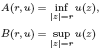
and let N(r,u) be the integrated counting function. Suppose that
 is a non-negative non-decreasing convex function of log r for which
  for all small r and
  , where 1 < ρ < 2, and define
A sharp upper bound is obtained for
 and a sharp lower bound is obtained for
  .
.
 is a non-negative non-decreasing convex function of log r for which
  for all small r and
  , where 1 < ρ < 2, and define
 and a sharp lower bound is obtained for
  .
.Bounds for the multiplicities of the roots of a complex polynomial
- Part of
-
- Journal:
- Proceedings of the Edinburgh Mathematical Society / Volume 54 / Issue 3 / October 2011
- Published online by Cambridge University Press:
- 08 April 2011, pp. 587-598
-
- Article
-
- You have access
- Export citation
