Refine search
Actions for selected content:
26063 results in Abstract analysis
GMJ volume 33 issue 1 Cover and Back matter
-
- Journal:
- Glasgow Mathematical Journal / Volume 33 / Issue 1 / January 1991
- Published online by Cambridge University Press:
- 18 May 2009, pp. b1-b2
-
- Article
-
- You have access
- Export citation
Homological characterizations of the approximation property for Banach spaces
-
- Journal:
- Glasgow Mathematical Journal / Volume 34 / Issue 2 / May 1992
- Published online by Cambridge University Press:
- 18 May 2009, pp. 229-239
-
- Article
-
- You have access
- Export citation
A note concerning the ideal of nuclear operators
-
- Journal:
- Glasgow Mathematical Journal / Volume 38 / Issue 2 / May 1996
- Published online by Cambridge University Press:
- 18 May 2009, pp. 233-236
-
- Article
-
- You have access
- Export citation
-
Let
 be a Banach algebra of bounded linear operators such that contains every operator with finite dimensional range. Then contains every nuclear operator.
 be a Banach algebra of bounded linear operators such that
 GMJ volume 5 issue 1 Cover and Back matter
-
- Journal:
- Proceedings of the Glasgow Mathematical Association / Volume 5 / Issue 1 / January 1961
- Published online by Cambridge University Press:
- 18 May 2009, pp. b1-b2
-
- Article
-
- You have access
- Export citation
Square roots in finite full transformation semigroups
-
- Journal:
- Glasgow Mathematical Journal / Volume 23 / Issue 2 / July 1982
- Published online by Cambridge University Press:
- 18 May 2009, pp. 137-149
-
- Article
-
- You have access
- Export citation
-
Let X be a finite set and let
 (X) be the full transformation semigroup on X, i.e. the set of all mappings from X into X, the semigroup operation being composition of mappings. This paper aims to characterize those elements of (X) which have square roots. An easily verifiable necessary condition, that of being quasi-square, is found in Theorem 2, and in Theorems 4 and 5 we find necessary and sufficient conditions for certain special elements of (X). The property of being compatibly amenable is shown in Theorem 7 to be equivalent for all elements of (X) to the possession of a square root.
 (X) be the full transformation semigroup on X, i.e. the set of all mappings from X into X, the semigroup operation being composition of mappings. This paper aims to characterize those elements of
 Superdiagonal forms for related linear operators
-
- Journal:
- Glasgow Mathematical Journal / Volume 26 / Issue 1 / January 1985
- Published online by Cambridge University Press:
- 18 May 2009, pp. 19-23
-
- Article
-
- You have access
- Export citation
Positive solutions of integrodifferential and difference equations with unbounded delay
-
- Journal:
- Glasgow Mathematical Journal / Volume 35 / Issue 1 / January 1993
- Published online by Cambridge University Press:
- 18 May 2009, pp. 105-113
-
- Article
-
- You have access
- Export citation
-
We establish a necessary and sufficient condition for the existence of a positive solution of the integrodifferential equation
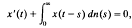
where nis an increasing real-valued function on the interval [0, α); that is, if and only if the characteristic equation

admits a positive root.
Consider the difference equation
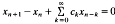 , where
  is a sequence of non-negative numbers. We prove this has positive solution if and only if the characteristic equation
  admits a root in (0, 1). For general results on integrodifferential equations we refer to the book by Burton [1] and the survey article by Corduneanu and Lakshmikantham [2]. Existence of a positive solution and oscillations in integrodifferential equations or in systems of integrodifferential equations recently have been investigated by Ladas, Philos and Sficas [5], Györi and Ladas [4], Philos and Sficas [12], Philos [9], [10], [11].
Recently, there has been some interest in the existence or the non-existence of positive solutions or the oscillation behavior of some difference equations. See Ladas, Philos and Sficas [6], [7].
The purpose of this paper is to investigate the positive solutions of integrodifferential equations (Section 1) and difference equations (Section 2) with unbounded delay. We obtain also some results for integrodifferential and difference inequalities.

 , where
  is a sequence of non-negative numbers. We prove this has positive solution if and only if the characteristic equation
  admits a root in (0, 1). For general results on integrodifferential equations we refer to the book by Burton [1] and the survey article by Corduneanu and Lakshmikantham [2]. Existence of a positive solution and oscillations in integrodifferential equations or in systems of integrodifferential equations recently have been investigated by Ladas, Philos and Sficas [5], Györi and Ladas [4], Philos and Sficas [12], Philos [9], [10], [11].
Two integral transform pairs involving hypergeometric functions†
-
- Journal:
- Proceedings of the Glasgow Mathematical Association / Volume 7 / Issue 1 / January 1965
- Published online by Cambridge University Press:
- 18 May 2009, pp. 42-44
-
- Article
-
- You have access
- Export citation
Embedding inverse semigroups in wreath products
-
- Journal:
- Glasgow Mathematical Journal / Volume 17 / Issue 2 / July 1976
- Published online by Cambridge University Press:
- 18 May 2009, pp. 77-82
-
- Article
-
- You have access
- Export citation
GMJ volume 28 issue 1 Cover and Front matter
-
- Journal:
- Glasgow Mathematical Journal / Volume 28 / Issue 1 / January 1986
- Published online by Cambridge University Press:
- 18 May 2009, pp. f1-f2
-
- Article
-
- You have access
- Export citation
Products of idempotents in regular rings
-
- Journal:
- Glasgow Mathematical Journal / Volume 28 / Issue 2 / July 1986
- Published online by Cambridge University Press:
- 18 May 2009, pp. 143-152
-
- Article
-
- You have access
- Export citation
GMJ volume 7 issue 3 Cover and Back matter
-
- Journal:
- Proceedings of the Glasgow Mathematical Association / Volume 7 / Issue 3 / January 1966
- Published online by Cambridge University Press:
- 18 May 2009, pp. b1-b2
-
- Article
-
- You have access
- Export citation
GMJ volume 38 issue 1 Cover and Front matter
-
- Journal:
- Glasgow Mathematical Journal / Volume 38 / Issue 1 / January 1996
- Published online by Cambridge University Press:
- 18 May 2009, pp. f1-f2
-
- Article
-
- You have access
- Export citation
On commutative non-self-adjoint operator algebras
-
- Journal:
- Glasgow Mathematical Journal / Volume 15 / Issue 1 / March 1974
- Published online by Cambridge University Press:
- 18 May 2009, pp. 54-59
-
- Article
-
- You have access
- Export citation
On the second natural representation of the symmetric groups
-
- Journal:
- Glasgow Mathematical Journal / Volume 10 / Issue 1 / January 1969
- Published online by Cambridge University Press:
- 18 May 2009, pp. 25-37
-
- Article
-
- You have access
- Export citation
Dual Trigonometrical Series
-
- Journal:
- Proceedings of the Glasgow Mathematical Association / Volume 4 / Issue 2 / July 1959
- Published online by Cambridge University Press:
- 18 May 2009, pp. 49-57
-
- Article
-
- You have access
- Export citation
-
In a recent joint paper with J. C. Cooke [1], we have given a method of determining the coefficients an in the “dual” Fourier-Bessel series

where −1 ≤p≤, F(r) is specified and αn is a positive root of Jv(αnα) = 0. This method reduced the problem to the solution of an infinite set of algebraical equations and it was shown that, under certain circumstances, numerical values for the coefficients could be obtained fairly readily.
Joint spectra of commuting normal operators on Banach spaces
-
- Journal:
- Glasgow Mathematical Journal / Volume 30 / Issue 3 / September 1988
- Published online by Cambridge University Press:
- 18 May 2009, pp. 339-345
-
- Article
-
- You have access
- Export citation
On a periodic neutral logistic equation
-
- Journal:
- Glasgow Mathematical Journal / Volume 33 / Issue 3 / September 1991
- Published online by Cambridge University Press:
- 18 May 2009, pp. 281-286
-
- Article
-
- You have access
- Export citation
-
The oscillatory and asymptotic behaviour of the positive solutions of the autonomous neutral delay logistic equation

with r, c, T, K ∈ (0, ∞) has been recently investigated in [2]. More recently the dynamics of the periodic delay logistic equation

in which r, K are periodic functions of period τ and m is a positive integer is considered in [6]. The purpose of the following analysis is to obtain sufficient conditions for the existence and linear asymptotic stability of a positive periodic solution of a periodic neutral delay logistic equation

in which Ṅ denotes
 and r, K, c are positive continuous periodic functions of period τ at and m is a positive integer. For the origin and biological relevance of (1.3) we refer to [2].
 and r, K, c are positive continuous periodic functions of period τ at and m is a positive integer. For the origin and biological relevance of (1.3) we refer to [2].
GMJ volume 37 issue 3 Cover and Front matter
-
- Journal:
- Glasgow Mathematical Journal / Volume 37 / Issue 3 / September 1995
- Published online by Cambridge University Press:
- 18 May 2009, pp. f1-f8
-
- Article
-
- You have access
- Export citation
The modularity of the lattice of varieties of completely regular semigroups and related representations
-
- Journal:
- Glasgow Mathematical Journal / Volume 32 / Issue 2 / May 1990
- Published online by Cambridge University Press:
- 18 May 2009, pp. 137-152
-
- Article
-
- You have access
- Export citation
-
A semigroup endowed with a unary operation satisfying the identities

is a completely regular semigroup. In several recent papers devoted to the study of the lattice
 of subvarieties of the variety
  of completely regular semigroups, various results have been obtained which decompose special intervals in into either direct products or subdirect products. Petrich [14], Hall and Jones [6] and Rasin [20] have shown that certain intervals of the form
  , where
  is the trivial variety and
  are subdirect products of
  and
and  Pastijn and Trotter [13] show that certain intervals of the form
  are direct products of the intervals
  and
and  The main objective of this paper is to develop an appropriate lattice theoretic framework for these representations.
 of subvarieties of the variety
  of completely regular semigroups, various results have been obtained which decompose special intervals in
  , where
  is the trivial variety and
  are subdirect products of
  and
and  Pastijn and Trotter [13] show that certain intervals of the form
  are direct products of the intervals
  and
and  The main objective of this paper is to develop an appropriate lattice theoretic framework for these representations.