Refine search
Actions for selected content:
26063 results in Abstract analysis
Constructing quaternionic fields
-
- Journal:
- Glasgow Mathematical Journal / Volume 34 / Issue 1 / January 1992
- Published online by Cambridge University Press:
- 18 May 2009, pp. 43-54
-
- Article
-
- You have access
- Export citation
Estimates for a remainder term associated with the sum of digits function
-
- Journal:
- Glasgow Mathematical Journal / Volume 29 / Issue 1 / January 1987
- Published online by Cambridge University Press:
- 18 May 2009, pp. 109-129
-
- Article
-
- You have access
- Export citation
-
If q(≥2) is a fixed integer it is well known that every positive integer k may be expressed uniquely in the form

We introduce the ‘sum of digits’ function

Both the above sums are of course finite. Although the behaviour of α(q, k) is somewhat erratic, its average behaviour is more regular and has been widely studied.
Homogeneous operators and essential complexes
-
- Journal:
- Glasgow Mathematical Journal / Volume 31 / Issue 1 / January 1989
- Published online by Cambridge University Press:
- 18 May 2009, pp. 73-85
-
- Article
-
- You have access
- Export citation
On some generalisations of the Riemann-Liouville and Weyl fractional integrals and their applications
-
- Journal:
- Glasgow Mathematical Journal / Volume 22 / Issue 2 / July 1981
- Published online by Cambridge University Press:
- 18 May 2009, pp. 173-180
-
- Article
-
- You have access
- Export citation
-
1. For functions f ∈ LLoc[0, ∞) the Riemann-Liouville operator of fractional integration I∞ is defined by

and its adjoint operator, the Weyl operator Kα, is defined by

for functions f ∈ LLoc[0, ∞) having a suitable behaviour at infinity.
Cyclic p-groups of symmetries of surfaces
-
- Journal:
- Glasgow Mathematical Journal / Volume 33 / Issue 2 / May 1991
- Published online by Cambridge University Press:
- 18 May 2009, pp. 213-221
-
- Article
-
- You have access
- Export citation
On Neumann's Formula for the Legendre Functions
-
- Journal:
- Proceedings of the Glasgow Mathematical Association / Volume 1 / Issue 1 / January 1952
- Published online by Cambridge University Press:
- 18 May 2009, pp. 10-12
-
- Article
-
- You have access
- Export citation
-
§1. Introductory. The formula

where w is zero or a positive integer and | ζ | > 1, was given by F. E. Neumann “Crelle's Journal, XXXVII (1848), p. 24”. In § 2 of this paper some related formulae are given; the extension to the case when n is not integral is dealt with in § 3; while in § 4 the corresponding formulae for the Associated Legendre Functions when the sum of the degree and the order is a positive integer are established.
Commutative rings whose quotients are Goldie
-
- Journal:
- Glasgow Mathematical Journal / Volume 16 / Issue 1 / March 1975
- Published online by Cambridge University Press:
- 18 May 2009, pp. 32-33
-
- Article
-
- You have access
- Export citation
Homotopy of compact symmetric spaces
-
- Journal:
- Glasgow Mathematical Journal / Volume 34 / Issue 2 / May 1992
- Published online by Cambridge University Press:
- 18 May 2009, pp. 221-228
-
- Article
-
- You have access
- Export citation
The spectrum of orthogonal sums of subnormal pairs
-
- Journal:
- Glasgow Mathematical Journal / Volume 30 / Issue 1 / January 1988
- Published online by Cambridge University Press:
- 18 May 2009, pp. 11-15
-
- Article
-
- You have access
- Export citation
Positive matrices and eigenvectors†
-
- Journal:
- Proceedings of the Glasgow Mathematical Association / Volume 6 / Issue 1 / January 1963
- Published online by Cambridge University Press:
- 18 May 2009, pp. 27-30
-
- Article
-
- You have access
- Export citation
-
For i, j = 1, 2, …, let aij be real. A matrix A = (aij) will be called positive (A>0) or non-negative (A≧0) according as, for all i and j, aij>0 or aij≧0 respectively. Correspondingly, a real vector x = (x1, x2, …) will be called positive (x>0) or non-negative (x≧0) according as, for all i, xi>0 or x≧0. A matrix A is said to be bounded if ∥ Ax ∥ ≦M ∥ x ∥ holds for some constant M, 0 ≦ M < ∞, and all x in the Hilbert space H of real vectors x = (x1, x2, …) satisfying
 . The least such constant M is denoted by ∥ A ∥. If x and y belong to H, then (x, y) will denote as usual the scalar product Σxiyi. Whether or not x is in H, or A is bounded, y = Ax will be considered as defined by
whenever each of the series of (1) is convergent.
 . The least such constant M is denoted by ∥ A ∥. If x and y belong to H, then (x, y) will denote as usual the scalar product Σx
A polynomial iteration for the spectral family of an operator
-
- Journal:
- Proceedings of the Glasgow Mathematical Association / Volume 6 / Issue 2 / July 1963
- Published online by Cambridge University Press:
- 18 May 2009, pp. 65-69
-
- Article
-
- You have access
- Export citation
The construction of branched covering Riemann surfaces
-
- Journal:
- Proceedings of the Glasgow Mathematical Association / Volume 3 / Issue 4 / July 1958
- Published online by Cambridge University Press:
- 18 May 2009, pp. 199-207
-
- Article
-
- You have access
- Export citation
Injective homogeneity and the Auslander–Gorenstein property
-
- Journal:
- Glasgow Mathematical Journal / Volume 37 / Issue 2 / May 1995
- Published online by Cambridge University Press:
- 18 May 2009, pp. 191-204
-
- Article
-
- You have access
- Export citation
The Convergence of Least Squares Approximations for dual Orthogonal Series†
-
- Journal:
- Glasgow Mathematical Journal / Volume 15 / Issue 2 / September 1974
- Published online by Cambridge University Press:
- 18 May 2009, p. 184
-
- Article
-
- You have access
- Export citation
-
1. Equation (4) should read

2. On p. 83 below equation (7) replace
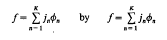
3. On p. 83 two lines above equation (9) replace
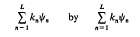
A note on Dunford-Pettis operators
-
- Journal:
- Glasgow Mathematical Journal / Volume 29 / Issue 2 / July 1987
- Published online by Cambridge University Press:
- 18 May 2009, pp. 271-273
-
- Article
-
- You have access
- Export citation
Fourier Expansions
-
- Journal:
- Proceedings of the Glasgow Mathematical Association / Volume 1 / Issue 2 / July 1952
- Published online by Cambridge University Press:
- 18 May 2009, pp. 76-93
-
- Article
-
- You have access
- Export citation
Inner Bogoliubov automorphisms of the minimal C* Weyl algebra
-
- Journal:
- Glasgow Mathematical Journal / Volume 34 / Issue 3 / September 1992
- Published online by Cambridge University Press:
- 18 May 2009, pp. 263-270
-
- Article
-
- You have access
- Export citation
Multiple semidirect products of associative systems
-
- Journal:
- Glasgow Mathematical Journal / Volume 31 / Issue 3 / September 1989
- Published online by Cambridge University Press:
- 18 May 2009, pp. 353-369
-
- Article
-
- You have access
- Export citation
-
Suppose that a group G is the semidirect product of a subgroup N and a normal subgroup M. Then the elements of G have unique expressions mn (m ∈ M, n ∈ N) and the commutator function

maps N x M into M. In fact there is an action (by automorphisms) of N on M given by

Conversely, if one is given an action of a group N on a group M then one can construct a semidirect product.
C*-algebras associated with amalgamated products of groups
-
- Journal:
- Glasgow Mathematical Journal / Volume 29 / Issue 2 / July 1987
- Published online by Cambridge University Press:
- 18 May 2009, pp. 143-148
-
- Article
-
- You have access
- Export citation
On prime divisors of large powers of elements in Noether lattices
-
- Journal:
- Glasgow Mathematical Journal / Volume 30 / Issue 3 / September 1988
- Published online by Cambridge University Press:
- 18 May 2009, pp. 359-367
-
- Article
-
- You have access
- Export citation
