Refine search
Actions for selected content:
26063 results in Abstract analysis
GMJ volume 2 issue 1 Cover and Front matter
-
- Journal:
- Proceedings of the Glasgow Mathematical Association / Volume 2 / Issue 1 / April 1954
- Published online by Cambridge University Press:
- 18 May 2009, pp. f1-f7
-
- Article
-
- You have access
- Export citation
Generalisation de la decomposition de kato aux opérateurs paranormaux et spectraux
-
- Journal:
- Glasgow Mathematical Journal / Volume 29 / Issue 2 / July 1987
- Published online by Cambridge University Press:
- 18 May 2009, pp. 159-175
-
- Article
-
- You have access
- Export citation
Groups whose Projective character degrees are powers of a prime†
-
- Journal:
- Glasgow Mathematical Journal / Volume 30 / Issue 2 / May 1988
- Published online by Cambridge University Press:
- 18 May 2009, pp. 177-180
-
- Article
-
- You have access
- Export citation
-
Let Gbe a finite group, and P:G → GL(n,
 ) be such that for all x, y ∈ G
(i) P(x)P(y) = α(x, y)P(xy), and
(ii)P(l) = In,
where α(x, y) ∈
*; then P is a projective representation of G with cocycle α and degree n. For other basic definitions concerning projective representations see [4].
 ) be such that for all x, y ∈ G
An equivalence induced by Ext and Tor applied to the finitistic weak dimension of coherent rings
-
- Journal:
- Glasgow Mathematical Journal / Volume 40 / Issue 2 / May 1998
- Published online by Cambridge University Press:
- 18 May 2009, pp. 167-176
-
- Article
-
- You have access
- Export citation
On reducible braids and composite braids
-
- Journal:
- Glasgow Mathematical Journal / Volume 36 / Issue 2 / May 1994
- Published online by Cambridge University Press:
- 18 May 2009, pp. 197-199
-
- Article
-
- You have access
- Export citation
-
The braid group on n strings Bn has a presentation as a group with generators σ1, …, σn−1 and relations

An identity for the Fibonacci and Lucas numbers
-
- Journal:
- Glasgow Mathematical Journal / Volume 35 / Issue 3 / September 1993
- Published online by Cambridge University Press:
- 18 May 2009, pp. 381-384
-
- Article
-
- You have access
- Export citation
Completions of semilattices of cancellative semigroups
-
- Journal:
- Glasgow Mathematical Journal / Volume 21 / Issue 1 / January 1980
- Published online by Cambridge University Press:
- 18 May 2009, pp. 29-37
-
- Article
-
- You have access
- Export citation
On a problem of Rankin about the Epstein zeta-function
-
- Journal:
- Proceedings of the Glasgow Mathematical Association / Volume 4 / Issue 2 / July 1959
- Published online by Cambridge University Press:
- 18 May 2009, pp. 73-80
-
- Article
-
- You have access
- Export citation
-
Let

be a positive definite quadratic form with determinant αβ−X2 = 1. A special form of this kind is

We consider the Epstein zeta-function
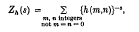
the series converging for s > 1. For s ≥ 1·035 Rankin [1] proved the following
STatement R.

The sign of equality is needed only when h is equivalent to Q.
The torsion of a semi-infinite elastic solid by an elliptical stamp
-
- Journal:
- Glasgow Mathematical Journal / Volume 9 / Issue 1 / January 1968
- Published online by Cambridge University Press:
- 18 May 2009, pp. 36-45
-
- Article
-
- You have access
- Export citation
On certain subgroups of a join of subnormal subgroups
-
- Journal:
- Glasgow Mathematical Journal / Volume 25 / Issue 1 / January 1984
- Published online by Cambridge University Press:
- 18 May 2009, pp. 103-105
-
- Article
-
- You have access
- Export citation
A note on Jacobson's conjecture for right Noetherian rings
-
- Journal:
- Glasgow Mathematical Journal / Volume 23 / Issue 1 / January 1982
- Published online by Cambridge University Press:
- 18 May 2009, pp. 7-8
-
- Article
-
- You have access
- Export citation
-
In 1956, Jacobson asked whether the intersection of the powers of the Jacobson radical, J(R), of a right Noetherian ring R, must always be zero [4, p. 200]. His question was answered in the negative by I. N. Herstein [3], who noted that
 , where Z(2) denotes the ring of rational numbers with denominator prime to 2, affords a counterexample. In contrast, the ring
  , though similar in appearance to R1, satisfies
  . (Here, k denotes a field.)
 , where Z
 , though similar in appearance to R
 . (Here, k denotes a field.)
On the locally antisimple radical
-
- Journal:
- Glasgow Mathematical Journal / Volume 13 / Issue 1 / March 1972
- Published online by Cambridge University Press:
- 18 May 2009, pp. 42-46
-
- Article
-
- You have access
- Export citation
An embedding theorem for groups
-
- Journal:
- Proceedings of the Glasgow Mathematical Association / Volume 4 / Issue 3 / January 1960
- Published online by Cambridge University Press:
- 18 May 2009, pp. 140-143
-
- Article
-
- You have access
- Export citation
GMJ volume 29 issue 1 Cover and Front matter
-
- Journal:
- Glasgow Mathematical Journal / Volume 29 / Issue 1 / January 1987
- Published online by Cambridge University Press:
- 18 May 2009, pp. f1-f7
-
- Article
-
- You have access
- Export citation
GMJ volume 26 issue 1 Cover and Front matter
-
- Journal:
- Glasgow Mathematical Journal / Volume 26 / Issue 1 / January 1985
- Published online by Cambridge University Press:
- 18 May 2009, pp. f1-f7
-
- Article
-
- You have access
- Export citation
Remarks on the Asymptotic Behaviour of Perturbed Linear Systems†
-
- Journal:
- Glasgow Mathematical Journal / Volume 11 / Issue 1 / January 1970
- Published online by Cambridge University Press:
- 18 May 2009, p. 84
-
- Article
-
- You have access
- Export citation
-
Remarks 1, 3 and 5 are incorrect as stated. They should be supplemented by the following observations:
(i) In case the perturbing term is linear in y, i.e. f(t, y) = B(t)y, the conclusion of Theorem 1 will follow from Lemma 1 when applied to equation (15) if we assume, instead of (6),

The hypothesis given in Trench's theorem is sufficient to imply (*) but not (6). A similar comment applies to Remark 5.
Generalized fractions and Hughes' gradetheoretic analogue of the Cousin complex
-
- Journal:
- Glasgow Mathematical Journal / Volume 32 / Issue 2 / May 1990
- Published online by Cambridge University Press:
- 18 May 2009, pp. 173-188
-
- Article
-
- You have access
- Export citation
-
Let A be a commutative Noetherian ring (with non-zero identity). The Cousin complex C(A) for A is described in [19, Section 2]: it is a complex of A-modules and A-homomorphisms

with the property that, for each n ∈ N0 (we use N0 to denote the set of non-negative integers),
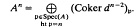
Cohen–Macaulay rings can be characterized in terms of the Cousin complex: A is a Cohen–Macaulay ring if and only if C(A) is exact [19, (4.7)]. Also, the Cousin complex provides a natural minimal injective resolution for a Gorenstein ring (see [19,(5.4)]).
Decomposition algebras of Riesz operators
-
- Journal:
- Glasgow Mathematical Journal / Volume 21 / Issue 1 / January 1980
- Published online by Cambridge University Press:
- 18 May 2009, pp. 75-79
-
- Article
-
- You have access
- Export citation
Normal closures of powers of Dehn twists in mapping class groups
-
- Journal:
- Glasgow Mathematical Journal / Volume 34 / Issue 3 / September 1992
- Published online by Cambridge University Press:
- 18 May 2009, pp. 314-317
-
- Article
-
- You have access
- Export citation
Integration of E-functions with respect to their parameters
-
- Journal:
- Proceedings of the Glasgow Mathematical Association / Volume 4 / Issue 2 / July 1959
- Published online by Cambridge University Press:
- 18 May 2009, pp. 84-87
-
- Article
-
- You have access
- Export citation
