Refine search
Actions for selected content:
26063 results in Abstract analysis
On joint essential spectra of doubly commuting n-tuples of p-hyponormal operators
-
- Journal:
- Glasgow Mathematical Journal / Volume 40 / Issue 3 / September 1998
- Published online by Cambridge University Press:
- 18 May 2009, pp. 353-358
-
- Article
-
- You have access
- Export citation
-
Let A be an operator on a Hillbert space with polar decomposition A = |A|, let  = |A|½U|A|½ and let  = V|Â| be the polar decomposition of Â. Write à for the operatorà = |Â|½V|Â|½. If
 = (A1,…,AN) is a doubly commuting n-tuple of p-hyponormal operators on a Hillbert space with equal defect and nullity, then = (Ã1,…,Ãn) is a doubly commuting n-tuple of hyponormal operators. In this paper we show that
where σ* denotes σTe (Taylor essential spectrum), σTw (Taylor-Weyl spectrum) and σTb (Taylor-Browder spectrum), respectively.
 = (A
= (A
Approximating Fredholm operators on a nonseparable Hilbert space
-
- Journal:
- Glasgow Mathematical Journal / Volume 35 / Issue 2 / May 1993
- Published online by Cambridge University Press:
- 18 May 2009, pp. 167-178
-
- Article
-
- You have access
- Export citation
Localization in non-noetherian group rings
-
- Journal:
- Glasgow Mathematical Journal / Volume 21 / Issue 1 / January 1980
- Published online by Cambridge University Press:
- 18 May 2009, pp. 151-163
-
- Article
-
- You have access
- Export citation
Character degrees and derived length in p-groups
-
- Journal:
- Glasgow Mathematical Journal / Volume 30 / Issue 2 / May 1988
- Published online by Cambridge University Press:
- 18 May 2009, pp. 221-230
-
- Article
-
- You have access
- Export citation
A simple ring separating certain radicals
-
- Journal:
- Glasgow Mathematical Journal / Volume 16 / Issue 1 / March 1975
- Published online by Cambridge University Press:
- 18 May 2009, pp. 29-31
-
- Article
-
- You have access
- Export citation
Factorization of Matrices and Minkowski's Conjecture
-
- Journal:
- Proceedings of the Glasgow Mathematical Association / Volume 5 / Issue 2 / July 1961
- Published online by Cambridge University Press:
- 18 May 2009, pp. 86-89
-
- Article
-
- You have access
- Export citation
-
Let Rn denote real Euclidean space of n dimensions. If
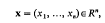
define
 , and (as usual)
  so that, by the inequality of arithmetic and geometric means,
Let Λ0 be the integer lattice, consisting of those points in Rn whose co-ordinates are integers. A non-singular n × n matrix M will be called a Minkowski matrix, if, for any point a ∈ Rn, there exists a point x ∈ Λ0 such that

It was shown by Minkowski that, when n = 2, every non-singular matrix is a Minkowski matrix, and that, for general n, every rational non-singular matrix is a Minkowski matrix. Minkowski is also said to have conjectured that every non-singular matrix is a Minkowski matrix, whatever the value of n. For n = 3, this was proved by Remak [5], and a much simpler proof was given later by Davenport [2]. For n = 4, it was proved by Dyson [3], who used a method similar to that of Remak and Davenport, but required the methods of algebraic topology to deal with some of the complications which arise in the higher dimension. Since this method depends also on the reduction of quadratic forms, it is quite likely that it might fail for higher values of n even if the topological difficulties could be overcome. Therefore, an alternative proof for n = 3, due to Birch and Swinnerton-Dyer [1], is of some interest, though in this dimension it is more complicated than Davenport's proof. A good deal of their analysis applies to general n, and they showed that for all n there is a neighbourhood of the unit matrix I that consists entirely of Minkowski matrices.
 , and (as usual)
  so that, by the inequality of arithmetic and geometric means,
Another proof of a result of N. J. Kalton, E. Saab and P. Saab on the Dieudonné property in C(K, E)
-
- Journal:
- Glasgow Mathematical Journal / Volume 31 / Issue 2 / May 1989
- Published online by Cambridge University Press:
- 18 May 2009, pp. 137-140
-
- Article
-
- You have access
- Export citation
Moufang affine buildings have Moufang spherical buildings at infinity
-
- Journal:
- Glasgow Mathematical Journal / Volume 39 / Issue 3 / September 1997
- Published online by Cambridge University Press:
- 18 May 2009, pp. 237-241
-
- Article
-
- You have access
- Export citation
On Recurrence Formulae
-
- Journal:
- Proceedings of the Glasgow Mathematical Association / Volume 3 / Issue 1 / December 1956
- Published online by Cambridge University Press:
- 18 May 2009, pp. 36-37
-
- Article
-
- You have access
- Export citation
Upon A Second Confluent Form of the Ɛ-Algorithm†
-
- Journal:
- Proceedings of the Glasgow Mathematical Association / Volume 5 / Issue 4 / July 1962
- Published online by Cambridge University Press:
- 18 May 2009, pp. 160-165
-
- Article
-
- You have access
- Export citation
-
In two previous papers [1], [2] the confluent form

of the δ-algorithm [3]

was established, and various properties which the confluent form of the algorithm possesses were discussed. It was shown, among other things, that if in (1)

and the notation

is used, then (1) is satisfied by

and further that under certain conditions, and for a certain n,

identically. It is the purpose of this note to derive another confluent form of the Ɛ-algorithm and to discuss its properties.
GMJ volume 1 issue 2 Cover and Front matter
-
- Journal:
- Proceedings of the Glasgow Mathematical Association / Volume 1 / Issue 2 / July 1952
- Published online by Cambridge University Press:
- 18 May 2009, pp. f1-f2
-
- Article
-
- You have access
- Export citation
GMJ volume 11 issue 2 Cover and Front matter
-
- Journal:
- Glasgow Mathematical Journal / Volume 11 / Issue 2 / July 1970
- Published online by Cambridge University Press:
- 18 May 2009, pp. f1-f2
-
- Article
-
- You have access
- Export citation
Quasi-homology and universal coefficients
-
- Journal:
- Glasgow Mathematical Journal / Volume 15 / Issue 1 / March 1974
- Published online by Cambridge University Press:
- 18 May 2009, pp. 30-38
-
- Article
-
- You have access
- Export citation
GMJ volume 6 issue 2 Cover and Front matter
-
- Journal:
- Proceedings of the Glasgow Mathematical Association / Volume 6 / Issue 2 / July 1963
- Published online by Cambridge University Press:
- 18 May 2009, pp. f1-f3
-
- Article
-
- You have access
- Export citation
Arens regularity and retractions
-
- Journal:
- Glasgow Mathematical Journal / Volume 24 / Issue 1 / January 1983
- Published online by Cambridge University Press:
- 18 May 2009, pp. 17-21
-
- Article
-
- You have access
- Export citation
-
In this paper a characterisation of the regularity of a normed algebra A is given in terms of retractions onto A** from A4*. The second dual A** of a normed algebra A possesses two natural Banach algebra multiplications, say ° and *. Each of ° and * extends the original algebra multiplication on A; see (2). An algebra A is called regular if and only if F * G = F ° G for all F, G ∈ A**. See (1). The existing results in the Arens regularity theory can be found in a recent survey (2). Denoting the nth dual of A by An*, and en the natural embedding of An* in its second dual A(n+2)*, we can naturally represent the second dual A** of A as a Banach space retract of A4* in two different ways:
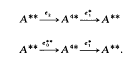
Our main results say that A** is in fact a Banach algebra retract of A4* (i.e. the maps involved are homomorphisms) in either of these cases if and only if A is regular.
The range of non-surjective convolution operators on Beurling spaces
-
- Journal:
- Glasgow Mathematical Journal / Volume 38 / Issue 1 / January 1996
- Published online by Cambridge University Press:
- 18 May 2009, pp. 125-135
-
- Article
-
- You have access
- Export citation
-
Let μ ≠ 0 be an ultradistribution of Beurling type with compact support in the space
 . We investigate the range of the convolution operator Tμ on the space of non-quasianalytic functions of Beurling type
  associated with a weight w, in the case the operator is not surjective. It is proved that the range of TM always contains the space of real-analytic functions, and that it contains a smaller space of Beurling type
  for a weight σ ≥ ω if and only if the convolution operator is surjective on the smaller class.
 . We investigate the range of the convolution operator T
 associated with a weight w, in the case the operator is not surjective. It is proved that the range of T
 for a weight σ ≥ ω if and only if the convolution operator is surjective on the smaller class.
Certain fundamental congruences on a regular semigroup†
-
- Journal:
- Proceedings of the Glasgow Mathematical Association / Volume 7 / Issue 3 / January 1966
- Published online by Cambridge University Press:
- 18 May 2009, pp. 145-159
-
- Article
-
- You have access
- Export citation
Topological invariants of germs of real analytic functions
-
- Journal:
- Glasgow Mathematical Journal / Volume 39 / Issue 1 / January 1997
- Published online by Cambridge University Press:
- 18 May 2009, pp. 85-89
-
- Article
-
- You have access
- Export citation
-
Let f: (ℝn, 0)→ (ℝ,0) be a germ of a real analytic function. Let L and F(f) denote the link of f and the Milnor fibre of fc respectively, i. e., L = {x ∈ Sn−1 | f(x) = 0},
 , where 0 ≤ ξ ≪ r ≪ 1,
  . In [2] Szafraniec introduced the notion of an
  -germ as a generalization of a germ defined by a weighted homogeneous polynomial satisfying some condition concerning the relation between its degree and weights (definition 1). He also proved that if f is an -germ (presumably with nonisolated singularity) then the number χ(F(f)/d mod 2 is a topological invariant of f, where χ(F(f)) is the Euler characterististic of F(f), and gave the formula for χ(L)/2 mod 2 (it is a well-known fact that F(L) is an even number). As a simple consequence he got the fact that χ(F(f)mod 2 is a topological invariant for any f, which is a generalization of Wall's result [3] (he considered only germs with an isolated singularity).
 , where 0 ≤ ξ ≪ r ≪ 1,
  . In [2] Szafraniec introduced the notion of an
  -germ as a generalization of a germ defined by a weighted homogeneous polynomial satisfying some condition concerning the relation between its degree and weights (definition 1). He also proved that if f is an
 A note on the invertible ideal theorem
-
- Journal:
- Glasgow Mathematical Journal / Volume 25 / Issue 1 / January 1984
- Published online by Cambridge University Press:
- 18 May 2009, pp. 27-30
-
- Article
-
- You have access
- Export citation
GMJ volume 10 issue 1 Cover and Front matter
-
- Journal:
- Glasgow Mathematical Journal / Volume 10 / Issue 1 / January 1969
- Published online by Cambridge University Press:
- 18 May 2009, pp. f1-f2
-
- Article
-
- You have access
- Export citation
