Refine search
Actions for selected content:
26070 results in Abstract analysis
The Convergence of Least Squares Approximations for dual Orthogonal Series†
-
- Journal:
- Glasgow Mathematical Journal / Volume 15 / Issue 2 / September 1974
- Published online by Cambridge University Press:
- 18 May 2009, p. 184
-
- Article
-
- You have access
- Export citation
-
1. Equation (4) should read

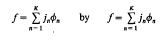
2. On p. 83 below equation (7) replace
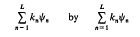
3. On p. 83 two lines above equation (9) replace
A note on Dunford-Pettis operators
-
- Journal:
- Glasgow Mathematical Journal / Volume 29 / Issue 2 / July 1987
- Published online by Cambridge University Press:
- 18 May 2009, pp. 271-273
-
- Article
-
- You have access
- Export citation
Fourier Expansions
-
- Journal:
- Proceedings of the Glasgow Mathematical Association / Volume 1 / Issue 2 / July 1952
- Published online by Cambridge University Press:
- 18 May 2009, pp. 76-93
-
- Article
-
- You have access
- Export citation
Inner Bogoliubov automorphisms of the minimal C* Weyl algebra
-
- Journal:
- Glasgow Mathematical Journal / Volume 34 / Issue 3 / September 1992
- Published online by Cambridge University Press:
- 18 May 2009, pp. 263-270
-
- Article
-
- You have access
- Export citation
Multiple semidirect products of associative systems
-
- Journal:
- Glasgow Mathematical Journal / Volume 31 / Issue 3 / September 1989
- Published online by Cambridge University Press:
- 18 May 2009, pp. 353-369
-
- Article
-
- You have access
- Export citation
-
Suppose that a group G is the semidirect product of a subgroup N and a normal subgroup M. Then the elements of G have unique expressions mn (m ∈ M, n ∈ N) and the commutator function

maps N x M into M. In fact there is an action (by automorphisms) of N on M given by

Conversely, if one is given an action of a group N on a group M then one can construct a semidirect product.
C*-algebras associated with amalgamated products of groups
-
- Journal:
- Glasgow Mathematical Journal / Volume 29 / Issue 2 / July 1987
- Published online by Cambridge University Press:
- 18 May 2009, pp. 143-148
-
- Article
-
- You have access
- Export citation
On prime divisors of large powers of elements in Noether lattices
-
- Journal:
- Glasgow Mathematical Journal / Volume 30 / Issue 3 / September 1988
- Published online by Cambridge University Press:
- 18 May 2009, pp. 359-367
-
- Article
-
- You have access
- Export citation
The boundary of the numerical range
-
- Journal:
- Glasgow Mathematical Journal / Volume 22 / Issue 1 / January 1981
- Published online by Cambridge University Press:
- 18 May 2009, pp. 69-72
-
- Article
-
- You have access
- Export citation
Partial Gaussian sums III
-
- Journal:
- Glasgow Mathematical Journal / Volume 34 / Issue 2 / May 1992
- Published online by Cambridge University Press:
- 18 May 2009, pp. 253-261
-
- Article
-
- You have access
- Export citation
-
For integers a, N and H > 0 write
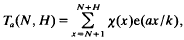
where ϰ denotes a non-principal Dirichlet character modulo the positive integer k and e(y) denotes e2πiy. By a well-known generalisation of the Póya–Vinogradov inequality

On Chern classes of stably fibre homotopic trivial bundles
-
- Journal:
- Glasgow Mathematical Journal / Volume 30 / Issue 2 / May 1988
- Published online by Cambridge University Press:
- 18 May 2009, pp. 213-214
-
- Article
-
- You have access
- Export citation
The solution of a pair of dual integral equations†
-
- Journal:
- Proceedings of the Glasgow Mathematical Association / Volume 6 / Issue 1 / January 1963
- Published online by Cambridge University Press:
- 18 May 2009, pp. 14-18
-
- Article
-
- You have access
- Export citation
-
We define two functions F(p), G(p) in terms of a third function ψ(ζ) by the equations

A standard problem in the theory of dual integral equations is to determine the function ψ(ζ) such that

when the functions f(p), g(p) are prescribed.
The Structure of Normal Inverse Semigroups
-
- Journal:
- Proceedings of the Glasgow Mathematical Association / Volume 3 / Issue 1 / December 1956
- Published online by Cambridge University Press:
- 18 May 2009, pp. 1-9
-
- Article
-
- You have access
- Export citation
GMJ volume 12 issue 2 Cover and Back matter
-
- Journal:
- Glasgow Mathematical Journal / Volume 12 / Issue 2 / September 1971
- Published online by Cambridge University Press:
- 18 May 2009, pp. b1-b2
-
- Article
-
- You have access
- Export citation
A note on reductions of ideals relative to an Artinian module
-
- Journal:
- Glasgow Mathematical Journal / Volume 35 / Issue 2 / May 1993
- Published online by Cambridge University Press:
- 18 May 2009, pp. 219-224
-
- Article
-
- You have access
- Export citation
-
The concept of reduction and integral closure of ideals relative to Artinian modules were introduced in [7]; and we summarize some of the main aspects now.
Let A be a commutative ring (with non-zero identity) and let a, b be ideals of A. Suppose that M is an Artinian module over A. We say that a is a reduction of b relative to M if a ⊆ b and there is a positive integer s such that
)O:Mabs)=(O:Mbs+l).
An element x of A is said to be integrally dependent on a relative to M if there exists n y ℕ(where ℕ denotes the set of positive integers) such that
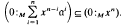
It is shown that this is the case if and only if a is a reduction of a+Ax relative to M; moreover
ᾱ={x ɛ A: xis integrally dependent on a relative to M}
is an ideal of A called the integral closure of a relative to M and is the unique maximal member of
℘ = {b: b is an ideal of A which has a as a reduction relative to M}.
Convolution operators associated with vector measures
-
- Journal:
- Glasgow Mathematical Journal / Volume 40 / Issue 3 / September 1998
- Published online by Cambridge University Press:
- 18 May 2009, pp. 367-384
-
- Article
-
- You have access
- Export citation
A formula of Bateman
-
- Journal:
- Proceedings of the Glasgow Mathematical Association / Volume 3 / Issue 2 / June 1957
- Published online by Cambridge University Press:
- 18 May 2009, pp. 99-101
-
- Article
-
- You have access
- Export citation
-
The formula

was stated by Bateman ([2], p. 457); a proof is sketched in [3], p. 144. Here

the Laguerre polynomial of degree


A note on liftings of hermitian elements and unitaries
-
- Journal:
- Glasgow Mathematical Journal / Volume 21 / Issue 2 / July 1980
- Published online by Cambridge University Press:
- 18 May 2009, pp. 183-185
-
- Article
-
- You have access
- Export citation
The expansion of continuous functions in series of integrals of orthonormal functions
-
- Journal:
- Glasgow Mathematical Journal / Volume 13 / Issue 1 / March 1972
- Published online by Cambridge University Press:
- 18 May 2009, pp. 29-38
-
- Article
-
- You have access
- Export citation
Analytic functions of a prespectral operator
-
- Journal:
- Glasgow Mathematical Journal / Volume 23 / Issue 2 / July 1982
- Published online by Cambridge University Press:
- 18 May 2009, pp. 171-175
-
- Article
-
- You have access
- Export citation
Macbeath's curve and the modular group
-
- Journal:
- Glasgow Mathematical Journal / Volume 27 / October 1985
- Published online by Cambridge University Press:
- 18 May 2009, pp. 239-247
-
- Article
-
- You have access
- Export citation
