Refine search
Actions for selected content:
26063 results in Abstract analysis
GMJ volume 5 issue 2 Cover and Front matter
-
- Journal:
- Proceedings of the Glasgow Mathematical Association / Volume 5 / Issue 2 / July 1961
- Published online by Cambridge University Press:
- 18 May 2009, pp. f1-f2
-
- Article
-
- You have access
- Export citation
Bilinear forms on vector Hardy spaces
-
- Journal:
- Glasgow Mathematical Journal / Volume 39 / Issue 3 / September 1997
- Published online by Cambridge University Press:
- 18 May 2009, pp. 371-378
-
- Article
-
- You have access
- Export citation
-
Let φ:
 ℋ →
ℋ →  be a bilinear form on vector Hardy space. Introduce the symbol φ of Φ by (φ (Z1, Z2), a ⊗ b) = Φ (K21 ⊗ a, K22 ⊗ b ), where Kw is the reproducing kernel for w ∈ D. We show that Φ extends to a bounded bilinear form on
  provided that the gradient
  defines a Carleson measure in the bidisc D2. We obtain a sufficient condition for Φ to extend to a Hilbert space. For vectorial bilinear Hankel forms we obtain an analogue of Nehari's Theorem.
 ℋ →
ℋ →  be a bilinear form on vector Hardy space. Introduce the symbol φ of Φ by (φ (Z
 provided that the gradient
  defines a Carleson measure in the bidisc D
GMJ volume 6 issue 3 Cover and Front matter
-
- Journal:
- Proceedings of the Glasgow Mathematical Association / Volume 6 / Issue 3 / January 1964
- Published online by Cambridge University Press:
- 18 May 2009, pp. f1-f2
-
- Article
-
- You have access
- Export citation
Continuity and differentiability properties of the Nemitskii operator in Hölder spaces
-
- Journal:
- Glasgow Mathematical Journal / Volume 30 / Issue 1 / January 1988
- Published online by Cambridge University Press:
- 18 May 2009, pp. 59-65
-
- Article
-
- You have access
- Export citation
-
Let ℝn be the n-dimensional Euclidean space with the usual norm denoted by |·| In what follows 蒆 will denote an open bounded subset of ℝn, and
 its closure.
For α ∊(0,1],
 is the space of all functions
  such that:
 is called the Holder space with exponent a and is a Banach space when endowed with the norm: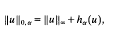
where ‖u‖∞ is, as usual, defined by:

 its closure.
 is the space of all functions
  such that:
Weight Functions on Extensions of the Compound Manual
-
- Journal:
- Glasgow Mathematical Journal / Volume 21 / Issue 1 / January 1980
- Published online by Cambridge University Press:
- 18 May 2009, pp. 97-101
-
- Article
-
- You have access
- Export citation
-
It has been shown ([8], [2], [1], [3], [9]) that a collection of physical operations or experiments can be represented by a nonempty set of nonempty sets satisfying certain technical conditions. Such a set
 is called a manual. The operations in are looked at as having no “before” and no “after”, i.e., they are isolated in time. If we wish to look at connected sequences of operations—in particular, if we wish to condition by events in —we must look at the compound manual c whose elements represent compound operations built up from the operations in the base manual .
 is called a manual. The operations in
 A Note on the Angles in an n-Dimensional Simplex
-
- Journal:
- Proceedings of the Glasgow Mathematical Association / Volume 4 / Issue 2 / July 1959
- Published online by Cambridge University Press:
- 18 May 2009, pp. 58-61
-
- Article
-
- You have access
- Export citation
-
Three different sets of equations connecting the sums of angles in an n-dimensional simplex have been given by Sommerville [7], Höhn [5], and Peschl [6]. The equivalence of the first two sets of equations has been proved by Sprott [7].
In the present note it is shown that results are simplified if we consider averages instead of sums, and that the averages form a sequence which is self-reciprocal with respect to the transformation
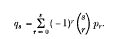
The equivalence of the sets of equations is then easily proved by symbolic methods.
An improved method for dual trigonometrical series
-
- Journal:
- Proceedings of the Glasgow Mathematical Association / Volume 6 / Issue 3 / January 1964
- Published online by Cambridge University Press:
- 18 May 2009, pp. 136-140
-
- Article
-
- You have access
- Export citation
Some Bessel Function Integrals
-
- Journal:
- Proceedings of the Glasgow Mathematical Association / Volume 2 / Issue 4 / February 1956
- Published online by Cambridge University Press:
- 18 May 2009, pp. 183-184
-
- Article
-
- You have access
- Export citation
-
The basic formula to be proved is

where p≧q + 1, z ≠0; | amp z | < π, R(n)>0, r = 1, 2,…,p. For other values of pand qthe result holds if the integral converges. From this formula some results, involving Bessel functions and Confluent Hypergeometric functions, will be deduced.
Automorphic forms on nondiscrete Möbius groups
-
- Journal:
- Glasgow Mathematical Journal / Volume 38 / Issue 2 / May 1996
- Published online by Cambridge University Press:
- 18 May 2009, pp. 249-253
-
- Article
-
- You have access
- Export citation
A purely analytic criterion for a decomposable operator
-
- Journal:
- Glasgow Mathematical Journal / Volume 21 / Issue 1 / January 1980
- Published online by Cambridge University Press:
- 18 May 2009, pp. 69-70
-
- Article
-
- You have access
- Export citation
GMJ volume 3 issue 2 Cover and Front matter
-
- Journal:
- Proceedings of the Glasgow Mathematical Association / Volume 3 / Issue 2 / June 1957
- Published online by Cambridge University Press:
- 18 May 2009, pp. f1-f2
-
- Article
-
- You have access
- Export citation
GMJ volume 15 issue 2 Cover and Front matter
-
- Journal:
- Glasgow Mathematical Journal / Volume 15 / Issue 2 / September 1974
- Published online by Cambridge University Press:
- 18 May 2009, pp. f1-f2
-
- Article
-
- You have access
- Export citation
Isoparametric functions and submanifolds
-
- Journal:
- Glasgow Mathematical Journal / Volume 35 / Issue 2 / May 1993
- Published online by Cambridge University Press:
- 18 May 2009, pp. 145-152
-
- Article
-
- You have access
- Export citation
-
The theory of isoparametric functions and a family of isoparametric hypersurfaces began essentially with E. Cartan in 1930's. He defined a real valued function V defined on a Riemannian space form to be isoparametric if ∥grad υ∥2=T
 V and ΔV = S
 V for some real valued functions S, T. Then a family of hypersurfaces Mt, is called isoparametric if Mt,=V-1 (t) where t is a regular value of V.
 V and ΔV = S
 V for some real valued functions S, T. Then a family of hypersurfaces M
GMJ volume 28 issue 1 Cover and Back matter
-
- Journal:
- Glasgow Mathematical Journal / Volume 28 / Issue 1 / January 1986
- Published online by Cambridge University Press:
- 18 May 2009, pp. b1-b6
-
- Article
-
- You have access
- Export citation
Complemented subspaces and the Hahn-Banach extension property in lp(0 < p < 1)
-
- Journal:
- Glasgow Mathematical Journal / Volume 28 / Issue 2 / July 1986
- Published online by Cambridge University Press:
- 18 May 2009, pp. 115-120
-
- Article
-
- You have access
- Export citation
GMJ volume 31 issue 3 Cover and Back matter
-
- Journal:
- Glasgow Mathematical Journal / Volume 31 / Issue 3 / September 1989
- Published online by Cambridge University Press:
- 18 May 2009, pp. b1-b6
-
- Article
-
- You have access
- Export citation
A characterization of spectral operators on Hilbert spaces
-
- Journal:
- Glasgow Mathematical Journal / Volume 23 / Issue 1 / January 1982
- Published online by Cambridge University Press:
- 18 May 2009, pp. 91-95
-
- Article
-
- You have access
- Export citation
-
Let H be a complex Hilbert space and denote by B(H) the Banach algebra of all bounded linear operators on H. In [5; 6] J. Ph. Labrousse proved that every operator S∈B(H) which is spectral in the sense of N. Dunford (see [3]) is similar to a T∈B(H) with the following property
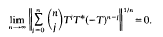
Conversely, he showed that given an operator S∈B(H) such that its essential spectrum (in the sense of [5; 6]) consists of at most one point and such that S is similar to a T∈B(H) with the property (1), then S is a spectral operator. This led him to the conjecture that an operator S∈B(H) is spectral if and only if it is similar to a T∈B(H) with property (1). The purpose of this note is to prove this conjecture in the case of operators which are decomposable in the sense of C. Foias (see [2]).
On certain triple integral equations with trigonometric kernels
-
- Journal:
- Glasgow Mathematical Journal / Volume 17 / Issue 2 / July 1976
- Published online by Cambridge University Press:
- 18 May 2009, pp. 103-105
-
- Article
-
- You have access
- Export citation
-
In this note we formally solve the following triple integral equations,



where f1(x), f2(x) and f3(x) are integrable for 0<x<α, α<x<β and β<x<∞, respectively, and the function g(λ) is assumed to satisfy sufficient conditions for the Fourier sine transform to exist. A special case of this system arose in a problem concerned with transistors.
Basis of quadratic differentials for Riemann surfaces with automorphisms
-
- Journal:
- Glasgow Mathematical Journal / Volume 39 / Issue 2 / May 1997
- Published online by Cambridge University Press:
- 18 May 2009, pp. 193-210
-
- Article
-
- You have access
- Export citation
Some examples of modules over Noetherian rings
-
- Journal:
- Glasgow Mathematical Journal / Volume 23 / Issue 1 / January 1982
- Published online by Cambridge University Press:
- 18 May 2009, pp. 9-13
-
- Article
-
- You have access
- Export citation
