Refine search
Actions for selected content:
26063 results in Abstract analysis
The semigroup of one-to-one transformations with finite defects
-
- Journal:
- Glasgow Mathematical Journal / Volume 31 / Issue 2 / May 1989
- Published online by Cambridge University Press:
- 18 May 2009, pp. 243-249
-
- Article
-
- You have access
- Export citation
-
Let
 be the semigroup of all total one-to-one transformations of an infinite set X. For an ƒ ∈ let the defect of ƒ def ƒ, be the cardinality of X – R(ƒ), where R(ƒ) = ƒ(X) is the range of ƒ. Then is a disjoint union of the symmetric group
  x on X, the semigroup S of all transformations in with finite non-zero defects and the semigroup Ā of all transformations in S with infinite defects, such that S U Ā and Ā are ideals of . The properties of x and Ā have been investigated by a number of authors (for the latter it was done via Baer-Levi semigroups, see [2], [3], [5], [6], [7], [8], [9], [10] and note that Ā decomposes into a union of Baer–Levi semigroups). Our aim here is to study the semigroup S. It is not difficult to see that S is left cancellative (we compose functions ƒ, g in S as ƒg(x) = ƒ(g(x)), for x ∈ X) and idempotent-free. All automorphisms of S are inner [4], that is of the form ƒ → hƒhfh-1 ƒ ∈ S, h ∈ x.
 be the semigroup of all total one-to-one transformations of an infinite set X. For an ƒ ∈
The mean-value of the Artin L-series and its derivative of a cubic field
-
- Journal:
- Glasgow Mathematical Journal / Volume 21 / Issue 1 / January 1980
- Published online by Cambridge University Press:
- 18 May 2009, pp. 9-18
-
- Article
-
- You have access
- Export citation
Proper Dubreil-Jacotin inverse semigroups
-
- Journal:
- Glasgow Mathematical Journal / Volume 16 / Issue 1 / March 1975
- Published online by Cambridge University Press:
- 18 May 2009, pp. 40-51
-
- Article
-
- You have access
- Export citation
A Problem associated with a Particular Markov Chain
-
- Journal:
- Proceedings of the Glasgow Mathematical Association / Volume 2 / Issue 2 / October 1954
- Published online by Cambridge University Press:
- 18 May 2009, pp. 100-104
-
- Article
-
- You have access
- Export citation
Homology and the Koszul complex
-
- Journal:
- Glasgow Mathematical Journal / Volume 12 / Issue 2 / September 1971
- Published online by Cambridge University Press:
- 18 May 2009, pp. 118-135
-
- Article
-
- You have access
- Export citation
GMJ volume 26 issue 1 Cover and Back matter
-
- Journal:
- Glasgow Mathematical Journal / Volume 26 / Issue 1 / January 1985
- Published online by Cambridge University Press:
- 18 May 2009, p. b1
-
- Article
-
- You have access
- Export citation
On M-harmonic Bloch functions and their Carleson measures†
-
- Journal:
- Glasgow Mathematical Journal / Volume 40 / Issue 2 / May 1998
- Published online by Cambridge University Press:
- 18 May 2009, pp. 273-289
-
- Article
-
- You have access
- Export citation
Interpolating sequences for the derivatives of Bloch functions
-
- Journal:
- Glasgow Mathematical Journal / Volume 34 / Issue 1 / January 1992
- Published online by Cambridge University Press:
- 18 May 2009, pp. 35-41
-
- Article
-
- You have access
- Export citation
-
We prove that sufficiently separated sequences are interpolating sequences for f′(z)(1−|z|2) where f is a Bloch function. If the sequence {zn} is an η net then the boundedness f′(z)(1−|z|2) on {zn} is a sufficient condition for f to be a Bloch function. The essential norm of a Hankel operator with a conjugate analytic symbol
 acting on the Bergman space is shown to be equivalent to
  .
.
 acting on the Bergman space is shown to be equivalent to
  .
.GMJ volume 19 issue 1 Cover and Front matter
-
- Journal:
- Glasgow Mathematical Journal / Volume 19 / Issue 1 / January 1978
- Published online by Cambridge University Press:
- 18 May 2009, pp. f1-f2
-
- Article
-
- You have access
- Export citation
Evaluation of an E-Function when two of the upper Parameters differ by an Integer
-
- Journal:
- Proceedings of the Glasgow Mathematical Association / Volume 5 / Issue 1 / January 1961
- Published online by Cambridge University Press:
- 18 May 2009, pp. 30-34
-
- Article
-
- You have access
- Export citation
-
If p ≧ q + 1, [1, p. 353]
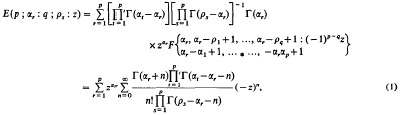
where, if p = q + 1, | z | < 1. The dash in the product sign indicates that the factor for which t = αr – αr + 1 is omitted, while the asterisk indicates that the parameter αr−αr + 1 is omitted.
Strongly analytic spaces in spectral decomposition
-
- Journal:
- Glasgow Mathematical Journal / Volume 30 / Issue 3 / September 1988
- Published online by Cambridge University Press:
- 18 May 2009, pp. 249-257
-
- Article
-
- You have access
- Export citation
The Packing of Spheres in the Space lp
-
- Journal:
- Proceedings of the Glasgow Mathematical Association / Volume 4 / Issue 1 / December 1958
- Published online by Cambridge University Press:
- 18 May 2009, pp. 22-25
-
- Article
-
- You have access
- Export citation
-
A point x in the real or complex space lpis an infinite sequence,(x1, x2, x3,…) of real or complex numbers such that
 is convergent. Here p ≥ 1 and we write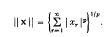
The unit sphere S consists of all points x ε lp for which ¶ x ¶ ≤ 1. The sphere of radius a≥ ≤ 0 and centre y is denoted by Sa(y) and consists of all points x ε lp such that ¶ x - y ¶ ≤ a. The sphere Sa(y) is contained in S if and only if ¶ y ¶≤1 - a, and the two spheres Sa(y) and Sa(z) do not overlap if and only if
¶ y- z ¶≥ 2a
The statement that a finite or infinite number of spheres Sa (y) of fixed radius a can be packed in S means that each sphere Sa (y) is contained in S and that no two such spheres overlap.
 is convergent. Here p ≥ 1 and we write
On a conjecture of G. Hajós
-
- Journal:
- Glasgow Mathematical Journal / Volume 15 / Issue 1 / March 1974
- Published online by Cambridge University Press:
- 18 May 2009, pp. 88-89
-
- Article
-
- You have access
- Export citation
A generalized Drazin inverse
-
- Journal:
- Glasgow Mathematical Journal / Volume 38 / Issue 3 / September 1996
- Published online by Cambridge University Press:
- 18 May 2009, pp. 367-381
-
- Article
-
- You have access
- Export citation
A Linear Relation between E-Functions
-
- Journal:
- Proceedings of the Glasgow Mathematical Association / Volume 1 / Issue 4 / December 1953
- Published online by Cambridge University Press:
- 18 May 2009, pp. 185-186
-
- Article
-
- You have access
- Export citation
-
The formula to be proved is

The formulae required in the proof are the Barnes Integral

and Whipple's Formula (1)

§ 2. Proof of the Formula. From (2) the E-function on the left of (1) is equal to

On the distance of the composition of two derivations to the generalized derivations
-
- Journal:
- Glasgow Mathematical Journal / Volume 33 / Issue 1 / January 1991
- Published online by Cambridge University Press:
- 18 May 2009, pp. 89-93
-
- Article
-
- You have access
- Export citation
Linearization of holomorphic mappings on fully nuclear spaces with a basis
-
- Journal:
- Glasgow Mathematical Journal / Volume 36 / Issue 2 / May 1994
- Published online by Cambridge University Press:
- 18 May 2009, pp. 201-208
-
- Article
-
- You have access
- Export citation
-
In [13] Mazet proved the following result.
If U is an open subset of a locally convex space E then there exists a complete locally convex space
 (U) and a holomorphic mapping δU: U→(U) such that for any complete locally convex space F and any f ɛ ℋ (U;F), the space of holomorphic mappings from U to F, there exists a unique linear mapping Tf: (U)→F such that the following diagram commutes;
The space
(U) is unique up to a linear topological isomorphism. Previously, similar but less general constructions, have been considered by Ryan [16] and Schottenloher [17].
 (U) and a holomorphic mapping δ
On normally embedded subgroups of locally soluble FC-groups
-
- Journal:
- Glasgow Mathematical Journal / Volume 28 / Issue 2 / July 1986
- Published online by Cambridge University Press:
- 18 May 2009, pp. 153-159
-
- Article
-
- You have access
- Export citation
E-unitary congruences on inverse semigroups
-
- Journal:
- Glasgow Mathematical Journal / Volume 17 / Issue 1 / January 1976
- Published online by Cambridge University Press:
- 18 May 2009, pp. 57-75
-
- Article
-
- You have access
- Export citation
-
By an E-unitary inverse semigroup we mean an inverse semigroup in which the semilattice is a unitary subset. Such semigroups, elsewhere called ‘proper’ or ‘reduced’ inverse semigroups, have been the object of much recent study. Free inverse semigroups form a subclass of particular interest.
An important structure theorem for E-unitary inverse semigroups has been obtained by McAlister [4, 5]. From a triple (G,
 ) consisting of a group G, a partially ordered set
  and a subset
  , satisfying certain conditions, he constructs an E-unitary inverse semigroup P(G, ). A semigroup of this type is called a P-semigroup. The structure theorem states that every E-unitary inverse semigroup is, to within isomorphism, of this form. A second theorem asserts that every inverse semigroup is isomorphic to a quotient of a Psemigroup by an idempotent-separating congruence. We refer below to these results as McAlister's Theorems A and B respectively. A triple (C, ) of the type used to construct a P-semigroup is here termed a “McAlister triple”. It is shown further, in [5], that there is essentially only one such triple corresponding to a given E-unitary inverse semigroup.
 ) consisting of a group G, a partially ordered set
  and a subset
  , satisfying certain conditions, he constructs an E-unitary inverse semigroup P(G,
 A norm property for spaces of completely bounded maps between C*-algebras
-
- Journal:
- Glasgow Mathematical Journal / Volume 29 / Issue 2 / July 1987
- Published online by Cambridge University Press:
- 18 May 2009, pp. 181-184
-
- Article
-
- You have access
- Export citation
-
Let Mn be the C*-algebra of n × n complex matrices. If A is a C*-algebra, let Mn(A) denote the C*-algebra of n × nmatrices a = [aij] with entries in A. For a linear map
 between C*-algebras, we define the multiplicity map
  by
by  A linear map Ø is said to be completely bounded if
  Let B(A, B), CB(A, B) denote the Banach space of bounded linear maps, the set of completely bounded maps from A to B, respectively.
 between C*-algebras, we define the multiplicity map
  by
by  A linear map Ø is said to be completely bounded if
  Let B(A, B), CB(A, B) denote the Banach space of bounded linear maps, the set of completely bounded maps from A to B, respectively.