Refine search
Actions for selected content:
26079 results in Abstract analysis
The Structure of Normal Inverse Semigroups
-
- Journal:
- Proceedings of the Glasgow Mathematical Association / Volume 3 / Issue 1 / December 1956
- Published online by Cambridge University Press:
- 18 May 2009, pp. 1-9
-
- Article
-
- You have access
- Export citation
GMJ volume 12 issue 2 Cover and Back matter
-
- Journal:
- Glasgow Mathematical Journal / Volume 12 / Issue 2 / September 1971
- Published online by Cambridge University Press:
- 18 May 2009, pp. b1-b2
-
- Article
-
- You have access
- Export citation
A note on reductions of ideals relative to an Artinian module
-
- Journal:
- Glasgow Mathematical Journal / Volume 35 / Issue 2 / May 1993
- Published online by Cambridge University Press:
- 18 May 2009, pp. 219-224
-
- Article
-
- You have access
- Export citation
-
The concept of reduction and integral closure of ideals relative to Artinian modules were introduced in [7]; and we summarize some of the main aspects now.
Let A be a commutative ring (with non-zero identity) and let a, b be ideals of A. Suppose that M is an Artinian module over A. We say that a is a reduction of b relative to M if a ⊆ b and there is a positive integer s such that
)O:Mabs)=(O:Mbs+l).
An element x of A is said to be integrally dependent on a relative to M if there exists n y ℕ(where ℕ denotes the set of positive integers) such that
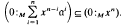
It is shown that this is the case if and only if a is a reduction of a+Ax relative to M; moreover
ᾱ={x ɛ A: xis integrally dependent on a relative to M}
is an ideal of A called the integral closure of a relative to M and is the unique maximal member of
℘ = {b: b is an ideal of A which has a as a reduction relative to M}.
Convolution operators associated with vector measures
-
- Journal:
- Glasgow Mathematical Journal / Volume 40 / Issue 3 / September 1998
- Published online by Cambridge University Press:
- 18 May 2009, pp. 367-384
-
- Article
-
- You have access
- Export citation
A formula of Bateman
-
- Journal:
- Proceedings of the Glasgow Mathematical Association / Volume 3 / Issue 2 / June 1957
- Published online by Cambridge University Press:
- 18 May 2009, pp. 99-101
-
- Article
-
- You have access
- Export citation
-
The formula

was stated by Bateman ([2], p. 457); a proof is sketched in [3], p. 144. Here

the Laguerre polynomial of degree


A note on liftings of hermitian elements and unitaries
-
- Journal:
- Glasgow Mathematical Journal / Volume 21 / Issue 2 / July 1980
- Published online by Cambridge University Press:
- 18 May 2009, pp. 183-185
-
- Article
-
- You have access
- Export citation
The expansion of continuous functions in series of integrals of orthonormal functions
-
- Journal:
- Glasgow Mathematical Journal / Volume 13 / Issue 1 / March 1972
- Published online by Cambridge University Press:
- 18 May 2009, pp. 29-38
-
- Article
-
- You have access
- Export citation
Analytic functions of a prespectral operator
-
- Journal:
- Glasgow Mathematical Journal / Volume 23 / Issue 2 / July 1982
- Published online by Cambridge University Press:
- 18 May 2009, pp. 171-175
-
- Article
-
- You have access
- Export citation
Macbeath's curve and the modular group
-
- Journal:
- Glasgow Mathematical Journal / Volume 27 / October 1985
- Published online by Cambridge University Press:
- 18 May 2009, pp. 239-247
-
- Article
-
- You have access
- Export citation
On the transcendence degree of group algebras of nilpotent groups
-
- Journal:
- Glasgow Mathematical Journal / Volume 25 / Issue 2 / July 1984
- Published online by Cambridge University Press:
- 18 May 2009, pp. 167-174
-
- Article
-
- You have access
- Export citation
Subalgebras of C*-algebras and von Neumann algebras
-
- Journal:
- Glasgow Mathematical Journal / Volume 25 / Issue 1 / January 1984
- Published online by Cambridge University Press:
- 18 May 2009, pp. 19-25
-
- Article
-
- You have access
- Export citation
The essential norms of composition operators
-
- Journal:
- Glasgow Mathematical Journal / Volume 34 / Issue 2 / May 1992
- Published online by Cambridge University Press:
- 18 May 2009, pp. 143-155
-
- Article
-
- You have access
- Export citation
-
Throughout the paper n denotes a fixed positive integer unless otherwise specified. Let B = Bn denote the open unit ball of ℂn and let S = Sn denote its boundary, the unit sphere. The unique rotation-invariant probability measure on 5 will be denoted by σ = σn. For n = l, we use more customary notations D = B1, T = S1 and dσ1= dθ/2π. The Hardy space on B, denoted by H2(B), is then the space of functions f holomorphic on B for which

A variance method in combinatorial number theory
-
- Journal:
- Glasgow Mathematical Journal / Volume 10 / Issue 2 / July 1969
- Published online by Cambridge University Press:
- 18 May 2009, pp. 126-129
-
- Article
-
- You have access
- Export citation
-
Let s = s(a1, a2,...., ar) denote the number of integer solutions of the equation
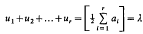
subject to the conditions

the ai being given positive integers, and square brackets denoting the integral part. Clearly s (a1,..., ar) is also the number s = s(m) of divisors of
 which contain exactly λ prime factors counted according to multiplicity, and is therefore, as is proved in [1], the cardinality of the largest possible set of divisors of m, no one of which divides another.
 which contain exactly λ prime factors counted according to multiplicity, and is therefore, as is proved in [1], the cardinality of the largest possible set of divisors of m, no one of which divides another.
GMJ volume 27 Cover and Front matter
-
- Journal:
- Glasgow Mathematical Journal / Volume 27 / October 1985
- Published online by Cambridge University Press:
- 18 May 2009, pp. f1-f6
-
- Article
-
- You have access
- Export citation
Coefficient conditions for starlike functions
-
- Journal:
- Glasgow Mathematical Journal / Volume 29 / Issue 1 / January 1987
- Published online by Cambridge University Press:
- 18 May 2009, pp. 141-142
-
- Article
-
- You have access
- Export citation
-
Let {ak} be a sequence of non-negative real numbers satisfying a1 = l and
 (1)
(1)Brannan [1] proved that the function
 (2)
(2)is close-to-convex univalent in the unit disc D. The example

shows that the conclusion in Brannan's theorem is sharp in that sense that “close-to-convex” cannot be replaced by the stronger one: “starlike”. It is therefore of interest to see which additional condition can guarantee this stronger conclusion.

Compact linear operators from an algebraic standpoint
-
- Journal:
- Glasgow Mathematical Journal / Volume 8 / Issue 1 / January 1967
- Published online by Cambridge University Press:
- 18 May 2009, pp. 41-49
-
- Article
-
- You have access
- Export citation
A direct proof of Leutbecher's Lemma
-
- Journal:
- Glasgow Mathematical Journal / Volume 13 / Issue 2 / September 1972
- Published online by Cambridge University Press:
- 18 May 2009, pp. 179-180
-
- Article
-
- You have access
- Export citation
GMJ volume 7 issue 1 Cover and Front matter
-
- Journal:
- Proceedings of the Glasgow Mathematical Association / Volume 7 / Issue 1 / January 1965
- Published online by Cambridge University Press:
- 18 May 2009, pp. f1-f7
-
- Article
-
- You have access
- Export citation
An arithmetic characterization of the parabolic points of G(2cos π/5)
-
- Journal:
- Proceedings of the Glasgow Mathematical Association / Volume 6 / Issue 2 / July 1963
- Published online by Cambridge University Press:
- 18 May 2009, pp. 88-96
-
- Article
-
- You have access
- Export citation
An identity in combinatorial analysis
-
- Journal:
- Proceedings of the Glasgow Mathematical Association / Volume 5 / Issue 4 / July 1962
- Published online by Cambridge University Press:
- 18 May 2009, pp. 197-200
-
- Article
-
- You have access
- Export citation
-
In a very recent paper [1], Basil Gordon discusses generalizations of Jacobi's identity

where x and z are complex numbers and |x| <1. He notes that some of its consequences, inter alia Euler's formula

are of interest in number theory and combinatory analysis. He proves the apparently new and striking result

where |s|<1, and also considers the possibility of generalizations. His methods are algebraic and quite simple, but perhaps do not make obvious what underlies such formulae. It may be worth while to do so, especially since the details become simpler and the presentation more perspicuous. The method given here assumes no more knowledge than his does, although the new proof is expressed in terms of theta-functions, in simple properties of which, formulae such as (3) have their origin. Further, (3) appears in a slightly more symmetrical form.
