Refine search
Actions for selected content:
26063 results in Abstract analysis
GMJ volume 2 issue 2 Cover and Back matter
-
- Journal:
- Proceedings of the Glasgow Mathematical Association / Volume 2 / Issue 2 / October 1954
- Published online by Cambridge University Press:
- 18 May 2009, pp. b1-b2
-
- Article
-
- You have access
- Export citation
On Schachermayer's example about the Banach-Saks property
-
- Journal:
- Glasgow Mathematical Journal / Volume 32 / Issue 2 / May 1990
- Published online by Cambridge University Press:
- 18 May 2009, pp. 201-203
-
- Article
-
- You have access
- Export citation
-
A Banach space (X, ∥.∥) is said to have the Banach-Saks property (B.S.P.) if, for every bounded sequence (xn) in X, we can choose a subsequence (
 ) of (xn) such that the sequence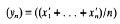
converges in the X-norm. This property, that a Banach space may enjoy or not, has been extensively studied.
 ) of (x
QF-3 endomorphism rings of Σ-quasi-projective modules†
-
- Journal:
- Glasgow Mathematical Journal / Volume 30 / Issue 2 / May 1988
- Published online by Cambridge University Press:
- 18 May 2009, pp. 215-220
-
- Article
-
- You have access
- Export citation
Maximum graphs non-Hamiltonian-connected from a vertex
-
- Journal:
- Glasgow Mathematical Journal / Volume 25 / Issue 1 / January 1984
- Published online by Cambridge University Press:
- 18 May 2009, pp. 97-98
-
- Article
-
- You have access
- Export citation
Measures equivalent to the Haar measure
-
- Journal:
- Proceedings of the Glasgow Mathematical Association / Volume 4 / Issue 4 / September 1960
- Published online by Cambridge University Press:
- 18 May 2009, pp. 157-162
-
- Article
-
- You have access
- Export citation
On some classes of weighted composition operators
-
- Journal:
- Glasgow Mathematical Journal / Volume 32 / Issue 1 / January 1990
- Published online by Cambridge University Press:
- 18 May 2009, pp. 87-94
-
- Article
-
- You have access
- Export citation
-
Let (X, Σμ) denote a complete a-finite measure space and T: X → X a measurable (T-1A ε Σ each A ε Σ) point transformation from X into itself with the property that the measure μ°T-1 is absolutely continuous with respect to μ. Given any measurable, complex-valued function w(x) on X, and a function f in L2(μ), define WTf(x) via the equation

Quasi-multiplicative maps on Baer semigroups
-
- Journal:
- Glasgow Mathematical Journal / Volume 13 / Issue 2 / September 1972
- Published online by Cambridge University Press:
- 18 May 2009, pp. 107-110
-
- Article
-
- You have access
- Export citation
Some arithmetical functions in finite fields
-
- Journal:
- Glasgow Mathematical Journal / Volume 11 / Issue 1 / January 1970
- Published online by Cambridge University Press:
- 18 May 2009, pp. 21-36
-
- Article
-
- You have access
- Export citation
A Counterexample in the theory of derivations
-
- Journal:
- Glasgow Mathematical Journal / Volume 31 / Issue 2 / May 1989
- Published online by Cambridge University Press:
- 18 May 2009, pp. 161-163
-
- Article
-
- You have access
- Export citation
-
Let B(H) be the algebra of all bounded linear operators on a separable, infinite dimensional complex Hilbert space H. Let C2 and C1 denote respectively, the Hilbert–Schmidt class and the trace class operators in B(H). It is known that C2 and C1 are two-sided*-ideals in B(H) and C2 is a Hilbert space with respect to the inner product

(where tr denotes the trace). For any Hilbert–Schmidt operator X let ∥X∥2=(X, X)½ be the Hilbert-Schmidt norm of X.
For fixed A ∈ B(H) let δA be the operator on B(H) defined by

Operators of the form (1) are called inner derivations and they (as well as their restrictions
 have been extensively studied (for example [1–3]). In [1], Fuad Kittaneh proved the following result.
 have been extensively studied (for example [1–3]). In [1], Fuad Kittaneh proved the following result.
The lattice of inverse subsemigroups of a reduced inverse semigroup†
-
- Journal:
- Glasgow Mathematical Journal / Volume 17 / Issue 2 / July 1976
- Published online by Cambridge University Press:
- 18 May 2009, pp. 161-172
-
- Article
-
- You have access
- Export citation
-
An inverse semigroup R is said to be reduced (or proper) if ℛ∩σ= i (where σ is the minimum group congruence on R). McAlister has shown ([3], [4]) that every reduced inverse semigroup is isomorphic with a “P-semigroup” P(G,
 ,
,  ), for some semilattice , poset containing as an ideal, and group G acting on by order-automorphisms; (and, conversely, every P-semigroup is reduced). In [4], he also found the morphisms between P-semigroups, in terms of morphisms between the respective groups, and between the respective posets.
 ,
,  ), for some semilattice
 On the decomposition of a field as a tensor product
-
- Journal:
- Glasgow Mathematical Journal / Volume 20 / Issue 2 / July 1979
- Published online by Cambridge University Press:
- 18 May 2009, pp. 141-145
-
- Article
-
- You have access
- Export citation
On sparsely totient numbers
-
- Journal:
- Glasgow Mathematical Journal / Volume 33 / Issue 3 / September 1991
- Published online by Cambridge University Press:
- 18 May 2009, pp. 350-358
-
- Article
-
- You have access
- Export citation
-
Following Masser and Shiu [6] we say that a positive integer n is sparsely totient if

Here φ is the familiar Euler totient function. We write ℱ for the set of sparsely totient numbers. In [6] several results are proved about the multiplicative structure of ℱ. If we write P(n) for the largest prime factor of n then it was shown (Theorem 2 of [6]) that

and infinitely often

Irreducible representations of the generalized symmetric group Bmn
-
- Journal:
- Glasgow Mathematical Journal / Volume 29 / Issue 1 / January 1987
- Published online by Cambridge University Press:
- 18 May 2009, pp. 1-6
-
- Article
-
- You have access
- Export citation
-
This paper is devoted to the determining of the irreducible linear representations of the generalized symmetric group
 (elsewhere written as
  , Cm ≀ Sn or G(m, 1, n)) by considering the conjugacy classes of and then constructing the same number of inequivalent irreducible linear representations of . These have previously been determined by Kerber [2, Section 5] using Clifford's theory applied to wreath products.
 (elsewhere written as
  , C
, CA note on p-groups with power automorphisms
-
- Journal:
- Glasgow Mathematical Journal / Volume 34 / Issue 3 / September 1992
- Published online by Cambridge University Press:
- 18 May 2009, pp. 327-332
-
- Article
-
- You have access
- Export citation
Some topological properties of residually Černikov groups
-
- Journal:
- Glasgow Mathematical Journal / Volume 23 / Issue 1 / January 1982
- Published online by Cambridge University Press:
- 18 May 2009, pp. 65-82
-
- Article
-
- You have access
- Export citation
Abstract theory of packings and coverings. I.
-
- Journal:
- Proceedings of the Glasgow Mathematical Association / Volume 4 / Issue 2 / July 1959
- Published online by Cambridge University Press:
- 18 May 2009, pp. 92-95
-
- Article
-
- You have access
- Export citation
Remarks on the Upper Centralc Series of a Group
-
- Journal:
- Proceedings of the Glasgow Mathematical Association / Volume 3 / Issue 1 / December 1956
- Published online by Cambridge University Press:
- 18 May 2009, pp. 38-44
-
- Article
-
- You have access
- Export citation
-
Following, for example, Kurošs [8], we define the (transfinite) upper central series of a group G to be the series

such that Zα + 1/Za is the centre of G/Zα, and if β is a limit ordinal, then
 If α is the least ordinal for which Zα =Zα+1=…, then we say that the upper central series has length α, and that Zα= His the hypercentre of G. As usual, we call G nilpotent if Zn= Gfor some finite n.
 If α is the least ordinal for which Z
Automorphy factors for a Hilbert modular group
-
- Journal:
- Glasgow Mathematical Journal / Volume 30 / Issue 2 / May 1988
- Published online by Cambridge University Press:
- 18 May 2009, pp. 231-236
-
- Article
-
- You have access
- Export citation
Finite co-Dedekindian groups
-
- Journal:
- Glasgow Mathematical Journal / Volume 38 / Issue 2 / May 1996
- Published online by Cambridge University Press:
- 18 May 2009, pp. 163-169
-
- Article
-
- You have access
- Export citation
On formulae of Macbeath and Hussein
-
- Journal:
- Glasgow Mathematical Journal / Volume 31 / Issue 1 / January 1989
- Published online by Cambridge University Press:
- 18 May 2009, pp. 65-70
-
- Article
-
- You have access
- Export citation
-
In his thesis [1], Hussein considered regular permutations of order 2 and 3 in Sn whose product is an n-cycle. For such a pair, we must have

for some g ≥ 1. Such a permutation pair corresponds to a free cycloidal subgroup of the classical modular group (see, e.g., [3]). Previously the free subgroups and the cycloidal subgroups of fixed genus had been enumerated ([4], [5]).
