Refine search
Actions for selected content:
26063 results in Abstract analysis
Error estimates for the spectral Galerkin approximations of the solutions of Navier–Stokes type equations
-
- Journal:
- Glasgow Mathematical Journal / Volume 31 / Issue 2 / May 1989
- Published online by Cambridge University Press:
- 18 May 2009, pp. 199-211
-
- Article
-
- You have access
- Export citation
GMJ volume 9 issue 1 Cover and Back matter
-
- Journal:
- Glasgow Mathematical Journal / Volume 9 / Issue 1 / January 1968
- Published online by Cambridge University Press:
- 18 May 2009, pp. b1-b2
-
- Article
-
- You have access
- Export citation
Any group is a maximal subgroup of the semigroup of binary relations on some set†
-
- Journal:
- Glasgow Mathematical Journal / Volume 14 / Issue 1 / February 1973
- Published online by Cambridge University Press:
- 18 May 2009, pp. 21-24
-
- Article
-
- You have access
- Export citation
GMJ volume 22 issue 1 Cover and Front matter
-
- Journal:
- Glasgow Mathematical Journal / Volume 22 / Issue 1 / January 1981
- Published online by Cambridge University Press:
- 18 May 2009, pp. f1-f7
-
- Article
-
- You have access
- Export citation
The unitary equivalence of compact operators
-
- Journal:
- Glasgow Mathematical Journal / Volume 26 / Issue 2 / July 1985
- Published online by Cambridge University Press:
- 18 May 2009, pp. 145-149
-
- Article
-
- You have access
- Export citation
Prime and maximal ideals in polynomial rings
-
- Journal:
- Glasgow Mathematical Journal / Volume 37 / Issue 3 / September 1995
- Published online by Cambridge University Press:
- 18 May 2009, pp. 351-362
-
- Article
-
- You have access
- Export citation
Derivations in central separable algebras
-
- Journal:
- Glasgow Mathematical Journal / Volume 19 / Issue 1 / January 1978
- Published online by Cambridge University Press:
- 18 May 2009, pp. 75-77
-
- Article
-
- You have access
- Export citation
The numerical range of an element of a normed algebra
-
- Journal:
- Glasgow Mathematical Journal / Volume 10 / Issue 1 / January 1969
- Published online by Cambridge University Press:
- 18 May 2009, pp. 68-72
-
- Article
-
- You have access
- Export citation
-
Given a normed linear space X, let S(X), X′, B(X) denote respectively the unit sphere {x: ∥x∥ = 1} of X, the dual space of X, and the algebra of all bounded linear mappings of X into X. For each x ∊ S(X) and T ∊ B(X), let Dx(x) = {f e X′:∥f∥ = f(x)= 1}, and V(T; x) = {f(Tx):f∊Dx(x)}. The numerical range V(T) is then defined by

Some examples of noncommutative local rings
-
- Journal:
- Glasgow Mathematical Journal / Volume 32 / Issue 1 / January 1990
- Published online by Cambridge University Press:
- 18 May 2009, pp. 79-86
-
- Article
-
- You have access
- Export citation
On non-commutative regular local rings
-
- Journal:
- Glasgow Mathematical Journal / Volume 17 / Issue 2 / July 1976
- Published online by Cambridge University Press:
- 18 May 2009, pp. 98-102
-
- Article
-
- You have access
- Export citation
-
Let R be a ring (with identity). We shall call R a local ring if R is aright noetherian ring such that the Jacobson radical M is a maximal ideal (and so is the only maximal ideal),
 and R/M is a simple artinian ring. A local ring R with maximal ideal M is called regular if there exists a chain
of ideals Mi of such that Mi–1/Mi is generated by a central regular element of R/Mi (1 ≦ i ≦ n). For such a ring R, Walker [6, Theorem 2. 7] proved that R is prime and n is the right global dimension of R, the Krull dimension of R, the homological dimension of theR-module R/M and the supremum of the lengths of chains of prime ideals of R. Such regular local rings will be called n-dimensional. The aim of this note is to give examples of regular local rings. These arise as localizations of universal enveloping algebras of nilpotent Lie algebras over fields and localizations of group algebras of certain finitely generated finite-by-nilpotent groups.
 and R/M is a simple artinian ring. A local ring R with maximal ideal M is called regular if there exists a chain
Relative Ockham lattices: their order-theoretic and algebraic characterisation
-
- Journal:
- Glasgow Mathematical Journal / Volume 32 / Issue 1 / January 1990
- Published online by Cambridge University Press:
- 18 May 2009, pp. 47-66
-
- Article
-
- You have access
- Export citation
-
Given a variety
 of lattice-ordered algebras, a lattice L is said to be a relative-lattice if every closed interval [a, b] of L may be given the structure of an algebra in (in other words, is the reduct of a member of —not necessarily unique). This paper discusses the characterisation in terms of forbidden substructures of finite relative.stf-lattices. We treat a large class of varieties of distributive-lattice-ordered algebras. For these varieties, the finite algebras can be described dually in terms of finite ordered sets, so that order-theoretic results and techniques prove valuable.
 of lattice-ordered algebras, a lattice L is said to be a relative
GMJ volume 36 issue 3 Cover and Back matter
-
- Journal:
- Glasgow Mathematical Journal / Volume 36 / Issue 3 / September 1994
- Published online by Cambridge University Press:
- 18 May 2009, pp. b1-b2
-
- Article
-
- You have access
- Export citation
A note on uniqueness for anisotropic fluids
-
- Journal:
- Glasgow Mathematical Journal / Volume 15 / Issue 1 / March 1974
- Published online by Cambridge University Press:
- 18 May 2009, pp. 43-47
-
- Article
-
- You have access
- Export citation
An integral formula for hypersurfaces in space forms
-
- Journal:
- Glasgow Mathematical Journal / Volume 37 / Issue 3 / September 1995
- Published online by Cambridge University Press:
- 18 May 2009, pp. 337-341
-
- Article
-
- You have access
- Export citation
-
Let
 be an n+ 1-dimensional, complete simply connected Riemannian manifold of constant sectional curvature c and
  We consider the function r(·) = d(·, P0) where d stands for the distance function in and we denote by grad r the gradient of The position vector (see [1]) with origin P0 is defined as
  where ϕ(r)equals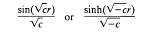
r, if c = 0, c< 0 or c <0 respectively.
 be an n+ 1-dimensional, complete simply connected Riemannian manifold of constant sectional curvature c and
  We consider the function r(·) = d(·, P
 where ϕ(r)equals
Generation of the lower central series II
-
- Journal:
- Glasgow Mathematical Journal / Volume 25 / Issue 2 / July 1984
- Published online by Cambridge University Press:
- 18 May 2009, pp. 193-201
-
- Article
-
- You have access
- Export citation
-
In this article, we obtain results on commutators in Sylow subgroups of the lower central series, extending the work of Dark and Newell [2], Rodney [12, 13] and Aschbacher and the author [1, 6, 7].
Some notation is required for the statement of the main results. Let r be a positive integer and define

and

where x1, …, xr, are elements in a group G. Let ΓrG = {[x1, …, xr]∣ x1 ∈ G} be the set of r-fold commutators in G. Then Lr,G = 〈ΓrG〉 is the rth term in the lower central series of G. Set L∞G = ∩ Lr,G.
The extremal points of the range of a vector-valued measure
-
- Journal:
- Glasgow Mathematical Journal / Volume 13 / Issue 1 / March 1972
- Published online by Cambridge University Press:
- 18 May 2009, pp. 61-63
-
- Article
-
- You have access
- Export citation
GMJ volume 30 issue 2 Cover and Front matter
-
- Journal:
- Glasgow Mathematical Journal / Volume 30 / Issue 2 / May 1988
- Published online by Cambridge University Press:
- 18 May 2009, pp. f1-f2
-
- Article
-
- You have access
- Export citation
Bishop's Condition (β)†
-
- Journal:
- Glasgow Mathematical Journal / Volume 26 / Issue 1 / January 1985
- Published online by Cambridge University Press:
- 18 May 2009, pp. 35-46
-
- Article
-
- You have access
- Export citation
Least squares approximations for dual trigonometric series
-
- Journal:
- Glasgow Mathematical Journal / Volume 14 / Issue 2 / September 1973
- Published online by Cambridge University Press:
- 18 May 2009, pp. 111-119
-
- Article
-
- You have access
- Export citation
Maximum Principles in matrix theory
-
- Journal:
- Proceedings of the Glasgow Mathematical Association / Volume 4 / Issue 1 / December 1958
- Published online by Cambridge University Press:
- 18 May 2009, pp. 34-37
-
- Article
-
- You have access
- Export citation
