Refine search
Actions for selected content:
26063 results in Abstract analysis
On a theorem of Iseki
-
- Journal:
- Glasgow Mathematical Journal / Volume 11 / Issue 2 / July 1970
- Published online by Cambridge University Press:
- 18 May 2009, pp. 110-113
-
- Article
-
- You have access
- Export citation
-
The purpose of this paper is to generalize a result of K. Iseki [1]. In his note, Iseki proves that, in a normal space S, for every countable discrete collection ℋ = {H1, H2, …} of sets from S, there exists a countable collection
 = {U1, U2, …} of mutually disjoint open sets from S such that Hi ⊂ Ui for every i.
 = {U
= {UGMJ volume 10 issue 2 Cover and Front matter
-
- Journal:
- Glasgow Mathematical Journal / Volume 10 / Issue 2 / July 1969
- Published online by Cambridge University Press:
- 18 May 2009, pp. f1-f2
-
- Article
-
- You have access
- Export citation
The quadratic reciprocity law and the elementary theta function
-
- Journal:
- Glasgow Mathematical Journal / Volume 27 / October 1985
- Published online by Cambridge University Press:
- 18 May 2009, pp. 19-30
-
- Article
-
- You have access
- Export citation
-
This note points out a new aspect of the well-known relationship between the subjects mentioned in the title. The following result and its generalization in totally real algebraic number fields is central to the discussion. Let
 denote the Legendre symbol for relatively prime numbers a and b ℇ ℤ and
  a substitution of the modular subgroup Γ0(4). Then, if γ>0 and b≡1 mod 2,
with

and

According to (1), the Legendre symbol behaves somewhat like a modular function ﹙apart from the known behaviour under
 and
and  ﹚. (1) follows (see below) from the functional equation
with

provided that

Here we used and always will use the abbreviation

and ℇδ means the absolutely least residue of δ mod 4. In the proof, Hecke [4] assumed γ>0 (see also Shimura [5]).
 denote the Legendre symbol for relatively prime numbers a and b ℇ ℤ and
  a substitution of the modular subgroup Γ
 and
and  ﹚. (1) follows (see below) from the functional equation

A remark on the divisor function d(n)
-
- Journal:
- Glasgow Mathematical Journal / Volume 14 / Issue 1 / February 1973
- Published online by Cambridge University Press:
- 18 May 2009, pp. 54-55
-
- Article
-
- You have access
- Export citation
Symmetries of surfaces: an extension of Kulkarni's theorem
-
- Journal:
- Glasgow Mathematical Journal / Volume 36 / Issue 2 / May 1994
- Published online by Cambridge University Press:
- 18 May 2009, pp. 173-184
-
- Article
-
- You have access
- Export citation
-
In [6] Kulkarni considered the set of values of g for which a given finite group G acts faithfully as a group of orientation-preserving self-homeomorphisms of a compact, connected, orientable surface σg of genus g. Let us denote this set by
 (G). Then Kulkarni showed that there exists a positive integer Kdepending only on the order d = |G| of G, the exponent e= exp G of G and the structure of a Sylow 2-subgroup G2 of G, satisfying:
Theorem 1. (Kulkarni [6])
(G) consists of all but finitely many non-negative integers g ≡ 1 mod K.
 (G). Then Kulkarni showed that there exists a positive integer Kdepending only on the order d = |G| of G, the exponent e= exp G of G and the structure of a Sylow 2-subgroup G
An algebraically closed field
-
- Journal:
- Glasgow Mathematical Journal / Volume 9 / Issue 2 / July 1968
- Published online by Cambridge University Press:
- 18 May 2009, pp. 146-151
-
- Article
-
- You have access
- Export citation
-
Let k be any algebraically closed field, and denote by k((t)) the field of formal power series in one indeterminate t over k. Let
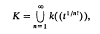
so that K is the field of Puiseux expansions with coefficients in k (each element of K is a formal power series in tl/r for some positive integer r). It is well-known that K is algebraically closed if and only if k is of characteristic zero [1, p. 61]. For examples relating to ramified extensions of fields with valuation [9, §6] it is useful to have a field analogous to K which is algebraically closed when k has non-zero characteristic p. In this paper, I prove that the set L of all formal power series of the form Σaitei (where (ei) is well-ordered, ei = mi|nprt, n ∈ Ζ, mi ∈ Ζ, ai ∈ k, ri ∈ Ν) forms an algebraically closed field.
Generalized Ramsey theory for graphs XII: Bipartite Ramsey sets
-
- Journal:
- Glasgow Mathematical Journal / Volume 22 / Issue 1 / January 1981
- Published online by Cambridge University Press:
- 18 May 2009, pp. 31-41
-
- Article
-
- You have access
- Export citation
Groups of complexes of a representable lattice-ordered group
-
- Journal:
- Glasgow Mathematical Journal / Volume 19 / Issue 2 / July 1978
- Published online by Cambridge University Press:
- 18 May 2009, pp. 135-139
-
- Article
-
- You have access
- Export citation
Proof of a conjecture of Ramanujan
-
- Journal:
- Glasgow Mathematical Journal / Volume 8 / Issue 1 / January 1967
- Published online by Cambridge University Press:
- 18 May 2009, pp. 14-32
-
- Article
-
- You have access
- Export citation
-
We write

and
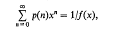
so that p(n) is the number of unrestricted partitions of n. Ramanujan [1] conjectured in 1919 that if q = 5, 7, or 11, and 24m ≡ 1 (mod qn), then p(m) ≡ 0 (mod qn). He proved his conecture for n = 1 and 2†, but it was not until 1938 that Watson [4] proved the conjecture for q = 5 and all n, and a suitably modified form for q = 7 and all n. (Chowla [5] had previously observed that the conjecture failed for q = 7 and n = 3.) Watson's method of modular equations, while theoretically available for the case q = 11, does not seem to be so in practice even with the help of present-day computers. Lehner [6, 7] has developed an essentially different method, which, while not as powerful as Watson's in the cases where Γ0(q) has genus zero, is applicable in principle to all primes q without prohibitive calculation. In particular he proved the conjecture for q = 11 and n = 3 in [7]. Here I shall prove the conjecture for q = 11 and all n, following Lehner's approach rather than Watson's. I also prove the analogous and essentially simpler result for c(m), the Fourier coefficient‡ of Klein's modular invariant j (τ) as
Adjunction of roots to nilpotent groups
-
- Journal:
- Proceedings of the Glasgow Mathematical Association / Volume 7 / Issue 3 / January 1966
- Published online by Cambridge University Press:
- 18 May 2009, pp. 109-118
-
- Article
-
- You have access
- Export citation
GMJ volume 17 issue 2 Cover and Front matter
-
- Journal:
- Glasgow Mathematical Journal / Volume 17 / Issue 2 / July 1976
- Published online by Cambridge University Press:
- 18 May 2009, pp. f1-f2
-
- Article
-
- You have access
- Export citation
Maximal homomorphic images of commutative semigroups
-
- Journal:
- Glasgow Mathematical Journal / Volume 12 / Issue 1 / April 1971
- Published online by Cambridge University Press:
- 18 May 2009, pp. 12-17
-
- Article
-
- You have access
- Export citation
Asymptotic values of meromorphic functions of smooth growth
-
- Journal:
- Glasgow Mathematical Journal / Volume 20 / Issue 2 / July 1979
- Published online by Cambridge University Press:
- 18 May 2009, pp. 155-162
-
- Article
-
- You have access
- Export citation
Rings which resemble rings of entire functions
-
- Journal:
- Glasgow Mathematical Journal / Volume 24 / Issue 1 / January 1983
- Published online by Cambridge University Press:
- 18 May 2009, pp. 7-16
-
- Article
-
- You have access
- Export citation
Primitive skew Laurent polynomial rings
-
- Journal:
- Glasgow Mathematical Journal / Volume 19 / Issue 1 / January 1978
- Published online by Cambridge University Press:
- 18 May 2009, pp. 79-85
-
- Article
-
- You have access
- Export citation
Solvable-by-finite subgroups of GL(2, F)
-
- Journal:
- Glasgow Mathematical Journal / Volume 19 / Issue 1 / January 1978
- Published online by Cambridge University Press:
- 18 May 2009, pp. 45-48
-
- Article
-
- You have access
- Export citation
Applications of the multiplication formula for the gamma function to E-function series
-
- Journal:
- Proceedings of the Glasgow Mathematical Association / Volume 4 / Issue 3 / January 1960
- Published online by Cambridge University Press:
- 18 May 2009, pp. 114-118
-
- Article
-
- You have access
- Export citation
A spectral approach to an integral equation
-
- Journal:
- Glasgow Mathematical Journal / Volume 26 / Issue 1 / January 1985
- Published online by Cambridge University Press:
- 18 May 2009, pp. 83-89
-
- Article
-
- You have access
- Export citation
-
In a recent paper [7], Rooney used a technique involving the Mellin transform to obtain solutions in certain spaces ℒμ, ρ of an integral equation which had been studied previously by Šub-Sizonenko [9]. The integral equation in question can be written as

where I denotes the identity operator and G0.1/2 is given by

with the inversion formula obtained by Rooney taking the form

Rooney verified that (1.1) and (1.2) formed an inversion pair in ℒμ, ρ for 1 ≤ p < ∞ and μ > 0.
Injective endomorphisms and maximal left ideals of left Artinian rings
-
- Journal:
- Glasgow Mathematical Journal / Volume 30 / Issue 2 / May 1988
- Published online by Cambridge University Press:
- 18 May 2009, pp. 195-201
-
- Article
-
- You have access
- Export citation
Tilting modules and a theorem of Hoshino
-
- Journal:
- Glasgow Mathematical Journal / Volume 35 / Issue 1 / January 1993
- Published online by Cambridge University Press:
- 18 May 2009, pp. 69-77
-
- Article
-
- You have access
- Export citation
-
Let k be an algebraically closed field, and A a finite dimensional k-algebra, which we shall assume, without loss of generality, to be basic and connected. By module is meant throughout a finitely generated right A-module. Following Happel and Ringel [10], we shall say that a module Tλ is a tilting (respectively, cotilting) module if it satisfies the following three conditions:
(1)

(2)

(3) the number of non-isomorphic indecomposable summands of T equals the rank of the Grothendieck group K0(A) of A.
