Refine search
Actions for selected content:
9086 results in Discrete Mathematics, Information Theory and Coding
1 - Why Data Structures? A Motivating Example
-
- Book:
- Basic Concepts in Data Structures
- Published online:
- 10 November 2016
- Print publication:
- 27 October 2016, pp 1-13
-
- Chapter
- Export citation
Contents
-
- Book:
- Basic Concepts in Data Structures
- Published online:
- 10 November 2016
- Print publication:
- 27 October 2016, pp v-viii
-
- Chapter
- Export citation
6 - B-Trees
-
- Book:
- Basic Concepts in Data Structures
- Published online:
- 10 November 2016
- Print publication:
- 27 October 2016, pp 83-100
-
- Chapter
- Export citation
10 - Sorting
-
- Book:
- Basic Concepts in Data Structures
- Published online:
- 10 November 2016
- Print publication:
- 27 October 2016, pp 152-177
-
- Chapter
- Export citation
PERFECT POWERS THAT ARE SUMS OF CONSECUTIVE CUBES
- Part of
-
- Journal:
- Mathematika / Volume 63 / Issue 1 / 2017
- Published online by Cambridge University Press:
- 05 October 2016, pp. 230-249
- Print publication:
- 2017
-
- Article
- Export citation
-
Euler noted the relation $6^{3}\,=\,3^{3}+4^{3}+5^{3}$ and asked for other instances of cubes that are sums of consecutive cubes. Similar problems have been studied by Cunningham, Catalan, Gennochi, Lucas, Pagliani, Cassels, Uchiyama, Stroeker and Zhongfeng Zhang. In particular, Stroeker determined all squares that can be written as a sum of at most 50 consecutive cubes. We generalize Stroeker’s work by determining all perfect powers that are sums of at most 50 consecutive cubes. Our methods include descent, linear forms in two logarithms and Frey–Hellegouarch curves.
A SIEVE PROBLEM AND ITS APPLICATION
- Part of
-
- Journal:
- Mathematika / Volume 63 / Issue 1 / 2017
- Published online by Cambridge University Press:
- 27 September 2016, pp. 213-229
- Print publication:
- 2017
-
- Article
- Export citation
-
Let $\unicode[STIX]{x1D703}$ be an arithmetic function and let ${\mathcal{B}}$ be the set of positive integers $n=p_{1}^{\unicode[STIX]{x1D6FC}_{1}}\cdots p_{k}^{\unicode[STIX]{x1D6FC}_{k}}$ which satisfy $p_{j+1}\leqslant \unicode[STIX]{x1D703}(p_{1}^{\unicode[STIX]{x1D6FC}_{1}}\cdots p_{j}^{\unicode[STIX]{x1D6FC}_{j}})$ for $0\leqslant j<k$ . We show that ${\mathcal{B}}$ has a natural density, provide a criterion to determine whether this density is positive, and give various estimates for the counting function of ${\mathcal{B}}$ . When $\unicode[STIX]{x1D703}(n)/n$ is non-decreasing, the set ${\mathcal{B}}$ coincides with the set of integers $n$ whose divisors $1=d_{1}<d_{2}<\cdots <d_{\unicode[STIX]{x1D70F}(n)}=n$ satisfy $d_{j+1}\leqslant \unicode[STIX]{x1D703}(d_{j})$ for $1\leqslant j<\unicode[STIX]{x1D70F}(n)$ .


SHIFTED MOMENTS OF $L$ -FUNCTIONS ANDMOMENTS OF THETA FUNCTIONS
- Part of
-
- Journal:
- Mathematika / Volume 63 / Issue 1 / 2017
- Published online by Cambridge University Press:
- 27 September 2016, pp. 196-212
- Print publication:
- 2017
-
- Article
- Export citation
-
Assuming the Riemann Hypothesis, Soundararajan [Ann. of Math. (2) 170 (2009), 981–993] showed that $\int _{0}^{T}|\unicode[STIX]{x1D701}(1/2+\text{i}t)|^{2k}\ll T(\log T)^{k^{2}+\unicode[STIX]{x1D716}}$ . His method was used by Chandee [Q. J. Math.62 (2011), 545–572] to obtain upper bounds for shifted moments of the Riemann Zeta function. Building on these ideas of Chandee and Soundararajan, we obtain, conditionally, upper bounds for shifted moments of Dirichlet $L$ -functions which allow us to derive upper bounds for moments of theta functions.


FORMS OF DIFFERING DEGREES OVER NUMBER FIELDS
- Part of
-
- Journal:
- Mathematika / Volume 63 / Issue 1 / 2017
- Published online by Cambridge University Press:
- 26 September 2016, pp. 92-123
- Print publication:
- 2017
-
- Article
- Export citation
-
Consider a system of polynomials in many variables over the ring of integers of a number field $K$ . We prove an asymptotic formula for the number of integral zeros of this system in homogeneously expanding boxes. As a consequence, any smooth and geometrically integral variety $X\subseteq \mathbb{P}_{K}^{m}$ satisfies the Hasse principle, weak approximation, and the Manin–Peyre conjecture if only its dimension is large enough compared to its degree. This generalizes work of Skinner, who considered the case where all polynomials have the same degree, and recent work of Browning and Heath-Brown, who considered the case where $K=\mathbb{Q}$ . Our main tool is Skinner’s number field version of the Hardy–Littlewood circle method. As a by-product, we point out and correct an error in Skinner’s treatment of the singular integral.


SHAPES OF POLYHEDRA, MIXED VOLUMES AND HYPERBOLIC GEOMETRY
- Part of
-
- Journal:
- Mathematika / Volume 63 / Issue 1 / 2017
- Published online by Cambridge University Press:
- 23 September 2016, pp. 124-183
- Print publication:
- 2017
-
- Article
- Export citation
-
We generalize to higher dimensions the Bavard–Ghys construction of the hyperbolic metric on the space of polygons with fixed directions of edges. The space of convex $d$ -dimensional polyhedra with fixed directions of facet normals has a decomposition into type cones that correspond to different combinatorial types of polyhedra. This decomposition is a subfan of the secondary fan of a vector configuration and can be analyzed with the help of Gale diagrams. We construct a family of quadratic forms on each of the type cones using the theory of mixed volumes. The Alexandrov–Fenchel inequalities ensure that these forms have exactly one positive eigenvalue. This introduces a piecewise hyperbolic structure on the space of similarity classes of polyhedra with fixed directions of facet normals. We show that some of the dihedral angles on the boundary of the resulting cone-manifold are equal to $\unicode[STIX]{x1D70B}/2$ .


CLOSED SETS WITH THE KAKEYA PROPERTY
- Part of
-
- Journal:
- Mathematika / Volume 63 / Issue 1 / 2017
- Published online by Cambridge University Press:
- 23 September 2016, pp. 184-195
- Print publication:
- 2017
-
- Article
- Export citation
-
We say that a planar set $A$ has the Kakeya property if there exist two different positions of $A$ such that $A$ can be continuously moved from the first position to the second within a set of arbitrarily small area. We prove that if $A$ is closed and has the Kakeya property, then the union of the non-trivial connected components of $A$ can be covered by a null set which is either the union of parallel lines or the union of concentric circles. In particular, if $A$ is closed, connected and has the Kakeya property, then $A$ can be covered by a line or a circle.


Saturated Subgraphs of the Hypercube
- Part of
-
- Journal:
- Combinatorics, Probability and Computing / Volume 26 / Issue 1 / January 2017
- Published online by Cambridge University Press:
- 19 September 2016, pp. 52-67
-
- Article
- Export citation
-
We say a graph is (Q n ,Q m )-saturated if it is a maximal Q m -free subgraph of the n-dimensional hypercube Q n . A graph is said to be (Q n ,Q m )-semi-saturated if it is a subgraph of Q n and adding any edge forms a new copy of Q m . The minimum number of edges a (Q n ,Q m )-saturated graph (respectively (Q n ,Q m )-semi-saturated graph) can have is denoted by sat(Q n ,Q m ) (respectively s-sat(Q n ,Q m )). We prove that
for fixed m, disproving a conjecture of Santolupo that, when m=2, this limit is 1/4. Further, we show by a different method that sat(Q n , Q 2)=O(2n ), and that s-sat(Q n , Q m )=O(2n ), for fixed m. We also prove the lower bound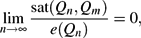 $$\begin{linenomath}\lim_{n\to\infty}\ffrac{\sat(Q_n,Q_m)}{e(Q_n)}=0,\end{linenomath}$$ thus determining sat(Q n ,Q 2) to within a constant factor, and discuss some further questions.
 $$\begin{linenomath}\ssat(Q_n,Q_m)\geq \ffrac{m+1}{2}\cdot 2^n,\end{linenomath}$$
A Sequence of Triangle-Free Pseudorandom Graphs
-
- Journal:
- Combinatorics, Probability and Computing / Volume 26 / Issue 2 / March 2017
- Published online by Cambridge University Press:
- 13 September 2016, pp. 195-200
-
- Article
- Export citation
On the Chromatic Number of Random Cayley Graphs
- Part of
-
- Journal:
- Combinatorics, Probability and Computing / Volume 26 / Issue 2 / March 2017
- Published online by Cambridge University Press:
- 09 September 2016, pp. 248-266
-
- Article
- Export citation
-
Let G be an abelian group of cardinality n, where hcf(n, 6) = 1, and let A be a random subset of G. Form a graph ΓA on vertex set G by joining x to y if and only if x + y ∈ A. Then, with high probability as n → ∞, the chromatic number χ(ΓA ) is at most $(1 + o(1))\tfrac{n}{2\log_2 n}$ . This is asymptotically sharp when G = ℤ/nℤ, n prime.

The Threshold Probability for Long Cycles
- Part of
-
- Journal:
- Combinatorics, Probability and Computing / Volume 26 / Issue 2 / March 2017
- Published online by Cambridge University Press:
- 08 September 2016, pp. 208-247
-
- Article
- Export citation
Triangles in Cartesian Squares of Quasirandom Groups
- Part of
-
- Journal:
- Combinatorics, Probability and Computing / Volume 26 / Issue 2 / March 2017
- Published online by Cambridge University Press:
- 25 August 2016, pp. 161-182
-
- Article
- Export citation
On the Lower Tail Variational Problem for Random Graphs
- Part of
-
- Journal:
- Combinatorics, Probability and Computing / Volume 26 / Issue 2 / March 2017
- Published online by Cambridge University Press:
- 16 August 2016, pp. 301-320
-
- Article
- Export citation
-
We study the lower tail large deviation problem for subgraph counts in a random graph. Let X H denote the number of copies of H in an Erdős–Rényi random graph $\mathcal{G}(n,p)$ . We are interested in estimating the lower tail probability $\mathbb{P}(X_H \le (1-\delta) \mathbb{E} X_H)$ for fixed 0 < δ < 1.
Thanks to the results of Chatterjee, Dembo and Varadhan, this large deviation problem has been reduced to a natural variational problem over graphons, at least for p ≥ n −α H (and conjecturally for a larger range of p). We study this variational problem and provide a partial characterization of the so-called ‘replica symmetric’ phase. Informally, our main result says that for every H, and 0 < δ < δH for some δH > 0, as p → 0 slowly, the main contribution to the lower tail probability comes from Erdős–Rényi random graphs with a uniformly tilted edge density. On the other hand, this is false for non-bipartite H and δ close to 1.

Judicious Partitioning of Hypergraphs with Edges of Size at Most 2†
- Part of
-
- Journal:
- Combinatorics, Probability and Computing / Volume 26 / Issue 2 / March 2017
- Published online by Cambridge University Press:
- 16 August 2016, pp. 267-284
-
- Article
- Export citation
-
Judicious partitioning problems on graphs and hypergraphs ask for partitions that optimize several quantities simultaneously. Let k ≥ 2 be an integer and let G be a hypergraph with m i edges of size i for i=1,2. Bollobás and Scott conjectured that G has a partition into k classes, each of which contains at most $m_1/k+m_2/k^2+O(\sqrt{m_1+m_2})$ edges. In this paper, we confirm the conjecture affirmatively by showing that G has a partition into k classes, each of which contains at most edges. This bound is tight up to O(1).
 $$m_1/k+m_2/k^2+\ffrac{k-1}{2k^2}\sqrt{2(km_1+m_2)}+O(1)$$.
On the Widom–Rowlinson Occupancy Fraction in Regular Graphs
- Part of
-
- Journal:
- Combinatorics, Probability and Computing / Volume 26 / Issue 2 / March 2017
- Published online by Cambridge University Press:
- 09 August 2016, pp. 183-194
-
- Article
- Export citation
RESTRICTED SIMULTANEOUS DIOPHANTINE APPROXIMATION
- Part of
-
- Journal:
- Mathematika / Volume 63 / Issue 1 / 2017
- Published online by Cambridge University Press:
- 26 July 2016, pp. 34-52
- Print publication:
- 2017
-
- Article
- Export citation
-
We study the problem of Diophantine approximation on lines in $\mathbb{R}^{d}$ under certain primality restrictions.

TWO-WEIGHT NORM INEQUALITIES FOR VECTOR-VALUED OPERATORS
- Part of
-
- Journal:
- Mathematika / Volume 63 / Issue 1 / 2017
- Published online by Cambridge University Press:
- 26 July 2016, pp. 72-91
- Print publication:
- 2017
-
- Article
- Export citation
-
We study two-weight norm inequalities for a vector-valued operator from a weighted $L^{p}(\unicode[STIX]{x1D70E})$ -space to mixed norm $L_{l^{s}}^{q}(\unicode[STIX]{x1D707})$ spaces, $1<p<\infty$ , $0<q<p$ . We apply these results to the boundedness of Wolff’s potentials.


