Refine search
Actions for selected content:
9085 results in Discrete Mathematics, Information Theory and Coding
19 - Splitting P(n) as an A2-module
-
- Book:
- Polynomials and the mod 2 Steenrod Algebra
- Published online:
- 04 November 2017
- Print publication:
- 09 November 2017, pp 75-94
-
- Chapter
- Export citation
21 - Endomorphisms of P(n) over A2
-
- Book:
- Polynomials and the mod 2 Steenrod Algebra
- Published online:
- 04 November 2017
- Print publication:
- 09 November 2017, pp 114-137
-
- Chapter
- Export citation
12 - Further structure of A2
-
- Book:
- Polynomials and the mod 2 Steenrod Algebra
- Published online:
- 06 November 2017
- Print publication:
- 09 November 2017, pp 234-253
-
- Chapter
- Export citation
6 - The cohit module Q(n)
-
- Book:
- Polynomials and the mod 2 Steenrod Algebra
- Published online:
- 06 November 2017
- Print publication:
- 09 November 2017, pp 96-122
-
- Chapter
- Export citation
Contents of Volume 2
-
- Book:
- Polynomials and the mod 2 Steenrod Algebra
- Published online:
- 06 November 2017
- Print publication:
- 09 November 2017, pp xi-xiv
-
- Chapter
- Export citation
17 - Irreducible F2GL(n)-modules
-
- Book:
- Polynomials and the mod 2 Steenrod Algebra
- Published online:
- 04 November 2017
- Print publication:
- 09 November 2017, pp 29-52
-
- Chapter
- Export citation
25 - The symmetric hit problem
-
- Book:
- Polynomials and the mod 2 Steenrod Algebra
- Published online:
- 04 November 2017
- Print publication:
- 09 November 2017, pp 204-219
-
- Chapter
- Export citation
Index for Volume 2
-
- Book:
- Polynomials and the mod 2 Steenrod Algebra
- Published online:
- 06 November 2017
- Print publication:
- 09 November 2017, pp 345-346
-
- Chapter
- Export citation
Contents of Volume 1
-
- Book:
- Polynomials and the mod 2 Steenrod Algebra
- Published online:
- 06 November 2017
- Print publication:
- 09 November 2017, pp v-x
-
- Chapter
- Export citation
8 - Special blocks and a basis for Q(3)
-
- Book:
- Polynomials and the mod 2 Steenrod Algebra
- Published online:
- 06 November 2017
- Print publication:
- 09 November 2017, pp 139-163
-
- Chapter
- Export citation
Preface
-
- Book:
- Polynomials and the mod 2 Steenrod Algebra
- Published online:
- 06 November 2017
- Print publication:
- 09 November 2017, pp xv-xxiv
-
- Chapter
- Export citation
Frontmatter
-
- Book:
- Polynomials and the mod 2 Steenrod Algebra
- Published online:
- 04 November 2017
- Print publication:
- 09 November 2017, pp i-iv
-
- Chapter
- Export citation
30 - The 4-variable hit problem, II
-
- Book:
- Polynomials and the mod 2 Steenrod Algebra
- Published online:
- 04 November 2017
- Print publication:
- 09 November 2017, pp 307-334
-
- Chapter
- Export citation
9 - The dual of the hit problem
-
- Book:
- Polynomials and the mod 2 Steenrod Algebra
- Published online:
- 06 November 2017
- Print publication:
- 09 November 2017, pp 164-188
-
- Chapter
- Export citation
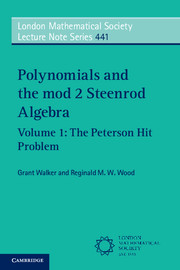
Polynomials and the mod 2 Steenrod Algebra
-
- Published online:
- 06 November 2017
- Print publication:
- 09 November 2017
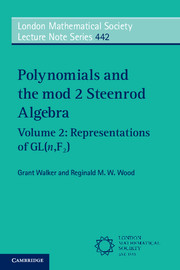
Polynomials and the mod 2 Steenrod Algebra
-
- Published online:
- 04 November 2017
- Print publication:
- 09 November 2017
Induced Turán Numbers
- Part of
-
- Journal:
- Combinatorics, Probability and Computing / Volume 27 / Issue 2 / March 2018
- Published online by Cambridge University Press:
- 02 November 2017, pp. 274-288
-
- Article
- Export citation
New Classes of Degree Sequences with Fast Mixing Swap Markov Chain Sampling
- Part of
-
- Journal:
- Combinatorics, Probability and Computing / Volume 27 / Issue 2 / March 2018
- Published online by Cambridge University Press:
- 02 November 2017, pp. 186-207
-
- Article
- Export citation
Linear Turán Numbers of Linear Cycles and Cycle-Complete Ramsey Numbers
- Part of
-
- Journal:
- Combinatorics, Probability and Computing / Volume 27 / Issue 3 / May 2018
- Published online by Cambridge University Press:
- 02 November 2017, pp. 358-386
-
- Article
- Export citation
-
An r-uniform hypergraph is called an r-graph. A hypergraph is linear if every two edges intersect in at most one vertex. Given a linear r-graph H and a positive integer n, the linear Turán number exL(n,H) is the maximum number of edges in a linear r-graph G that does not contain H as a subgraph. For each ℓ ≥ 3, let Crℓ denote the r-uniform linear cycle of length ℓ, which is an r-graph with edges e1, . . ., eℓ such that, for all i ∈ [ℓ−1], |ei ∩ ei+1|=1, |eℓ ∩ e1|=1 and ei ∩ ej = ∅ for all other pairs {i,j}, i ≠ j. For all r ≥ 3 and ℓ ≥ 3, we show that there exists a positive constant c = cr,ℓ, depending only r and ℓ, such that exL(n,Crℓ) ≤ cn1+1/⌊ℓ/2⌋. This answers a question of Kostochka, Mubayi and Verstraëte [30]. For even ℓ, our result extends the result of Bondy and Simonovits [7] on the Turán numbers of even cycles to linear hypergraphs.
Using our results on linear Turán numbers, we also obtain bounds on the cycle-complete hypergraph Ramsey numbers. We show that there are positive constants a = am,r and b = bm,r, depending only on m and r, such that
 \begin{equation}R(C^r_{2m}, K^r_t)\leq a \Bigl(\frac{t}{\ln t}\Bigr)^{{m}/{(m-1)}}\quad\text{and}\quadR(C^r_{2m+1}, K^r_t)\leq b t^{{m}/{(m-1)}}.\end{equation}
Counting Intersecting and Pairs of Cross-Intersecting Families
- Part of
-
- Journal:
- Combinatorics, Probability and Computing / Volume 27 / Issue 1 / January 2018
- Published online by Cambridge University Press:
- 16 October 2017, pp. 60-68
-
- Article
- Export citation
-
A family of subsets of {1,. . .,n} is called intersecting if any two of its sets intersect. A classical result in extremal combinatorics due to Erdős, Ko and Rado determines the maximum size of an intersecting family of k-subsets of {1,. . .,n}. In this paper we study the following problem: How many intersecting families of k-subsets of {1,. . .,n} are there? Improving a result of Balogh, Das, Delcourt, Liu and Sharifzadeh, we determine this quantity asymptotically for n ≥ 2k+2+2 $\sqrt{k\log k}$ and k → ∞. Moreover, under the same assumptions we also determine asymptotically the number of non-trivial intersecting families, that is, intersecting families for which the intersection of all sets is empty. We obtain analogous results for pairs of cross-intersecting families.

