Refine search
Actions for selected content:
9085 results in Discrete Mathematics, Information Theory and Coding
Monotone Subsequences in High-Dimensional Permutations
- Part of
-
- Journal:
- Combinatorics, Probability and Computing / Volume 27 / Issue 1 / January 2018
- Published online by Cambridge University Press:
- 16 October 2017, pp. 69-83
-
- Article
- Export citation
-
This paper is part of the ongoing effort to study high-dimensional permutations. We prove the analogue to the Erdős–Szekeres theorem: For every k ≥ 1, every order-nk-dimensional permutation contains a monotone subsequence of length Ωk ( $\sqrt{n}$ ), and this is tight. On the other hand, and unlike the classical case, the longest monotone subsequence in a random k-dimensional permutation of order n is asymptotically almost surely Θk (n k/(k+1)).

On Edge-Disjoint Spanning Trees in a Randomly Weighted Complete Graph
- Part of
-
- Journal:
- Combinatorics, Probability and Computing / Volume 27 / Issue 2 / March 2018
- Published online by Cambridge University Press:
- 09 October 2017, pp. 228-244
-
- Article
- Export citation
Uniformly Discrete Forests with Poor Visibility
- Part of
-
- Journal:
- Combinatorics, Probability and Computing / Volume 27 / Issue 4 / July 2018
- Published online by Cambridge University Press:
- 09 October 2017, pp. 442-448
-
- Article
-
- You have access
- Export citation
Colourings of Uniform Hypergraphs with Large Girth and Applications
- Part of
-
- Journal:
- Combinatorics, Probability and Computing / Volume 27 / Issue 2 / March 2018
- Published online by Cambridge University Press:
- 09 October 2017, pp. 245-273
-
- Article
- Export citation
-
This paper deals with a combinatorial problem concerning colourings of uniform hypergraphs with large girth. We prove that if H is an n-uniform non-r-colourable simple hypergraph then its maximum edge degree Δ(H) satisfies the inequality
for some absolute constant c > 0.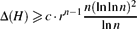 $$\Delta(H)\geqslant c\cdot r^{n-1}\ffrac{n(\ln\ln n)^2}{\ln n}$$
 As an application of our probabilistic technique we establish a lower bound for the classical van der Waerden number W(n, r), the minimum natural N such that in an arbitrary colouring of the set of integers {1,. . .,N} with r colours there exists a monochromatic arithmetic progression of length n. We prove that
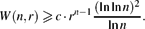 $$W(n,r)\geqslant c\cdot r^{n-1}\ffrac{(\ln\ln n)^2}{\ln n}.$$
A Simple SVD Algorithm for Finding Hidden Partitions
- Part of
-
- Journal:
- Combinatorics, Probability and Computing / Volume 27 / Issue 1 / January 2018
- Published online by Cambridge University Press:
- 09 October 2017, pp. 124-140
-
- Article
- Export citation
Bisections of Graphs Without Short Cycles
- Part of
-
- Journal:
- Combinatorics, Probability and Computing / Volume 27 / Issue 1 / January 2018
- Published online by Cambridge University Press:
- 28 September 2017, pp. 44-59
-
- Article
- Export citation
Erratum For ‘A Bound on the Number of Edges in Graphs Without an Even Cycle’
-
- Journal:
- Combinatorics, Probability and Computing / Volume 26 / Issue 6 / November 2017
- Published online by Cambridge University Press:
- 14 August 2017, pp. 952-953
-
- Article
-
- You have access
- Export citation
-
Due to a calculation error, the constant in the main theorem is not $80 \sqrt{k\log k}$ but $80\sqrt{k} \log k$ . The error was discovered by Xizhi Liu.
For a new discussion on the limit of the method used in this paper see the revised arXiv version of the paper.


The Growth Constant of Odd Cutsets in High Dimensions
- Part of
-
- Journal:
- Combinatorics, Probability and Computing / Volume 27 / Issue 2 / March 2018
- Published online by Cambridge University Press:
- 14 August 2017, pp. 208-227
-
- Article
- Export citation
Triangle-Free Subgraphs of Random Graphs
- Part of
-
- Journal:
- Combinatorics, Probability and Computing / Volume 27 / Issue 2 / March 2018
- Published online by Cambridge University Press:
- 14 August 2017, pp. 141-161
-
- Article
- Export citation
Generalized Majority Colourings of Digraphs
- Part of
-
- Journal:
- Combinatorics, Probability and Computing / Volume 26 / Issue 6 / November 2017
- Published online by Cambridge University Press:
- 14 August 2017, pp. 850-855
-
- Article
- Export citation
Minimizing the Number of Triangular Edges
- Part of
-
- Journal:
- Combinatorics, Probability and Computing / Volume 27 / Issue 4 / July 2018
- Published online by Cambridge University Press:
- 14 August 2017, pp. 580-622
-
- Article
- Export citation
Anagram-Free Colourings of Graphs
- Part of
-
- Journal:
- Combinatorics, Probability and Computing / Volume 27 / Issue 4 / July 2018
- Published online by Cambridge University Press:
- 08 August 2017, pp. 623-642
-
- Article
- Export citation
Diameter of the Stochastic Mean-Field Model of Distance
- Part of
-
- Journal:
- Combinatorics, Probability and Computing / Volume 26 / Issue 6 / November 2017
- Published online by Cambridge University Press:
- 07 August 2017, pp. 797-825
-
- Article
- Export citation
Exact Minimum Codegree Threshold for K − 4-Factors
-
- Journal:
- Combinatorics, Probability and Computing / Volume 26 / Issue 6 / November 2017
- Published online by Cambridge University Press:
- 04 August 2017, pp. 856-885
-
- Article
- Export citation
Packing Loose Hamilton Cycles
-
- Journal:
- Combinatorics, Probability and Computing / Volume 26 / Issue 6 / November 2017
- Published online by Cambridge University Press:
- 01 August 2017, pp. 839-849
-
- Article
- Export citation
-
A subset C of edges in a k-uniform hypergraph H is a loose Hamilton cycle if C covers all the vertices of H and there exists a cyclic ordering of these vertices such that the edges in C are segments of that order and such that every two consecutive edges share exactly one vertex. The binomial random k-uniform hypergraph H k n,p has vertex set [n] and an edge set E obtained by adding each k-tuple e ∈ ( $\binom{[n]}{k}$ ) to E with probability p, independently at random.
Here we consider the problem of finding edge-disjoint loose Hamilton cycles covering all but o(|E|) edges, referred to as the packing problem. While it is known that the threshold probability of the appearance of a loose Hamilton cycle in H k n,p is
the best known bounds for the packing problem are around p = polylog(n)/n. Here we make substantial progress and prove the following asymptotically (up to a polylog(n) factor) best possible result: for p ≥ logC n/n k−1, a random k-uniform hypergraph H k n,p with high probability contains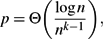 $p=\Theta\biggl(\frac{\log n}{n^{k-1}}\biggr),$ edge-disjoint loose Hamilton cycles.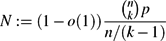 $N:=(1-o(1))\frac{\binom{n}{k}p}{n/(k-1)}$
 Our proof utilizes and modifies the idea of ‘online sprinkling’ recently introduced by Vu and the first author.

Super-Exponential Extinction Time of the Contact Process on Random Geometric Graphs
-
- Journal:
- Combinatorics, Probability and Computing / Volume 27 / Issue 2 / March 2018
- Published online by Cambridge University Press:
- 01 August 2017, pp. 162-185
-
- Article
- Export citation
Correlation Bounds for Distant Parts of Factor of IID Processes
-
- Journal:
- Combinatorics, Probability and Computing / Volume 27 / Issue 1 / January 2018
- Published online by Cambridge University Press:
- 01 August 2017, pp. 1-20
-
- Article
- Export citation
-
We study factor of i.i.d. processes on the d-regular tree for d ≥ 3. We show that if such a process is restricted to two distant connected subgraphs of the tree, then the two parts are basically uncorrelated. More precisely, any functions of the two parts have correlation at most $k(d-1) / (\sqrt{d-1})^k$ , where k denotes the distance between the subgraphs. This result can be considered as a quantitative version of the fact that factor of i.i.d. processes have trivial 1-ended tails.
Induced Subgraphs With Many Distinct Degrees
- Part of
-
- Journal:
- Combinatorics, Probability and Computing / Volume 27 / Issue 1 / January 2018
- Published online by Cambridge University Press:
- 01 August 2017, pp. 110-123
-
- Article
- Export citation
Corrigendum to ‘Mixing, Communication Complexity and Conjectures of Gowers and Viola’
-
- Journal:
- Combinatorics, Probability and Computing / Volume 26 / Issue 6 / November 2017
- Published online by Cambridge University Press:
- 01 August 2017, pp. 954-955
-
- Article
-
- You have access
- Export citation
Asymptotic Enumeration of Difference Matrices over Cyclic Groups
-
- Journal:
- Combinatorics, Probability and Computing / Volume 27 / Issue 1 / January 2018
- Published online by Cambridge University Press:
- 01 August 2017, pp. 84-109
-
- Article
- Export citation
