Refine search
Actions for selected content:
9085 results in Discrete Mathematics, Information Theory and Coding
Frank Ramsey
-
- Journal:
- Combinatorics, Probability and Computing / Volume 12 / Issue 5-6 / November 2003
- Published online by Cambridge University Press:
- 25 May 2017, pp. 469-475
-
- Article
-
- You have access
- Export citation
Special Issue on Ramsey Theory
-
- Journal:
- Combinatorics, Probability and Computing / Volume 12 / Issue 5-6 / November 2003
- Published online by Cambridge University Press:
- 25 May 2017, p. 467
-
- Article
- Export citation
The Proofs of Two Directed Paths Conjectures of Bollobás and Leader
- Part of
-
- Journal:
- Combinatorics, Probability and Computing / Volume 26 / Issue 5 / September 2017
- Published online by Cambridge University Press:
- 22 May 2017, pp. 762-774
-
- Article
- Export citation
Mixing in High-Dimensional Expanders
-
- Journal:
- Combinatorics, Probability and Computing / Volume 26 / Issue 5 / September 2017
- Published online by Cambridge University Press:
- 17 May 2017, pp. 746-761
-
- Article
- Export citation
Bridge-Addability, Edge-Expansion and Connectivity
- Part of
-
- Journal:
- Combinatorics, Probability and Computing / Volume 26 / Issue 5 / September 2017
- Published online by Cambridge University Press:
- 11 May 2017, pp. 697-719
-
- Article
- Export citation
Comparing Graphs of Different Sizes
- Part of
-
- Journal:
- Combinatorics, Probability and Computing / Volume 26 / Issue 5 / September 2017
- Published online by Cambridge University Press:
- 02 May 2017, pp. 681-696
-
- Article
- Export citation
Sets in Almost General Position
- Part of
-
- Journal:
- Combinatorics, Probability and Computing / Volume 26 / Issue 5 / September 2017
- Published online by Cambridge University Press:
- 18 April 2017, pp. 720-745
-
- Article
- Export citation
CPC volume 24 issue 1 Cover and Front matter
-
- Journal:
- Combinatorics, Probability and Computing / Volume 24 / Issue 1 / January 2015
- Published online by Cambridge University Press:
- 08 April 2017, pp. f1-f2
-
- Article
-
- You have access
- Export citation
CPC volume 24 issue 1 Cover and Back matter
-
- Journal:
- Combinatorics, Probability and Computing / Volume 24 / Issue 1 / January 2015
- Published online by Cambridge University Press:
- 08 April 2017, pp. b1-b3
-
- Article
-
- You have access
- Export citation
Stability and Turán Numbers of a Class of Hypergraphs via Lagrangians
- Part of
-
- Journal:
- Combinatorics, Probability and Computing / Volume 26 / Issue 3 / May 2017
- Published online by Cambridge University Press:
- 29 March 2017, pp. 367-405
-
- Article
- Export citation
-
Given a family of r-uniform hypergraphs ${\cal F}$ (or r-graphs for brevity), the Turán number ex(n, ${\cal F})$ of ${\cal F}$ is the maximum number of edges in an r-graph on n vertices that does not contain any member of ${\cal F}$ . A pair {u,v} is covered in a hypergraph G if some edge of G contains {u, v}. Given an r-graph F and a positive integer p ⩾ n(F), where n(F) denotes the number of vertices in F, let HFp denote the r-graph obtained as follows. Label the vertices of F as v 1,. . .,vn (F). Add new vertices vn(F)+1 ,. . .,vp . For each pair of vertices vi, vj not covered in F, add a set Bi,j of r − 2 new vertices and the edge {vi, vj } ∪ Bi,j , where the Bi,j are pairwise disjoint over all such pairs {i, j}. We call HFp the expanded p-clique with an embedded F. For a relatively large family of F, we show that for all sufficiently large n, ex(n,HFp ) = |Tr (n, p − 1)|, where Tr (n, p − 1) is the balanced complete (p − 1)-partite r-graph on n vertices. We also establish structural stability of near-extremal graphs. Our results generalize or strengthen several earlier results and provide a class of hypergraphs for which the Turán number is exactly determined (for large n).

An Inequality for Functions on the Hamming Cube
- Part of
-
- Journal:
- Combinatorics, Probability and Computing / Volume 26 / Issue 3 / May 2017
- Published online by Cambridge University Press:
- 29 March 2017, pp. 468-480
-
- Article
- Export citation
Erdős–Ko–Rado for Random Hypergraphs: Asymptotics and Stability
- Part of
-
- Journal:
- Combinatorics, Probability and Computing / Volume 26 / Issue 3 / May 2017
- Published online by Cambridge University Press:
- 29 March 2017, pp. 406-422
-
- Article
- Export citation
-
We investigate the asymptotic version of the Erdős–Ko–Rado theorem for the random k-uniform hypergraph $\mathcal{H}$ k (n, p). For 2⩽k(n) ⩽ n/2, let $N=\binom{n}k$ and $D=\binom{n-k}k$ . We show that with probability tending to 1 as n → ∞, the largest intersecting subhypergraph of $\mathcal{H}$ has size for any
 $$(1+o(1))p\ffrac kn N$$ This lower bound on p is asymptotically best possible for k = Θ(n). For this range of k and p, we are able to show stability as well.
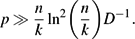 $$p\gg \ffrac nk\ln^2\biggl(\ffrac nk\biggr)D^{-1}.$$
 A different behaviour occurs when k = o(n). In this case, the lower bound on p is almost optimal. Further, for the small interval D −1 ≪ p ⩽ (n/k)1−ϵ D −1, the largest intersecting subhypergraph of
$\mathcal{H}$ k (n, p) has size Θ(ln(pD)ND −1), provided that  $k \gg \sqrt{n \ln n}$ .
Together with previous work of Balogh, Bohman and Mubayi, these results settle the asymptotic size of the largest intersecting family in
$\mathcal{H}$ k , for essentially all values of p and k.


Simply Generated Non-Crossing Partitions
-
- Journal:
- Combinatorics, Probability and Computing / Volume 26 / Issue 4 / July 2017
- Published online by Cambridge University Press:
- 28 March 2017, pp. 560-592
-
- Article
- Export citation
On Regularity Lemmas and their Algorithmic Applications
-
- Journal:
- Combinatorics, Probability and Computing / Volume 26 / Issue 4 / July 2017
- Published online by Cambridge University Press:
- 28 March 2017, pp. 481-505
-
- Article
- Export citation
Uniform s-Cross-Intersecting Families
-
- Journal:
- Combinatorics, Probability and Computing / Volume 26 / Issue 4 / July 2017
- Published online by Cambridge University Press:
- 28 March 2017, pp. 517-524
-
- Article
- Export citation
-
In this paper we study a question related to the classical Erdős–Ko–Rado theorem, which states that any family of k-element subsets of the set [n] = {1,. . .,n} in which any two sets intersect has cardinality at most $\binom{n-1}{k-1}$ .
We say that two non-empty families ${\mathcal A}, {\mathcal B}\subset \binom{[n]}{k}$ are s-cross-intersecting if, for any A ∈ ${\mathcal A}$ , B ∈ ${\mathcal B}$ , we have |A ∩ B| ≥ s. In this paper we determine the maximum of | ${\mathcal A}$ |+| ${\mathcal B}$ | for all n. This generalizes a result of Hilton and Milner, who determined the maximum of | ${\mathcal A}$ |+| ${\mathcal B}$ | for non-empty 1-cross-intersecting families.


Minimum Codegree Threshold for C 6 3-Factors in 3-Uniform Hypergraphs
-
- Journal:
- Combinatorics, Probability and Computing / Volume 26 / Issue 4 / July 2017
- Published online by Cambridge University Press:
- 22 March 2017, pp. 536-559
-
- Article
- Export citation
Surprise Probabilities in Markov Chains
- Part of
-
- Journal:
- Combinatorics, Probability and Computing / Volume 26 / Issue 4 / July 2017
- Published online by Cambridge University Press:
- 16 March 2017, pp. 603-627
-
- Article
- Export citation
-
In a Markov chain started at a state x, the hitting time τ(y) is the first time that the chain reaches another state y. We study the probability $\mathbb{P}_x(\tau(y) = t)$ that the first visit to y occurs precisely at a given time t. Informally speaking, the event that a new state is visited at a large time t may be considered a ‘surprise’. We prove the following three bounds.
-
• In any Markov chain with n states, $\mathbb{P}_x(\tau(y) = t) \le {n}/{t}$ .
 -
• In a reversible chain with n states, $\mathbb{P}_x(\tau(y) = t) \le {\sqrt{2n}}/{t}$ for $t \ge 4n + 4$ .
 -
• For random walk on a simple graph with n ≥ 2 vertices, $\mathbb{P}_x(\tau(y) = t) \le 4e \log(n)/t$ .
To prove the bound for random walk on graphs, we establish the following estimate conjectured by Aldous, Ding and Oveis-Gharan (private communication): for random walk on an n-vertex graph, for every initial vertex x,
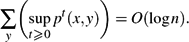 $$\sum_y \biggl( \sup_{t \ge 0} p^t(x, y) \biggr) = O(\log n). $$
 -

A Stability Result for Families with Fixed Diameter
- Part of
-
- Journal:
- Combinatorics, Probability and Computing / Volume 26 / Issue 4 / July 2017
- Published online by Cambridge University Press:
- 06 March 2017, pp. 506-516
-
- Article
- Export citation
-
Let $\mathcal F$ ⊂ 2[n] be a family of subsets. The diameter of $\mathcal F$ is the maximum of the size of symmetric differences among pairs of members of $\mathcal F$ . In 1966 Kleitman determined the maximum of | $\mathcal F$ | for fixed diameter. However, this important classical result lacked a characterization of the families meeting the bound. This is remedied in the present paper, where a best possible stability result is established as well.
In Section 4 we introduce a ‘parity trick’ that provides an easy way of deducing the odd case from the even case in both Kleitman's original theorem and its stability version.

Forbidden Hypermatrices Imply General Bounds on Induced Forbidden Subposet Problems
-
- Journal:
- Combinatorics, Probability and Computing / Volume 26 / Issue 4 / July 2017
- Published online by Cambridge University Press:
- 15 February 2017, pp. 593-602
-
- Article
- Export citation
-
We prove that for every poset P, there is a constant CP such that the size of any family of subsets of {1, 2, . . ., n} that does not contain P as an induced subposet is at most
settling a conjecture of Katona, and Lu and Milans. We obtain this bound by establishing a connection to the theory of forbidden submatrices and then applying a higher-dimensional variant of the Marcus–Tardos theorem, proved by Klazar and Marcus. We also give a new proof of their result. $$C_P{\binom{n}{\lfloor\gfrac{n}{2}\rfloor}},$$

A Rainbow r-Partite Version of the Erdős–Ko–Rado Theorem
- Part of
-
- Journal:
- Combinatorics, Probability and Computing / Volume 26 / Issue 3 / May 2017
- Published online by Cambridge University Press:
- 23 January 2017, pp. 321-337
-
- Article
- Export citation
