Refine search
Actions for selected content:
6997 results in Mathematical modeling and methods
BOUNDS ON THE CRITICAL TIMES FOR THE GENERAL FISHER–KPP EQUATION
- Part of
-
- Journal:
- The ANZIAM Journal / Volume 63 / Issue 4 / October 2021
- Published online by Cambridge University Press:
- 02 November 2021, pp. 448-468
-
- Article
- Export citation
IDEAL PLANAR FLUID FLOW OVER A SUBMERGED OBSTACLE: REVIEW AND EXTENSION
- Part of
-
- Journal:
- The ANZIAM Journal / Volume 63 / Issue 4 / October 2021
- Published online by Cambridge University Press:
- 25 October 2021, pp. 377-419
-
- Article
- Export citation
ANZ VOLUME 63 ISSUE 3 COVER AND FRONT MATTER
-
- Journal:
- The ANZIAM Journal / Volume 63 / Issue 3 / July 2021
- Published online by Cambridge University Press:
- 06 October 2021, pp. f1-f2
-
- Article
-
- You have access
- Export citation
ANZ VOLUME 63 ISSUE 3 COVER AND BACK MATTER
-
- Journal:
- The ANZIAM Journal / Volume 63 / Issue 3 / July 2021
- Published online by Cambridge University Press:
- 06 October 2021, pp. b1-b6
-
- Article
-
- You have access
- Export citation
INTERACTION OF A SINGULAR SURFACE WITH A STRONG SHOCK IN THE INTERSTELLAR GAS CLOUDS
-
- Journal:
- The ANZIAM Journal / Volume 63 / Issue 3 / July 2021
- Published online by Cambridge University Press:
- 23 September 2021, pp. 342-358
-
- Article
- Export citation
ANZ VOLUME 63 ISSUE 2 COVER AND BACK MATTER
-
- Journal:
- The ANZIAM Journal / Volume 63 / Issue 2 / April 2021
- Published online by Cambridge University Press:
- 23 September 2021, pp. b1-b6
-
- Article
-
- You have access
- Export citation
A REVIEW OF ONE-PHASE HELE-SHAW FLOWS AND A LEVEL-SET METHOD FOR NONSTANDARD CONFIGURATIONS
- Part of
-
- Journal:
- The ANZIAM Journal / Volume 63 / Issue 3 / July 2021
- Published online by Cambridge University Press:
- 23 September 2021, pp. 269-307
-
- Article
- Export citation
EDITORIAL: SPECIAL ISSUE ON FINANCIAL MATHEMATICS AND QUANTITATIVE FINANCE
-
- Journal:
- The ANZIAM Journal / Volume 63 / Issue 2 / April 2021
- Published online by Cambridge University Press:
- 23 September 2021, pp. 101-103
-
- Article
-
- You have access
- HTML
- Export citation
ANZ VOLUME 63 ISSUE 2 COVER AND FRONT MATTER
-
- Journal:
- The ANZIAM Journal / Volume 63 / Issue 2 / April 2021
- Published online by Cambridge University Press:
- 23 September 2021, pp. f1-f2
-
- Article
-
- You have access
- Export citation
ALGORITHM TO CONSTRUCT INTEGRO SPLINES
- Part of
-
- Journal:
- The ANZIAM Journal / Volume 63 / Issue 3 / July 2021
- Published online by Cambridge University Press:
- 13 September 2021, pp. 359-375
-
- Article
- Export citation
-
We study some properties of integro splines. Using these properties, we design an algorithm to construct splines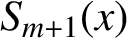 $S_{m+1}(x)$ of neighbouring degrees to the given spline $S_m(x)$ with degree m. A local integro-sextic spline is constructed with the proposed algorithm. The local integro splines work efficiently, that is, they have low computational complexity, and they are effective for use in real time. The construction of nonlocal integro splines usually leads to solving a system of linear equations with band matrices, which yields high computational costs.

ON OPTIMAL THRESHOLDS FOR PAIRS TRADING IN A ONE-DIMENSIONAL DIFFUSION MODEL
- Part of
-
- Journal:
- The ANZIAM Journal / Volume 63 / Issue 2 / April 2021
- Published online by Cambridge University Press:
- 07 September 2021, pp. 104-122
-
- Article
-
- You have access
- Open access
- HTML
- Export citation
AN ANALYTICAL APPROXIMATION FORMULA FOR THE PRICING OF CREDIT DEFAULT SWAPS WITH REGIME SWITCHING
- Part of
-
- Journal:
- The ANZIAM Journal / Volume 63 / Issue 2 / April 2021
- Published online by Cambridge University Press:
- 02 September 2021, pp. 143-162
-
- Article
- Export citation
SPECTRALLY ACCURATE OPTION PRICING UNDER THE TIME-FRACTIONAL BLACK–SCHOLES MODEL
- Part of
-
- Journal:
- The ANZIAM Journal / Volume 63 / Issue 2 / April 2021
- Published online by Cambridge University Press:
- 25 August 2021, pp. 228-248
-
- Article
- Export citation
-
We propose a Legendre–Laguerre spectral approximation to price the European and double barrier options in the time-fractional framework. By choosing an appropriate basis function, the spectral discretization is used for the approximation of the spatial derivatives of the time-fractional Black–Scholes equation. For the time discretization, we consider the popular $L1$ finite difference approximation, which converges with order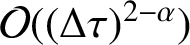 $\mathcal {O}((\Delta \tau )^{2-\alpha })$ for functions which are twice continuously differentiable. However, when using the $L1$ scheme for problems with nonsmooth initial data, only the first-order accuracy in time is achieved. This low-order accuracy is also observed when solving the time-fractional Black–Scholes European and barrier option pricing problems for which the payoffs are all nonsmooth. To increase the temporal convergence rate, we therefore consider a Richardson extrapolation method, which when combined with the spectral approximation in space, exhibits higher order convergence such that high accuracies over the whole discretization grid are obtained. Compared with the traditional finite difference scheme, numerical examples clearly indicate that the spectral approximation converges exponentially over a small number of grid points. Also, as demonstrated, such high accuracies can be achieved in much fewer time steps using the extrapolation approach.


AN ANALYTICAL OPTION PRICING FORMULA FOR MEAN-REVERTING ASSET WITH TIME-DEPENDENT PARAMETER
- Part of
-
- Journal:
- The ANZIAM Journal / Volume 63 / Issue 2 / April 2021
- Published online by Cambridge University Press:
- 23 August 2021, pp. 178-202
-
- Article
- Export citation
PRICING TIMER OPTIONS: SECOND-ORDER MULTISCALE STOCHASTIC VOLATILITY ASYMPTOTICS
- Part of
-
- Journal:
- The ANZIAM Journal / Volume 63 / Issue 2 / April 2021
- Published online by Cambridge University Press:
- 23 August 2021, pp. 249-267
-
- Article
- Export citation
FINITE MATURITY AMERICAN-STYLE STOCK LOANS WITH REGIME-SWITCHING VOLATILITY
- Part of
-
- Journal:
- The ANZIAM Journal / Volume 63 / Issue 2 / April 2021
- Published online by Cambridge University Press:
- 19 August 2021, pp. 163-177
-
- Article
- Export citation
LOCALIZED RADIAL BASIS FUNCTIONS FOR NO-ARBITRAGE PRICING OF OPTIONS UNDER STOCHASTIC ALPHA–BETA–RHO DYNAMICS
- Part of
-
- Journal:
- The ANZIAM Journal / Volume 63 / Issue 2 / April 2021
- Published online by Cambridge University Press:
- 19 August 2021, pp. 203-227
-
- Article
- Export citation
OPTION PRICING UNDER THE FRACTIONAL STOCHASTIC VOLATILITY MODEL
- Part of
-
- Journal:
- The ANZIAM Journal / Volume 63 / Issue 2 / April 2021
- Published online by Cambridge University Press:
- 13 August 2021, pp. 123-142
-
- Article
- Export citation
A NOTE ON THE AXISYMMETRIC DIFFUSION EQUATION
- Part of
-
- Journal:
- The ANZIAM Journal / Volume 63 / Issue 3 / July 2021
- Published online by Cambridge University Press:
- 21 July 2021, pp. 333-341
-
- Article
- Export citation
-
We consider the explicit solution to the axisymmetric diffusion equation. We recast the solution in the form of a Mellin inversion formula, and outline a method to compute a formula for $u(r,t)$ as a series using the Cauchy residue theorem. As a consequence, we are able to represent the solution to the axisymmetric diffusion equation as a rapidly converging series.

OPTIMAL PORTFOLIO AND CONSUMPTION FOR A MARKOVIAN REGIME-SWITCHING JUMP-DIFFUSION PROCESS
- Part of
-
- Journal:
- The ANZIAM Journal / Volume 63 / Issue 3 / July 2021
- Published online by Cambridge University Press:
- 21 July 2021, pp. 308-332
-
- Article
- Export citation
