Refine search
Actions for selected content:
6993 results in Mathematical modeling and methods
Flowshop/no-idle scheduling to minimise the mean flowtime
-
- Journal:
- The ANZIAM Journal / Volume 47 / Issue 2 / October 2005
- Published online by Cambridge University Press:
- 17 February 2009, pp. 265-275
-
- Article
-
- You have access
- Export citation
ANZ volume 29 issue 3 Cover and Back matter
-
- Journal:
- Journal of the Australian Mathematical Society. Series B. Applied Mathematics / Volume 29 / Issue 3 / January 1988
- Published online by Cambridge University Press:
- 17 February 2009, pp. b1-b2
-
- Article
-
- You have access
- Export citation
Ship bows with contiunous and splashless flow attachment
-
- Journal:
- Journal of the Australian Mathematical Society. Series B. Applied Mathematics / Volume 27 / Issue 4 / April 1986
- Published online by Cambridge University Press:
- 17 February 2009, pp. 442-452
-
- Article
-
- You have access
- Export citation
Two-dimensional resonators with small openings
-
- Journal:
- Journal of the Australian Mathematical Society. Series B. Applied Mathematics / Volume 24 / Issue 1 / July 1982
- Published online by Cambridge University Press:
- 17 February 2009, pp. 2-27
-
- Article
-
- You have access
- Export citation
Inversion of the Struve transform of half integer order
-
- Journal:
- Journal of the Australian Mathematical Society. Series B. Applied Mathematics / Volume 25 / Issue 2 / October 1983
- Published online by Cambridge University Press:
- 17 February 2009, pp. 161-174
-
- Article
-
- You have access
- Export citation
-
Defining a spherical Struve function
 we show that the Struve transform of half integer order, or spherical Struve transform,
where n is a non-negative integer, may under suitable conditions be solved for f(t):

where
 is the sum of the first n + 1 terms in the asymptotic expansion of φn(x) as x → ∞. The coefficients in the asymptotic expansion are identified as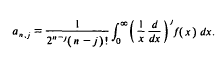
It is further shown that functions φn (x) which are representable as spherical Struve transforms satisfy n + 1 integral constraints, which in turn allow the construction of many equivalent inversion formulae.
 we show that the Struve transform of half integer order, or spherical Struve transform,
 is the sum of the first
Stiff systems of ordinary differential equations. III. Partially stiff systems
-
- Journal:
- Journal of the Australian Mathematical Society. Series B. Applied Mathematics / Volume 23 / Issue 3 / January 1982
- Published online by Cambridge University Press:
- 17 February 2009, pp. 310-331
-
- Article
-
- You have access
- Export citation
-
The partially stiff system of ordinary differential equations

is studied by the methods developed in the earlier papers in this series. Here e is a small positive parameter, x and y are n- and m-vectors respectively, and A is nonsingular. A useful basis for the solution space of the homogeneous system is constructed and the method of variation of parameters is used to obtain useful representations of all solutions. Sufficient conditions are derived under which the formal approximation

is close to the actual solution. it is found that purely imaginary eigenvalues for A require more stringent requirements for the formal technique to be valid. A brief discussion of the case when A is singular shows that there are a great number of possibilities requiring consideration for a general theory. it is suggested that local computation of such cases is likely to be the most effective weapon for any specific system.


A convergence theorem for singular integral equations
-
- Journal:
- Journal of the Australian Mathematical Society. Series B. Applied Mathematics / Volume 22 / Issue 4 / April 1981
- Published online by Cambridge University Press:
- 17 February 2009, pp. 539-552
-
- Article
-
- You have access
- Export citation
ANZ volume 43 issue 3 Cover and Front matter
-
- Journal:
- The ANZIAM Journal / Volume 43 / Issue 3 / January 2002
- Published online by Cambridge University Press:
- 17 February 2009, pp. f1-f4
-
- Article
-
- You have access
- Export citation
Synthesis of layered shells from a finite set of viscoelastic materials
-
- Journal:
- Journal of the Australian Mathematical Society. Series B. Applied Mathematics / Volume 40 / Issue 4 / April 1999
- Published online by Cambridge University Press:
- 17 February 2009, pp. 525-534
-
- Article
-
- You have access
- Export citation
Two infinite-Froude-number cusped free-surface flows due to a submerged line source or sink
-
- Journal:
- Journal of the Australian Mathematical Society. Series B. Applied Mathematics / Volume 28 / Issue 2 / October 1986
- Published online by Cambridge University Press:
- 17 February 2009, pp. 260-270
-
- Article
-
- You have access
- Export citation
General iterative methods for nonlinear boundary value problems
-
- Journal:
- Journal of the Australian Mathematical Society. Series B. Applied Mathematics / Volume 37 / Issue 1 / July 1995
- Published online by Cambridge University Press:
- 17 February 2009, pp. 58-85
-
- Article
-
- You have access
- Export citation
Eigenvalue characterization for (n · p) boundary-value problems
-
- Journal:
- Journal of the Australian Mathematical Society. Series B. Applied Mathematics / Volume 39 / Issue 3 / January 1998
- Published online by Cambridge University Press:
- 17 February 2009, pp. 386-407
-
- Article
-
- You have access
- Export citation
-
We consider the (n, p) boundary value problem

where λ > 0 and 0 ≤ p ≤ n - l is fixed. We characterize the values of λ such that the boundary value problem has a positive solution. For the special case λ = l, we also offer sufficient conditions for the existence of positive solutions of the boundary value problem.
Numerical integration of the RLW equation using cubic splines
-
- Journal:
- The ANZIAM Journal / Volume 47 / Issue 1 / July 2005
- Published online by Cambridge University Press:
- 17 February 2009, pp. 131-142
-
- Article
-
- You have access
- Export citation
Series operations using minimum storage
-
- Journal:
- Journal of the Australian Mathematical Society. Series B. Applied Mathematics / Volume 21 / Issue 1 / April 1979
- Published online by Cambridge University Press:
- 17 February 2009, pp. 84-89
-
- Article
-
- You have access
- Export citation
The commutation relation i[Y, Z] = 2Y and the absolutely continuous spectrum of Y
-
- Journal:
- Journal of the Australian Mathematical Society. Series B. Applied Mathematics / Volume 23 / Issue 4 / April 1982
- Published online by Cambridge University Press:
- 17 February 2009, pp. 420-427
-
- Article
-
- You have access
- Export citation
-
A relation between positive commutators and absolutely continuous spectrum is obtained. If i[Y, Z] = 2Y holds on a core for Z and if Y is positive then we have a system of imprimitivity for the group
 on , from which it follows that Y has no singular continuous spectrum.
 on
on The sputtering temperature of a cooling cylindrical rod without and with an insulated core in a two-fluid medium
-
- Journal:
- Journal of the Australian Mathematical Society. Series B. Applied Mathematics / Volume 38 / Issue 1 / July 1996
- Published online by Cambridge University Press:
- 17 February 2009, pp. 87-100
-
- Article
-
- You have access
- Export citation
The transition through resonance of a nonlinear non-autonomous system
-
- Journal:
- Journal of the Australian Mathematical Society. Series B. Applied Mathematics / Volume 34 / Issue 1 / July 1992
- Published online by Cambridge University Press:
- 17 February 2009, pp. 81-111
-
- Article
-
- You have access
- Export citation
A robust linearisation scheme for a nonlinear elliptic boundary value problem: Error estimates
-
- Journal:
- The ANZIAM Journal / Volume 46 / Issue 4 / April 2005
- Published online by Cambridge University Press:
- 17 February 2009, pp. 449-470
-
- Article
-
- You have access
- Export citation
Computer-controlled variable-structure systems
-
- Journal:
- Journal of the Australian Mathematical Society. Series B. Applied Mathematics / Volume 34 / Issue 1 / July 1992
- Published online by Cambridge University Press:
- 17 February 2009, pp. 1-17
-
- Article
-
- You have access
- Export citation
New algorithms for discrete-time optimal control problems
-
- Journal:
- Journal of the Australian Mathematical Society. Series B. Applied Mathematics / Volume 26 / Issue 2 / October 1984
- Published online by Cambridge University Press:
- 17 February 2009, pp. 129-145
-
- Article
-
- You have access
- Export citation
