Refine listing
Actions for selected content:
2837 results in 11xxx
Construction of mixed automorphic forms
- Part of
-
- Journal:
- Journal of the Australian Mathematical Society. Series A. Pure Mathematics and Statistics / Volume 63 / Issue 3 / December 1997
- Published online by Cambridge University Press:
- 09 April 2009, pp. 390-395
- Print publication:
- December 1997
-
- Article
-
- You have access
- Export citation
Universal positive quaternary quadratic lattices over totally real number fields
- Part of
-
- Journal:
- Mathematika / Volume 44 / Issue 2 / December 1997
- Published online by Cambridge University Press:
- 26 February 2010, pp. 342-347
- Print publication:
- December 1997
-
- Article
- Export citation
Almost-prime k-tuples
- Part of
-
- Journal:
- Mathematika / Volume 44 / Issue 2 / December 1997
- Published online by Cambridge University Press:
- 26 February 2010, pp. 245-266
- Print publication:
- December 1997
-
- Article
- Export citation
On a conjecture of Crittenden and Vanden Eynden concerning coverings by arithmetic progressions
- Part of
-
- Journal:
- Journal of the Australian Mathematical Society. Series A. Pure Mathematics and Statistics / Volume 63 / Issue 3 / December 1997
- Published online by Cambridge University Press:
- 09 April 2009, pp. 396-420
- Print publication:
- December 1997
-
- Article
-
- You have access
- Export citation
Integer points on algebraic curves with exceptional units
- Part of
-
- Journal:
- Journal of the Australian Mathematical Society. Series A. Pure Mathematics and Statistics / Volume 63 / Issue 2 / October 1997
- Published online by Cambridge University Press:
- 09 April 2009, pp. 145-164
- Print publication:
- October 1997
-
- Article
-
- You have access
- Export citation
An extension theorem for integral representations
- Part of
-
- Journal:
- Journal of the Australian Mathematical Society. Series A. Pure Mathematics and Statistics / Volume 63 / Issue 1 / August 1997
- Published online by Cambridge University Press:
- 09 April 2009, pp. 1-15
- Print publication:
- August 1997
-
- Article
-
- You have access
- Export citation
Effective measures of irrationality for certain algebraic numbers
- Part of
-
- Journal:
- Journal of the Australian Mathematical Society. Series A. Pure Mathematics and Statistics / Volume 62 / Issue 3 / June 1997
- Published online by Cambridge University Press:
- 09 April 2009, pp. 329-344
- Print publication:
- June 1997
-
- Article
-
- You have access
- Export citation
-
In this paper, we derive a number of explicit lower bounds for rational approximation to certain cubic irrationalities, proving, for example, that
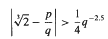 for any non-zero integers p and q. A number of these irrationality measures improve known results, including those for
  . Some Diophantine consequences are briefly discussed.
 for any non-zero integers
  . Some Diophantine consequences are briefly discussed.
Bigger and better subset-sum-distinct sets
- Part of
-
- Journal:
- Mathematika / Volume 44 / Issue 1 / June 1997
- Published online by Cambridge University Press:
- 26 February 2010, pp. 56-60
- Print publication:
- June 1997
-
- Article
- Export citation
Appendix to the paper by T. Łuczak—A simple proof of the lower
- Part of
-
- Journal:
- Mathematika / Volume 44 / Issue 1 / June 1997
- Published online by Cambridge University Press:
- 26 February 2010, pp. 54-55
- Print publication:
- June 1997
-
- Article
- Export citation
-
In this note we point out that a simple proof of the lower bound of the sets
 (b, c), and so also of Ξ(b, c), defined in the previous paper [1] can be obtained as a simple application of a general method. By Example 4.6 from [2], if [0, 1] = E0⊃E1⊃ … are sets each of which is a finite union of disjoint closed intervals such that each interval of Ek−1, contains at least mk intervals of Ek which are separated by gaps of lengths at least εk, and if mk≥2 and εk≥εk+1>0, then the dimension of the intersection of Ek is at least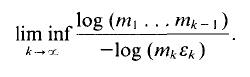
 (
(
Mixed cusp forms and parabolic cohomology
- Part of
-
- Journal:
- Journal of the Australian Mathematical Society. Series A. Pure Mathematics and Statistics / Volume 62 / Issue 3 / June 1997
- Published online by Cambridge University Press:
- 09 April 2009, pp. 279-289
- Print publication:
- June 1997
-
- Article
-
- You have access
- Export citation
On the fractional dimension of sets of continued fractions
- Part of
-
- Journal:
- Mathematika / Volume 44 / Issue 1 / June 1997
- Published online by Cambridge University Press:
- 26 February 2010, pp. 50-53
- Print publication:
- June 1997
-
- Article
- Export citation
-
Let [0;a1(ξ), a2(ξ),…] denote the continued fraction expansion of ξ∈[0, 1]. The problem of estimating the fractional dimension of sets of continued fractions emerged in late twenties in papers by Jarnik [6, 7] and Besicovitch [1] and since then has been addressed by a number of authors (see [2, 4, 5, 8, 9]). In particular, Good [4] proved that the set of all ξ, for which an(ξ)→∞ as n→∞ has the Hausdorff dimension ½ For the set of continued fractions whose expansion terms tend to infinity doubly exponentially the dimension decreases even further. More precisely, let

Hirst [5] showed that dim
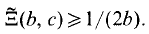 On the other hand, Moorthy [8] showed that dim
  where
where
 On the other hand, Moorthy [8] showed that dim
  where
where
Some Diophantine equations with almost all solutions trivial
- Part of
-
- Journal:
- Mathematika / Volume 44 / Issue 1 / June 1997
- Published online by Cambridge University Press:
- 26 February 2010, pp. 14-36
- Print publication:
- June 1997
-
- Article
- Export citation
-
In this paper we investigate the solutions in integers x, y, z, X, Y, Z of the system

where P is a real number that may be taken to be arbitrarily large, and the (fixed) integer exponent h satisfies h≥4. The system has 6P3 + O(P2) “trivial” solutions in which x, y, z are a permutation of X, Y, Z. Our result implies that the number of non-trivial solutions is at most o(P3), so that the total number of solutions is asymptotic to 6P3.
On gaps between numbers that are sums of three cubes
- Part of
-
- Journal:
- Mathematika / Volume 44 / Issue 1 / June 1997
- Published online by Cambridge University Press:
- 26 February 2010, pp. 1-13
- Print publication:
- June 1997
-
- Article
- Export citation
-
Let (Sn)n = 1,2,… be the strictly increasing sequence of those natural numbers that can be represented as the sum of three cubes of positive integers. The estimate

is easily proved as follows: Let x1 be the largest natural number with
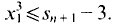 Then
Then  This procedure is iterated by choosing x2 and then x3 as the largest natural numbers satisfying
  and
and  Thus
Thus 
 Since
Since 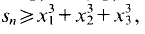 this implies (1).
 Then
Then  This procedure is iterated by choosing
  and
and  Thus
Thus 
 Since
Since  this implies (1).
On discrepancy bounds via dual shatter function
- Part of
-
- Journal:
- Mathematika / Volume 44 / Issue 1 / June 1997
- Published online by Cambridge University Press:
- 26 February 2010, pp. 42-49
- Print publication:
- June 1997
-
- Article
- Export citation
-
Recently, it has been shown that tight or almost tight upper bounds for the discrepancy of many geometrically denned set systems can be derived from simple combinatorial parameters of these set systems. Namely, if the primal shatter function of a set system ℛ on an n-point set X is bounded by const. md, then the discrepancy disc (ℛ) = O(n(d−1)/2d) (which is known to be tight), and if the dual shatter function is bounded by const. md, then disc
 We prove that for d = 2, 3, the latter bound also cannot be improved in general. We also show that bounds on the shatter functions alone do not imply the average (L1)-discrepancy to be much smaller than the maximum discrepancy: this contrasts results of Beck and Chen for certain geometric cases. In the proof we give a construction of a certain asymptotically extremal bipartite graph, which may be of independent interest.
 We prove that for
 On generalized theta series liftings
- Part of
-
- Journal:
- Journal of the Australian Mathematical Society. Series A. Pure Mathematics and Statistics / Volume 62 / Issue 2 / April 1997
- Published online by Cambridge University Press:
- 09 April 2009, pp. 229-238
- Print publication:
- April 1997
-
- Article
-
- You have access
- Export citation
A note on metric inhomogeneous Diophantine approximation
- Part of
-
- Journal:
- Journal of the Australian Mathematical Society. Series A. Pure Mathematics and Statistics / Volume 62 / Issue 2 / April 1997
- Published online by Cambridge University Press:
- 09 April 2009, pp. 175-185
- Print publication:
- April 1997
-
- Article
-
- You have access
- Export citation
On the divisor function d(n)
- Part of
-
- Journal:
- Mathematika / Volume 43 / Issue 2 / December 1996
- Published online by Cambridge University Press:
- 26 February 2010, pp. 320-322
- Print publication:
- December 1996
-
- Article
- Export citation
On the sum of four cubes
- Part of
-
- Journal:
- Mathematika / Volume 43 / Issue 2 / December 1996
- Published online by Cambridge University Press:
- 26 February 2010, pp. 323-348
- Print publication:
- December 1996
-
- Article
- Export citation
Lattice packing of spheres and the Wulff-Shape
- Part of
-
- Journal:
- Mathematika / Volume 43 / Issue 2 / December 1996
- Published online by Cambridge University Press:
- 26 February 2010, pp. 229-236
- Print publication:
- December 1996
-
- Article
- Export citation
A pair correlation hypothesis and the exceptional set in Goldbach's problem
- Part of
-
- Journal:
- Mathematika / Volume 43 / Issue 2 / December 1996
- Published online by Cambridge University Press:
- 26 February 2010, pp. 349-361
- Print publication:
- December 1996
-
- Article
- Export citation
-
In 1973, Montgomery [12] introduced, in order to study the vertical distribution of the zeros of the Riemann zeta function, the pair correlation function

where w(u) = 4/(4 + u2) and γjj = 1, 2, run over the imaginary part of the nontrivial zeros of ζ(s). It is easy to see that, for T → ∞,
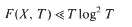
uniformly in X, and Montgomery [12], see also Goldston-Montgomery [7], proved that under the Riemann Hypothesis (RH)

uniformly for X ≤ T ≤ XA, for any fixed A > 1. He also conjectured, under RH, that (1) holds uniformly for Xε ≤ T ≤ X, for every fixed ε > 0. We denote by MC the above conjecture.
