Refine listing
Actions for selected content:
2838 results in 11xxx
Sums and differences of quartic norms
- Part of
-
- Journal:
- Mathematika / Volume 40 / Issue 2 / December 1993
- Published online by Cambridge University Press:
- 26 February 2010, pp. 233-245
- Print publication:
- December 1993
-
- Article
- Export citation
-
Let K be a number field of degree k > 1. We would like to know if a positive integer N can be represented as the sum, or the difference, of two norms of integral ideals of K. Suppose K/ℚ is abelian of conductor Δ. Then from the class field theory (Artin's reciprocity law) the norms are fully characterized by the residue classes modulo Δ. Precisely, a prime number p ∤ Δ (unramified in K) is a norm (splits completely in K), if, and only if,

where k is a subgroup of (ℤ/Δℤ)* of index k. Accordingly we may ask N to be represented as the sum

or the difference

of positive integers a, b each of which splits completely in K. For N to be represented in these ways the following congruences

must be solvable in α β є k, respectively. Moreover the condition

must hold. Presumably the above local conditions are sufficient for (−) to have infinitely many solutions and for (+) to have arbitrarily many solutions, provided N is sufficiently large in the latter case.
On Mahler's compound bodies
- Part of
-
- Journal:
- Journal of the Australian Mathematical Society. Series A. Pure Mathematics and Statistics / Volume 55 / Issue 2 / October 1993
- Published online by Cambridge University Press:
- 09 April 2009, pp. 183-215
- Print publication:
- October 1993
-
- Article
-
- You have access
- Export citation
Irregularities of point distribution relative to convex polygons II
- Part of
-
- Journal:
- Mathematika / Volume 40 / Issue 1 / June 1993
- Published online by Cambridge University Press:
- 26 February 2010, pp. 127-136
- Print publication:
- June 1993
-
- Article
- Export citation
-
Suppose that
 is a distribution of N points in the unit square U = [0, 1]2. For every measurable set B in U, let Z[; B] denote the number of ponts of in B, and write
where µ denotes the usual measure in ℝ2
 is a distribution of
A bound, and a conjecture, on the maximum lattice-packing density of a superball
- Part of
-
- Journal:
- Mathematika / Volume 40 / Issue 1 / June 1993
- Published online by Cambridge University Press:
- 26 February 2010, pp. 137-143
- Print publication:
- June 1993
-
- Article
- Export citation
-
We obtain explicit lower bounds on the lattice packing densities δL of superballs G of quite a general nature, and we conjecture that as the dimension n approaches infinity, the bounds are asymptotically exact. If the conjecture were true, it would follow that the maximum lattice-packing density of the Iσ-ball
 is 2−n(1+σ(1)) for each σ in the interval 1 ≤ σ ≤ 2.
 is 2
is 2Long mollifiers of the Riemann Zeta-function
- Part of
-
- Journal:
- Mathematika / Volume 40 / Issue 1 / June 1993
- Published online by Cambridge University Press:
- 26 February 2010, pp. 71-87
- Print publication:
- June 1993
-
- Article
- Export citation
-
The best current bounds for the proportion of zeros of ζ(s) on the critical line are due to Conrey [C], using Levinson's method [Lev]. This method can also be used to detect simple zeros on the critical line. To apply Levinson's method one first needs an asymptotic formula for the meansquare from 0 to T of ζ(s)M(s) near the
 -line, where
where μ(n) is the Möbius function, h(x) is a real polynomial with h(0) = 0, and y=Tθ for some θ > 0. It turns out that the parameter θ is critical to the method: having an asymptotic formula valid for large values of θ is necessary in order to obtain good results. For example, if we let κ denote the proportion of nontrivial zeros of ζ(s) which are simple and on the critical line, then having the formula valid for 0 < θ <
 yields κ > 0·3562, having 0 < θ <
  gives κ > 0·40219, and it is necessary to have θ > 0·165 in order to obtain a positive lower bound for κ. At present, it is known that the asymptotic formula remains valid for 0 < θ <
  , this is due to Conrey. Without assuming the Riemann Hypothesis, Levinson's method provides the only known way of obtaining a positive lower bound for κ.
 -line, where
 yields κ > 0·3562, having 0 < θ <
  gives κ > 0·40219, and it is necessary to have θ > 0·165 in order to obtain a positive lower bound for κ. At present, it is known that the asymptotic formula remains valid for 0 < θ <
  , this is due to Conrey. Without assuming the Riemann Hypothesis, Levinson's method provides the only known way of obtaining a positive lower bound for κ.
On the distribution of gaps between squarefree numbers
- Part of
-
- Journal:
- Mathematika / Volume 40 / Issue 1 / June 1993
- Published online by Cambridge University Press:
- 26 February 2010, pp. 88-101
- Print publication:
- June 1993
-
- Article
- Export citation
-
Let s1, s2, … denote the squarefree numbers in ascending order. In [1], Erdős showed that, if 0 ≤ γ ≤ 2, then

where B(γ) is a function only of γ. In 1973 Hooley [4] improved the range of validity of this result to 0 ≤ γ ≤ 3, and then later gained a further slight improvement by a method he outlined at the International Number Theory Symposium at Stillwater, Oklahoma in 1984. We have, however, independently obtained the better improvement that (1) holds for

in contrast to the range

derived by Hooley. The main purpose of this paper is to substantiate our new result. Professor Hooley has informed me that there are similarities between our methods as well as significant differences.
Multiple Franel integrals
- Part of
-
- Journal:
- Mathematika / Volume 40 / Issue 1 / June 1993
- Published online by Cambridge University Press:
- 26 February 2010, pp. 51-70
- Print publication:
- June 1993
-
- Article
- Export citation
-
Let

and A1, A2, …, An, a1, a2, …, an be positive integers. We consider the related integrals

and

Irregularities of point distribution relative to half-planes I
- Part of
-
- Journal:
- Mathematika / Volume 40 / Issue 1 / June 1993
- Published online by Cambridge University Press:
- 26 February 2010, pp. 102-126
- Print publication:
- June 1993
-
- Article
- Export citation
-
Suppose that
 is a distribution of N points in U0, the closed disc of unit area and centred at the origin 0. For every measurable set B in ℝ2, let Z[; B] denote the number of ponts of in B, and write
where µ denotes the usual measure in ℝ2
 is a distribution of
Geometric and arithmetic postulation of the exponential function
- Part of
-
- Journal:
- Journal of the Australian Mathematical Society. Series A. Pure Mathematics and Statistics / Volume 54 / Issue 1 / February 1993
- Published online by Cambridge University Press:
- 09 April 2009, pp. 111-127
- Print publication:
- February 1993
-
- Article
-
- You have access
- Export citation
A problem of Good on Hausdorff dimension
- Part of
-
- Journal:
- Mathematika / Volume 39 / Issue 2 / December 1992
- Published online by Cambridge University Press:
- 26 February 2010, pp. 244-246
- Print publication:
- December 1992
-
- Article
- Export citation
-
Given ξ in [0, 1] let ξ = [0, a1, a2…] denote a simple continued fraction expansion of ξ Given the expansion ξ = [0, a1, a2, …] let

Thus with the conventions p1 = q0 = 1 and q−1 = p0 = 0 we have

The spatial distribution of algebraic integers on constant-norm hypersurfaces
- Part of
-
- Journal:
- Mathematika / Volume 39 / Issue 2 / December 1992
- Published online by Cambridge University Press:
- 26 February 2010, pp. 350-366
- Print publication:
- December 1992
-
- Article
- Export citation
-
Let K be an algebraic number field, [ K:
 ] = KΣ
 . Most of what we shall discuss is trivial when K = , so that we assume that K ≥ 2 from now onwards. To describe our results, we consider the classical device [2] of Minkowski, whereby K is embedded (diagonally-) into the direct product MK of its completions at its (inequivalent) infinite places. Thus MK is -algebra isomorphic to
  , and is to be regarded as a topological
  -algebra, dimRMK = K, in which K is everywhere dense, while the ring Zx of integers of K embeds as a discrete
  -submodule of rank K. Following the ideas implicit in Hecke's fundamental papers [6] we may measure the “spatial distribution” of points of MK (modulo units of κ) by means of a canonical projection onto a certain torus . The principal application of our main results (Theorems I–III described below) is to the study of the spatial distribution of the
  which have a fixed norm n = NK/Q(α). In §2 we shall show that, with suitable interpretations, for “typical” n (for which NK/Q(α) = n is soluble), these α have “almost uniform” spatial distribution under the canonical projection onto TK. Analogous questions have been considered by several authors (see, e.g., [5, 9, 14]), but in all cases, they have considered weighted averages over such n of a type which make it impossible to make useful statements for “typical” n.
 ] =
] =  . Most of what we shall discuss is trivial when
  , and is to be regarded as a topological
  -algebra, dim
 -submodule of rank
  which have a fixed norm
 On the exceptional set for the sum of a prime and a k-th power
- Part of
-
- Journal:
- Mathematika / Volume 39 / Issue 2 / December 1992
- Published online by Cambridge University Press:
- 26 February 2010, pp. 400-421
- Print publication:
- December 1992
-
- Article
- Export citation
Linear equations in primes
- Part of
-
- Journal:
- Mathematika / Volume 39 / Issue 2 / December 1992
- Published online by Cambridge University Press:
- 26 February 2010, pp. 367-378
- Print publication:
- December 1992
-
- Article
- Export citation
On Vinogradov's mean value theorem
- Part of
-
- Journal:
- Mathematika / Volume 39 / Issue 2 / December 1992
- Published online by Cambridge University Press:
- 26 February 2010, pp. 379-399
- Print publication:
- December 1992
-
- Article
- Export citation
-
The object of this paper is to obtain improvements in Vinogradov's mean value theorem widely applicable in additive number theory. Let Js,k(P) denote the number of solutions of the simultaneous diophantine equations

with 1 ≥ xi, yi ≥ P for 1 ≥ i ≥ s. In the mid-thirties Vinogradov developed a new method (now known as Vinogradov's mean value theorem) which enabled him to obtain fairly strong bounds for Js,k(P). On writing

in which e(α) denotes e2πiα, we observe that
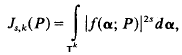
where Tk denotes the k-dimensional unit cube, and α = (α1,…,αk).
Characterization of two-distance sequences
- Part of
-
- Journal:
- Journal of the Australian Mathematical Society. Series A. Pure Mathematics and Statistics / Volume 53 / Issue 2 / October 1992
- Published online by Cambridge University Press:
- 09 April 2009, pp. 198-218
- Print publication:
- October 1992
-
- Article
-
- You have access
- Export citation
Uniform distribution and lattice point counting
- Part of
-
- Journal:
- Journal of the Australian Mathematical Society. Series A. Pure Mathematics and Statistics / Volume 53 / Issue 1 / August 1992
- Published online by Cambridge University Press:
- 09 April 2009, pp. 39-50
- Print publication:
- August 1992
-
- Article
-
- You have access
- Export citation
Metrical properties of best approximants
- Part of
-
- Journal:
- Journal of the Australian Mathematical Society. Series A. Pure Mathematics and Statistics / Volume 53 / Issue 1 / August 1992
- Published online by Cambridge University Press:
- 09 April 2009, pp. 78-91
- Print publication:
- August 1992
-
- Article
-
- You have access
- Export citation
On Bombieri and Davenport's theorem concerning small gaps between primes
- Part of
-
- Journal:
- Mathematika / Volume 39 / Issue 1 / June 1992
- Published online by Cambridge University Press:
- 26 February 2010, pp. 10-17
- Print publication:
- June 1992
-
- Article
- Export citation
-
§1. Introduction. In this paper we give a new proof of a theorem of Bombieri and Davenport [2, Theorem 1]. Let t(–k) = t(k) be real,

where e(u) = e2πiu. Let p and p' denote primes, k an integer, and define

An asymptotic formula for a-th powers dividing binomial coefficients
- Part of
-
- Journal:
- Mathematika / Volume 39 / Issue 1 / June 1992
- Published online by Cambridge University Press:
- 26 February 2010, pp. 25-36
- Print publication:
- June 1992
-
- Article
- Export citation
-
§1. Introduction. In 1985, Sárkõzy [11] proved a conjecture of Erdõs [2] by showing that the greatest square factor s(n)2 of the “middle” binomial coefficient
 satisfies for arbitrary ε > 0 and sufficiently large n
Where

 satisfies for arbitrary
Simultaneous additive congruences to a large prime modulus
- Part of
-
- Journal:
- Mathematika / Volume 39 / Issue 1 / June 1992
- Published online by Cambridge University Press:
- 26 February 2010, pp. 1-9
- Print publication:
- June 1992
-
- Article
- Export citation
